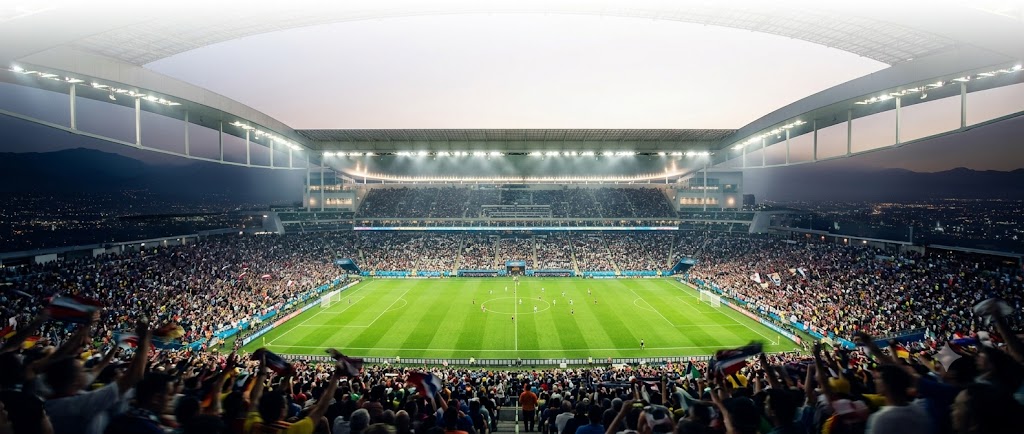
Forty-two million Americans watched one soccer game on Monday night. I watched it too — and I couldn’t stop taking portfolio notes.
I read the Journal every morning before the market opens. This week, the sports pages were better investment research than the markets pages. The U.S. collapsed. Messi cried at the penalty spot. A replay booth stole a goal from Egypt over something that happened 100 yards away. And a 68-year-old French record started wobbling. Every one of those stories is a lesson we’ve already built into the Capital Wealth models. Here are all six.
-
Lesson 01 · The United States
The match isn’t over at 90 minutes.
“U.S. Soccer’s Spectacular Collapse” — Andrew Beaton & Joshua Robinson (WSJ, July 8); front page (WSJ, July 7)The Americans arrived in Seattle hoping to reach their first World Cup quarterfinal since 2002. They had scored 11 goals — their most ever at a World Cup. The rallying cry was “Why not us?” Then Belgium answered: 4–1, in what was likely the most-watched soccer match in this country’s history (WSJ, July 8). Worst showing of the tournament, saved for the exact moment it cost everything.
Same paper, same day: Argentina survived its own round-of-16 game on a stunning third goal headed home in the second minute of stoppage time (WSJ, July 8). One team went home in injury time. One team lives because of it. The whistle you’re planning around never blows at 90:00.
Minute 90+2: one team’s season ends, another’s continues.Markets have injury time too. It’s the selloff that comes after you thought the year was decided — the October surprise, the Friday-afternoon headline. You don’t defend it by predicting it. You defend it by always having defenders on the field.
The Capital Wealth playEvery model tier we run totals 99.5% invested with an explicit 0.5% cash buffer in SGOV (Treasury bills) — the goalkeeper who never leaves his line. Around it: gold via IAU as the calm layer, and an energy sleeve as insurance against exactly the shocks nobody schedules. Bills, gold, energy. That’s our back line for minute 91.
-
Lesson 02 · Harry Kane vs. Improvisation
Six penalties. One routine. That’s the record.
“Messi Is the Greatest Player Ever. Why Is He So Bad at Penalty Kicks?” — Jonathan Clegg & Joshua Robinson (WSJ, July 9)Harry Kane holds the World Cup record with six penalty goals, and he’s converted 111 of 124 career spot kicks — over 89% — by doing the same thing, the same way, every single time (WSJ, July 9). Boring? Deeply. Effective? A record.
Messi — the greatest player who ever lived — converts just 77% from the spot. Why? The Journal’s answer: he has no standard technique. He improvises based on how he feels and which keeper he’s facing. His favorite move is also the riskiest: wait for the keeper to commit, then go the other way. On Tuesday it got parried away like a beachball, and the best player on Earth burst into tears.
Kane, one routine: 89%. Messi, improvising: 77%.That 12-point gap is the entire argument for having an investment process. Genius that improvises loses to a plan that repeats. From twelve yards and in the market.
The Capital Wealth playThis is why our Aggressive Growth models run two sleeves with two disciplines: Tier A “Tactical Conviction” (3–18 month holds, driven by the news flow we read every morning) and Tier B “Fundamentals Core” (3–10 year holds, grounded in earnings and balance sheets). Two different games — each with a Kane-style routine. What we never do is stand over the ball and decide based on how we feel today.
-
Lesson 03 · The Replay Booth
Over-reviewing ruins the game. And the portfolio.
“The World Cup’s Replay System Is a Killjoy and Must Be Destroyed” — Jason Gay (WSJ, July 9)In the Argentina–Egypt round-of-16 nail-biter, VAR erased a glorious, field-crossing Mostafa Ziko goal because of a foul committed roughly 100 yards away and 15 seconds earlier. Jason Gay called the replay system “a joy denial device” and compared the ruling to getting stopped in Rhode Island for jaywalking in Oregon. In 1974. Days before, a sensor inside the ball revoked a Croatia goal because it grazed a player’s hairline (WSJ, July 9).
“We tell ourselves this stuff should be limited… but we never limit it. It only expands.”Jason Gay, WSJ, July 9Now replace “replay” with “checking your account.” Same disease. The investor who reviews every touch — every red day, every headline, every 2% dip — ends up overturning perfectly good goals. Studies of trading behavior say it plainly: the more often you review, the more often you trade, and the more often you trade, the worse you do. Granular forensics wrecks entertainment; it wrecks compounding faster.
The Capital Wealth playWe call it the don’t-tinker discipline. Positions in Tier B are underwritten for 3–10 years and reviewed on a schedule — not on adrenaline. Even Tier A, our news-driven sleeve, trades on a written thesis with an exit, never on a Tuesday mood. Your quarterly review with me is the only replay booth this portfolio needs.
-
Lesson 04 · Messi & The Record
Careers are judged by the last chapter.
“The World Cup’s Goals Record Once Appeared Untouchable” — Jonathan Clegg & Joshua Robinson (WSJ, July 10)For 68 years, Just Fontaine’s 13 goals at the 1958 World Cup sat untouchable — the soccer version of DiMaggio’s 56-game streak. Now Messi has eight goals in just 410 minutes — one every 51.25 minutes — with as many as three games left (WSJ, July 10). At 39, in his sixth World Cup, the final act is deciding how the whole story reads.
Because that’s the brutal math of endings: Messi missed penalties in 2016 and 2018 and those years are remembered as heartbreak. He converted six of seven in Qatar in 2022 and lifted the trophy — and that’s the chapter everyone quotes. Same player. The ending did the judging.
8 goals, 410 minutes, 3 games left. The finish decides the legacy.Retirement portfolios work exactly this way. Advisors call it sequence-of-returns risk: a bad market year at 34 is a footnote; the same year at 64 can rewrite your whole retirement. The five years on either side of your retirement date are your quarterfinals, semis, and final — the red zone where every result counts double.
The Capital Wealth playInside the red zone we change formations: the growth tiers get paired with an income floor — guaranteed-income annuities for the bills that never stop, the IAU gold layer and short Treasurys for the withdrawals you’ll take in down years — so a 2008 at age 64 can’t force you to sell your best players at the bottom. Protect the last chapter. It’s the one they read.
-
Lesson 05 · The Sharks
Never build the team around one striker.
Thomas Tuchel, quoted in Clegg & Robinson (WSJ, July 10); TV-records report by Molly Reinmann (WSJ, July 8)“They’re all sharks. If they smell blood, they come and score.”England coach Thomas Tuchel on Messi, Mbappé, Kane and Haaland — WSJ, July 10Here’s the detail I love: the record chase isn’t one shark. Messi has 8, Mbappé and Haaland 7, Kane 6 — four different killers, any of whom “could explode for a hat trick at any moment” (WSJ, July 10). And Fontaine himself? He wasn’t even supposed to start in 1958. The first-choice striker got hurt, and Fontaine borrowed a pair of boots and scored 13. The goals come from where you least expect — ask Cape Verde, whose Cinderella run helped shatter U.S. television records this summer (WSJ, July 8).
Four sharks over 6 goals each. Zero teams built around only one.Meanwhile, half of America wants to build its entire portfolio around one AI striker. One name, one story, one point of failure. That’s not conviction — that’s a team with no bench, one hamstring away from going home.
The Capital Wealth playOur rule for AI: own the sleeve, not the horse. We spread the theme across the chipmakers’ suppliers, the power and infrastructure companies electrifying the data centers, and the dividend payers getting paid either way — never one hero name carrying the whole squad. If any single shark scores, the sleeve scores. If one pulls up lame, the team plays on.
-
Lesson 06 · The Task Force
You can’t lobby the scoreboard.
White House World Cup task-force reporting (WSJ, July 7); Beaton & Robinson (WSJ, July 8)The strangest story of the week: senior administration officials — including the executive director of the White House’s World Cup task force — worked behind the scenes to pressure FIFA into reinstating suspended U.S. striker Folarin Balogun (WSJ, July 7). It worked. The ban was overturned, the soccer world was aghast, and Belgium’s federation was furious.
Then the game started. Belgium won 4–1 and posted two words afterward: “Overturn that.” (WSJ, July 8.)
All the connections on Earth, and the final was still 4–1.The market is the same referee. You can’t call anyone to reverse a drawdown, appeal a rate decision, or get your cost basis reinstated. Policy, taxes, tariffs, Fed meetings — the rules will change on you mid-match, sometimes 24 hours before kickoff. The only appeal that has ever worked is being positioned for more than one outcome.
The Capital Wealth playIt’s why the models hold offense and defense at the same time: Tier A trading the news, Tier B compounding through it, gold and T-bills for the days the whistle goes against you. Diversification isn’t a slogan — it’s the only phone call the scoreboard answers.
Defense for stoppage time. A routine from the spot. Hands off the replay button. Protect the last chapter. More than one shark. And no lobbying the scoreboard. That’s the tournament — and that’s exactly how we build every book at Capital Wealth.
This is what a deep, disciplined roster looks like.
Four Aggressive Growth tiers, scaled by account size — Tactical Conviction and Fundamentals Core side by side, with the SGOV buffer and the gold layer built into every model. Fifteen minutes and I’ll walk you through where your money sits on the field.
Enjoy the quarterfinals — and root for the teams that keep their shape when the match gets ugly. In soccer and in portfolios, they’re the ones still playing at the end.
— Sean Anees Saifi