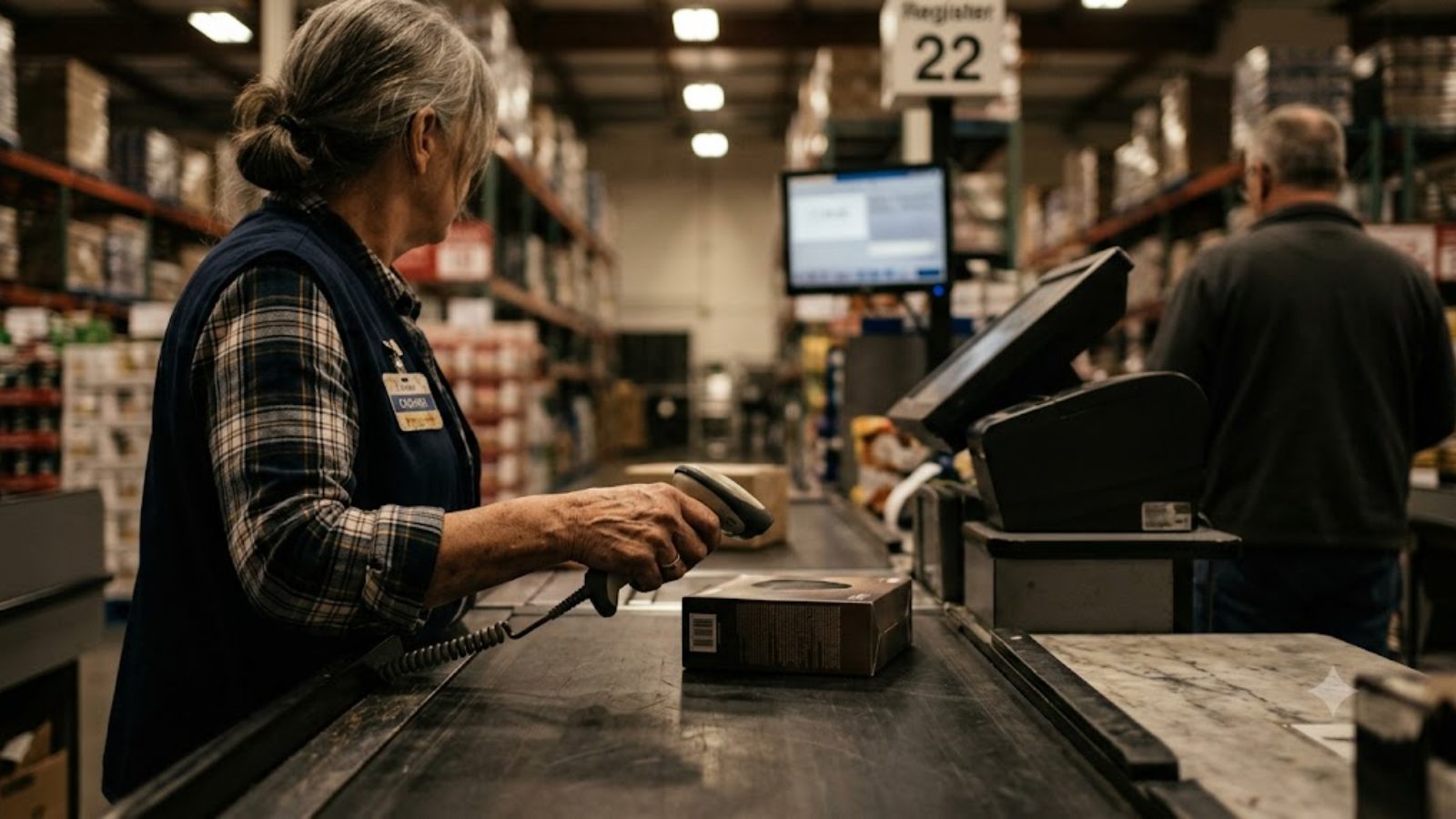
Nobody opens The Wall Street Journal hoping to feel bad about themselves before 7 a.m. And yet here comes Tony Barzar, 60, a grocery cashier in Tucson, strolling onto the front page with a million dollars in his 401(k) and the easy calm of a man who has never once panic-sold anything. I have panic-sold a sandwich. Tony started at Price Club in 1986 for $5.85 an hour — not a typo, just the eighties — stayed put when Costco (COST) swallowed the chain, and is still scanning groceries in the same warehouse today at $32.90 an hour. Since 1993 he has peeled a small slice off every paycheck into his 401(k). That’s it. That’s the whole strategy. No hot stock. No crypto phase. No podcast.
And before you assume the money sat in a vault being no fun: it bought a house with a pool in 2009 and two trips to Europe. When his wife was diagnosed with stage-3 brain cancer, his benefits covered three surgeries in full and gave him nearly a year of paid leave to sit beside her. “This is my calling,” he told the Journal, “right where I’m at.” Costco’s CFO says many thousands of hourly workers have done the same thing. Many. Thousands. Of cashiers — quietly out-executing an awful lot of people who own monogrammed golf bags.
Four numbers, and none of them is the one that matters. The number that matters is zero — the number of times Tony paused, borrowed against, or cashed out that account across five bear markets.
Here’s the part that should make the rest of us squirm: Tony never earned a big salary in any single year, and never picked a miracle stock. Time did the heavy lifting; his only job was to not interrupt it, and he didn’t. That’s the entire engine a CFP curriculum files under Retirement Planning (Module 10): deferral plus compounding, uninterrupted. In our experience, plenty of people earning triple Barzar’s wage carry a fraction of his balance — not because they earned less, but because the compounding kept getting broken. Contributions paused in a tight year and never restarted. Loans taken against the balance. Old accounts cashed out between jobs because the check was right there, looking friendly. Never stopping is a habit, not a talent — which is the good news, because a habit can be installed at any age.
Tony’s behavior is exactly what our Tier B “Fundamentals Core” sleeve is built to reward: money that shows up every payday, buys durable earnings-grounded compounders, and holds them on a 3–10 year clock. Costco (COST) is the archetype of a Tier B name — boring on purpose, membership-renewal economics, decades of doing the same thing well. Our Tier A “Tactical Conviction” sleeve trades the news on a 3–18 month clock; Tier B is where the Tony Barzars of a portfolio live. And a deferral never has to pause in a bad year, because the structure won’t let it: every model tier carries a 0.5% SGOV cash buffer so cash needs never force a sale, and the dividend and income book keeps getting paid while the compounders compound.
One: consolidate the scattered old 401(k)s under one roof — an orphaned account from two employers ago is compounding on nobody’s watch. Two: read the benefits line as hard as the salary line; three covered surgeries and a year of paid leave did more for Tony’s family than any raise would have. Three: automate “never stopping.” Tony supplied the discipline by temperament; a standing contribution into a Tier B core supplies it by structure, no temperament required.
You don’t wait for the storm to find out whether the roof holds. You glance up while the sky is still clear and fix the loose shingle today. If there’s an old 401(k) from a former employer sitting somewhere unattended, that’s the shingle. A review runs about fifteen minutes — roughly the time it takes Tony to scan a full cart — and all you need is your latest statement. We’ll take a look together before the weather turns.