When the World Went on Sale: What 1873 Can Teach Us About 2026
On Friday, May 9, 1873, the Vienna Stock Exchange fell 45% in a single day — and the whole world changed. A new book makes the case that the “Long Depression” that followed wasn’t a catastrophe at all. It was a productivity boom wearing a scary costume. Sound familiar?
Reviewed by James Grant · The Wall Street Journal · May 30-31, 2026 · Capital Wealth analysis by Sean Anees Saifi
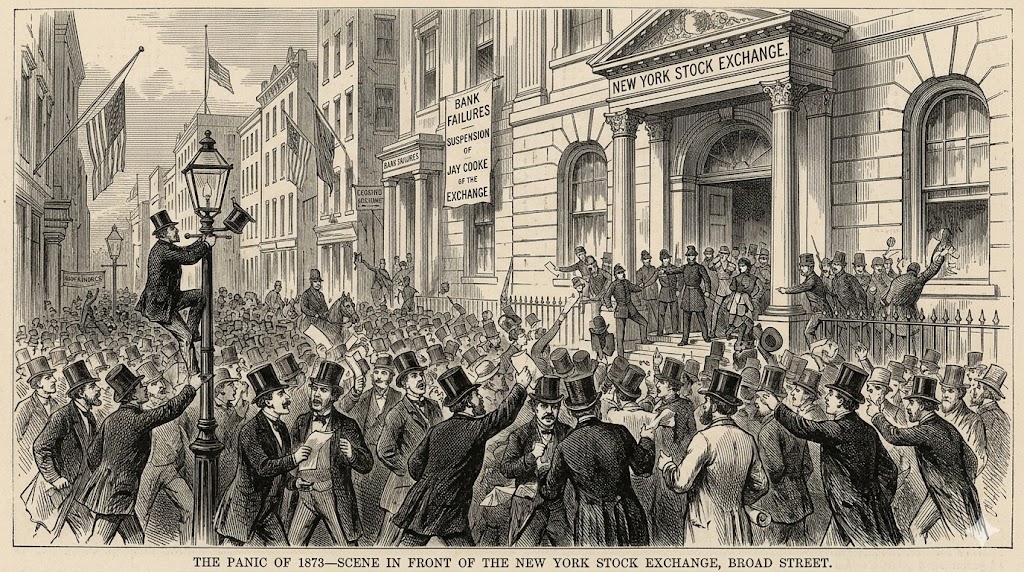
The Panic of 1873 in front of the New York Stock Exchange.
The Day the Music Stopped (in German)
Liaquat Ahamed — who won a Pulitzer for Lords of Finance — has a new book simply called 1873, and James Grant’s review of it is the most quietly important thing in this weekend’s paper. The story starts on a Friday in May 1873 when prices on the Vienna Stock Exchange dropped 45% in a day. The crash rolled across the Atlantic, took down the mighty banking house of Jay Cooke, and kicked off what historians later called the “Long Depression” — roughly 1873 to 1879.
Here is the twist that makes the book worth your Sunday: a huge chunk of those “depression” years were actually a roaring productivity boom. The railroad replaced the horse. The factory replaced the workshop. Steam replaced sail. All that new efficiency made stuff cheaper — which shows up in the data as falling prices, which economists call the scary word “deflation,” which Grant suggests a normal person might just call “things getting more affordable.”
Bubbles, Pig Iron, and a Broke Karl Marx
The book is stuffed with characters you’d swear were invented: opulent Rothschilds, monetary cranks selling get-rich pamphlets, a German railroad baron named Strousberg who was essentially a 19th-century meme stock, and a then-obscure writer named Karl Marx whose poorly-reviewed first volume of Das Kapital reportedly “didn’t earn the cost of the cigars its author had puffed while writing it.” (Every author’s nightmare.)
By 1878, American iron makers were staring at the lowest pig-iron prices since colonial times and wondering, only half-joking, whether they should convert their idle blast-furnace smokestacks into astronomical observatories. When your factory is more useful as a telescope, you have a sentiment problem.
The bubble had a familiar shape: a genuinely transformative technology (rail), a flood of cheap capital chasing it, a mania, and then a brutal repricing. The technology was real. The valuations got silly. Both things were true at once.
What This Means For Your Money
Swap “railroads” for “artificial intelligence” and 1873 reads like a forecast. We have a real, world-changing technology. We have a torrent of capital chasing it. We have records on the Dow (above 51,000 for the first time this week) and a JPMorgan (JPM) CEO using the actual word “exuberance.” History doesn’t repeat, but it sure does rhyme.
The investing principle here is the oldest one we have: a great technology and a great investment are not the same thing — the gap between them is called valuation, and your protection is margin of safety. The railroads really did remake the world. A lot of the people who financed them at 1872 prices still got wiped out. We are not selling our AI exposure. We are refusing to pay any price for it, keeping the book diversified, and remembering that ‘this time is different’ is the most expensive sentence in finance.
The good news from 1873: the world that came out the other side was richer, more connected, and more productive. Patient, diversified owners did fine. The ones who panicked at the bottom — or paid anything at the top — did not.