BYD’s $14 Billion Bet: A Self-Driving Chip That Undercuts Nvidia
China’s BYD — the EV giant that already outsells most rivals — just unveiled its own autonomous-driving chip at roughly one-third the hardware cost of Nvidia’s comparable solution. It’s pledging $14 billion to the effort. The low end of the AI-chip market just got a lot more crowded.
Jiahui Huang · The Wall Street Journal · May 30-31, 2026 · Capital Wealth analysis by Sean Anees Saifi
BYD goes for the affordable middle of the market.
China’s EV Champ Wants to Be a Chip Champ
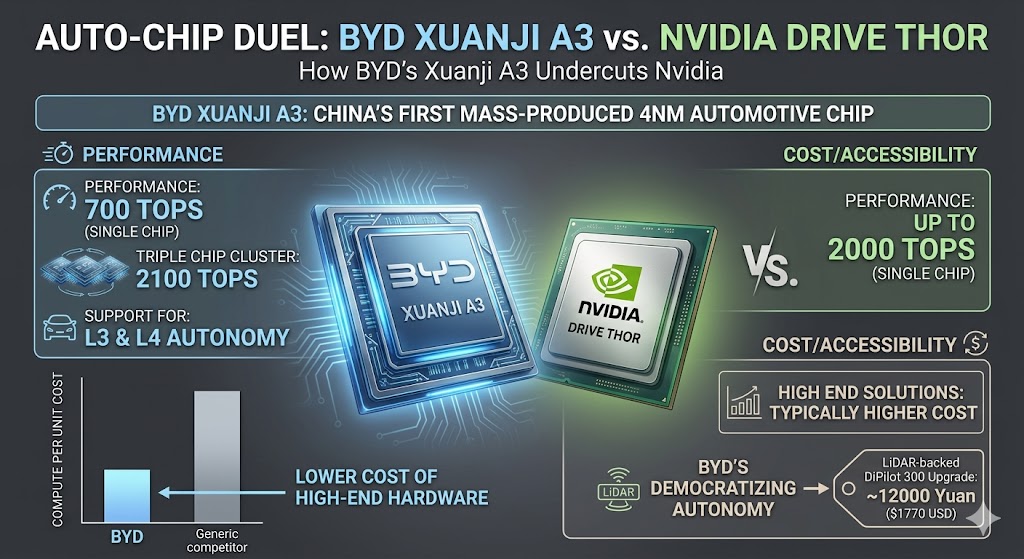
BYD unveiled the Xuanji A3 — a 4-nanometer chip for autonomous driving — at its technology day in Shenzhen. It’s already in mass production and supports “level 3” and “level 4” autonomy (cars that can handle most or all of the driving in defined conditions). BYD also pledged to invest more than 100 billion yuan — about $14.75 billion — in intelligent tech over three years.
The number that made analysts sit up: the total hardware cost of the new chip is roughly one-third of Nvidia’s (NVDA) Thor-based solution, according to Citi. BYD is going straight for the affordable, mass-market middle of the road that Nvidia’s premium chips price out.
The Liability Twist
There’s a fascinating wrinkle. BYD said buyers of cars with certain versions of its “God’s Eye” system would get a full year of compensation for any losses from accidents during assisted-driving operation — including vehicle damage and third-party liability. Citi flagged this as a big deal: it effectively shifts part of the accident-liability burden from the driver to the automaker. That’s a confidence flex you only make if you really trust your tech (or your lawyers).
Chinese rivals NIO, Li Auto, and XPeng are all building their own autonomous chips too. BYD’s shares actually closed down 2.1% in Hong Kong on the news, underperforming the index — a reminder that “great product announcement” and “great stock day” are different sports.
What This Means For Your Money
This is a yellow flag for the “Nvidia owns everything forever” thesis. Nvidia (NVDA) is a magnificent company, but when a determined, vertically-integrated competitor attacks the low end at one-third the cost, that’s how margins eventually get pressured — not next quarter, but it’s the movie that always plays out in semiconductors.
The principle: no moat is permanent, so don’t pay as if it is. We’re keeping Nvidia, but we’re watching the competitive picture and we’d rather own the broad AI-infrastructure ecosystem than a single name at a nosebleed multiple. On the China/EV side, this is also a reminder that the most aggressive innovation in autos is increasingly happening in Shenzhen, not Detroit — which is why we have BYD’s Western rivals like Ford (F) and General Motors (GM) on the watch list rather than in the core.