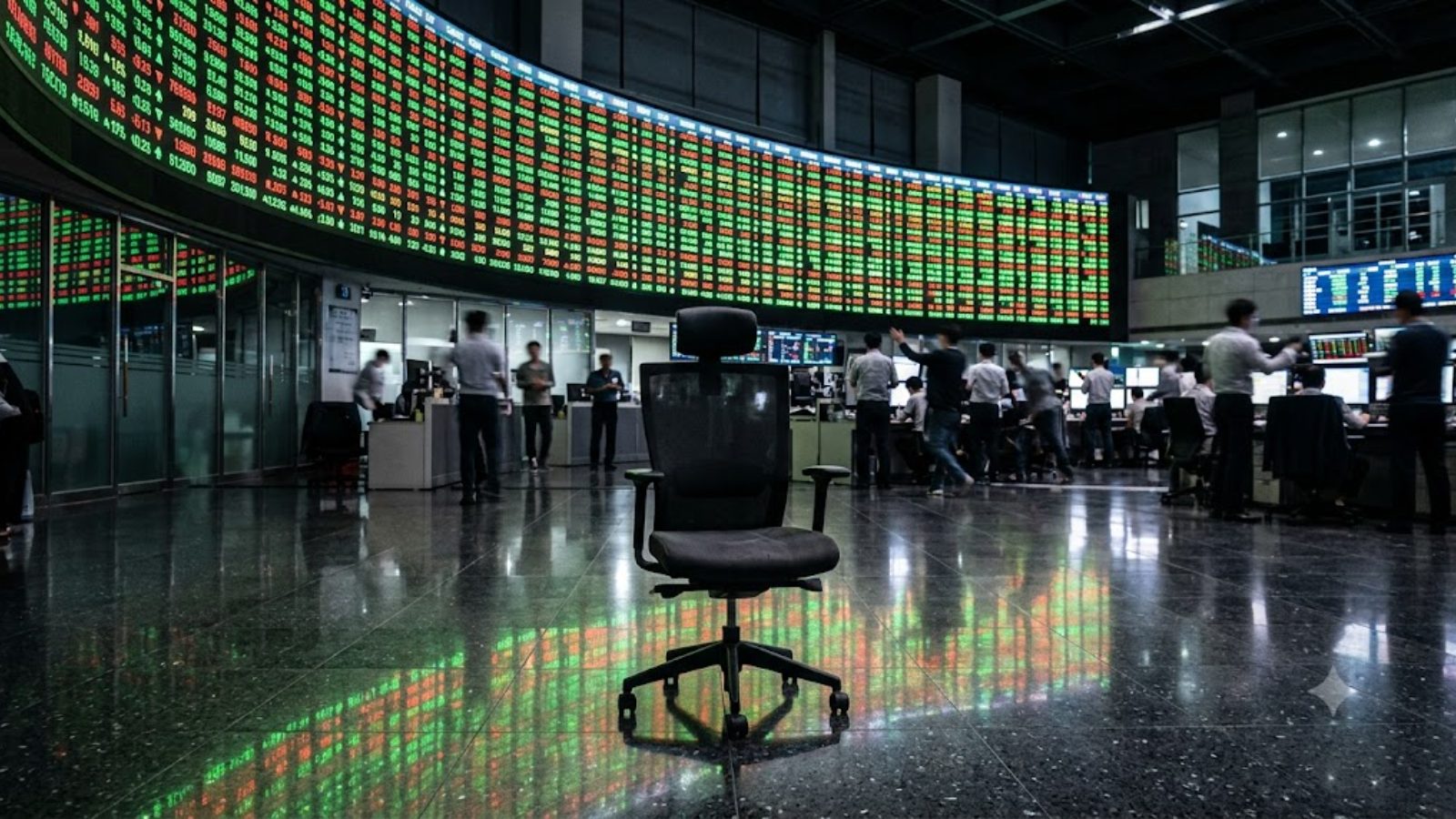
Monday gave us a strange split-screen. In New York, the Dow Jones Industrial Average closed at a record 53,055.91, with the S&P 500 at 7,537.43 and the Nasdaq at 26,121.16 — a calm, orderly, almost boring record. In Seoul, nothing is boring. Samsung Electronics reported preliminary second-quarter operating profit of roughly 89.4 trillion won — about $58.47 billion — a nineteen-fold surge from a year earlier and up 56% from just the prior quarter, beating the 85.054 trillion won analysts expected. Revenue more than doubled to a record 171 trillion won.
Read that again: one company earned roughly fifty-eight billion dollars of operating profit in three months, mostly by selling memory chips into the AI build-out. Samsung shares doubled from April through June, are up about 150% this year, and up roughly 415% over the past year. Citigroup’s Peter Lee just raised his 2026 operating-profit forecast to 401 trillion won, from 334 trillion. SK Hynix — the other half of Korea’s memory duopoly — is up about 765% over the past year, is now worth more than $1 trillion, and just kicked off a $28 billion U.S. capital raise, among the biggest ever, with U.S. trading set to begin Friday. (Its Seoul shares actually edged lower on the dilution — a rare flicker of arithmetic in all this.)
The Kospi is up 91.1% this year and about 165% over the past year. But the number that tells you what kind of market this is: over the past year, the Kospi has had 77 daily moves of 2% or more. The S&P 500 has had five. Korea has logged 44 daily moves of 3%-plus and 23 of 5%-plus. That is not an index behaving like a market; that is an index behaving like a single hot stock.
And Wall Street has noticed there’s a crowd. The CSOP SK Hynix Daily 2x product, launched in November 2025, is now the world’s largest leveraged single-stock vehicle. The Roundhill Memory ETF, launched in April, became the fastest ETF ever to reach $20 billion. Interactive Brokers became the first major U.S. brokerage to offer direct trading on the Korea Exchange in May. If you remember the stories out of Seoul in June — day traders quitting jobs, apartments mortgaged into chip stocks — this is the same fever, now with American retail invited to the party.
That’s worth sitting with. The boom in memory-chip demand is real — Samsung’s profits are audited money, not a story. Yet the institutions with the best information are net sellers into the strength, while the fastest-growing products are 2x-leveraged wrappers designed for people who arrived last. Both things can be true, because the asset and the wrapper are different things. Memory chips can have a great decade while a 2x daily-reset product torches its holders inside six volatile weeks — in a market that moves 2% or more 77 times a year, the math of daily leverage is a wood chipper.
If you hold a broad international index fund, you already own Samsung and SK Hynix — sized by the market, bought before the fever, at no extra effort. In fact, Korea and Taiwan together now make up roughly half of the entire emerging-markets index. That’s the quiet genius of index discipline: you captured the 415% and the 765% without ever having to decide to. The only decision left is whether to buy it a second time, at these prices, through a leveraged wrapper. That decision has a much worse track record.
For a teacher or pension household, the lesson isn’t “avoid Korea.” It’s that manias attack you through packaging. Nobody calls you about Samsung’s dividend; they call about the 2x product. Our approach stays the same on record days and fever days alike: a dividend and cash-flow tilt for the income you actually spend, a short-Treasury sleeve still paying north of 4% so no headline forces a sale, and index exposure that owns the winners automatically — including Seoul’s — without ever chasing them.
First, check what you already own — your international index fund almost certainly holds this boom, properly sized. Second, treat any pitch containing the words “daily,” “2x,” or “single-stock” as a product being sold, not an investment being offered. Third, notice who is selling into the strength — $100 billion of professional money left Korea while the wrappers multiplied. Fourth, if the AI-memory story tempts you, express it through diversified funds and let the position size stay honest. Booms are survivable. Leverage on top of booms usually isn’t.