Gold is what people own so they don’t have to think about weekends like this one. No earnings report. No dividend to cut. No board of directors. Just a metal that is supposed to go up when the world gets frightening.
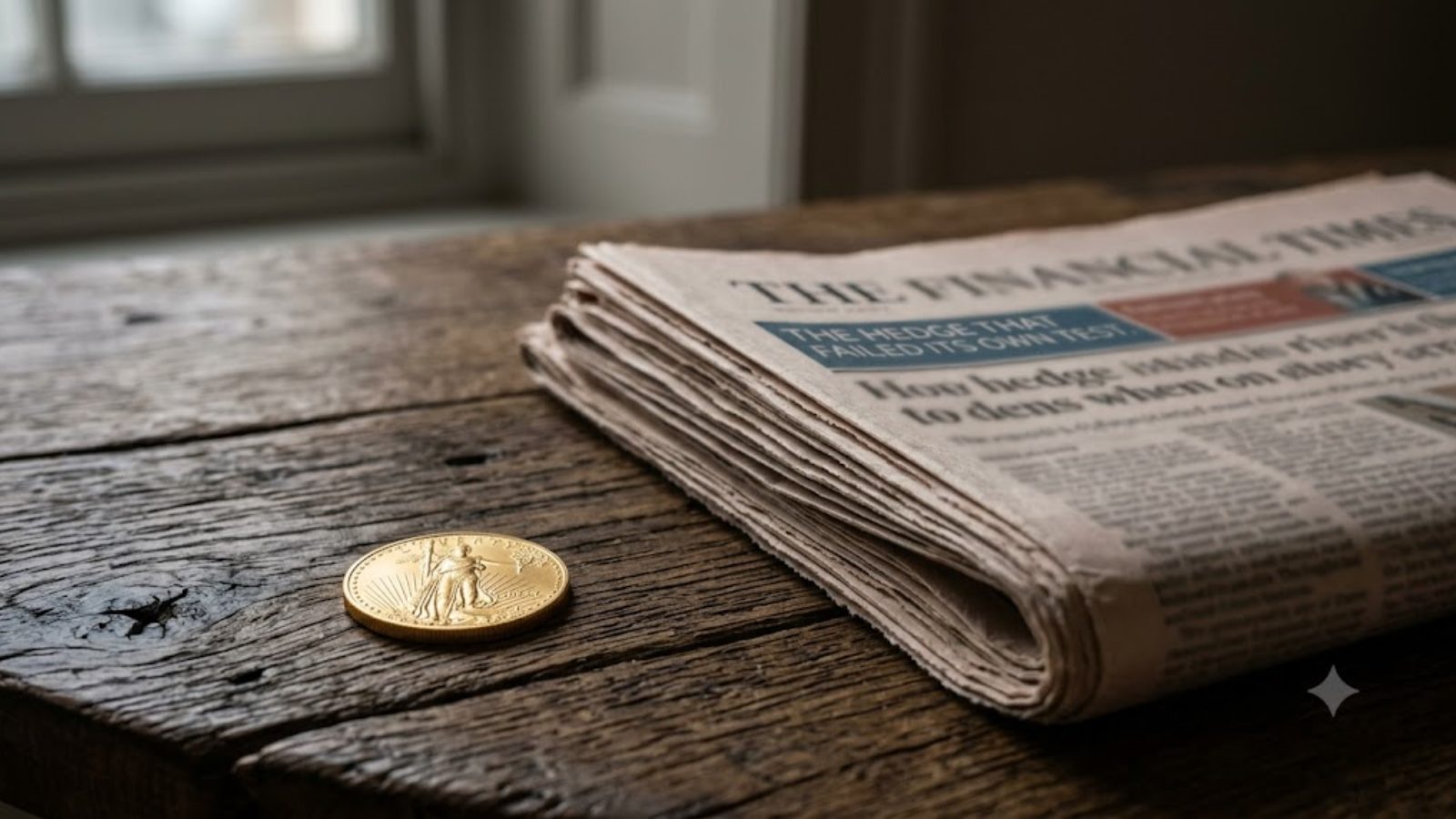
The world got frightening. The U.S. and Iran traded a fresh round of attacks over the weekend, oil prices gained, and on Monday gold fell 2.6% to $3,997 a troy ounce. It is now down about 25% from the record it set in January.
The Reason Is Rates, Not the War
The reason has less to do with the fighting than you would guess. Investors have been worried that the war with Iran drives up energy prices, that higher energy keeps inflation up, and that inflation stops the Federal Reserve from cutting. Fed officials broadly agreed at their June meeting that they would need to raise rates if inflation stays elevated this year. Gold pays no interest, so it struggles to compete with Treasurys and other cash-like holdings when rates are higher. That is the Journal’s own explanation, and it is a boring one. Suki Cooper, head of commodities research at Standard Chartered Bank, said this has “increased the opportunity cost of holding gold or the perceived opportunity cost of holding gold, and that’s weighed on prices in the near term.” Aakash Doshi, head of gold strategy at State Street Investment Management, said Fed rate decisions will have a larger effect on gold than daily geopolitical shifts. His read on a temporary break in a ceasefire: “It’s just day-to-day noise.”
Two men in Tuesday’s paper own gold, and neither is doing anything about the drop. Stu Bradley is 83, a retired financial adviser in Michigan. He did his selling earlier this year, when gold was rallying above $5,000 an ounce and he doubted it could climb much higher. “It’s one of those things. You say, ’God, should I just keep all this money? It’s going so well.’ But then you say: ’No, I’ve seen this happen before,’” he said. He still has 10% of his portfolio in gold and silver, and he is sitting tight on it. “Gold’s fairly stable,” he said.
Richard Elias is 76, a retired financial adviser in St. Louis. He put around 3% of his portfolio into gold after the 2008 financial crisis and hasn’t looked back since, except to move some of it into physical coins. “To hold a gold coin in your hand is different from owning a proxy for it,” he said. He is staying put. “The pullback doesn’t strike me as anything other than normal.”
The point is not that gold is bad, or good. Neither man tried to guess where it goes next, and neither of them needs to. One holds 10%, the other about 3%, and a bad Monday didn’t change either number. Here is the general principle, and it is ours rather than the Journal’s: a haven works better as a percentage you decide on and rebalance back to than as a conviction you ride. If you cannot say out loud what percentage of your money is sitting in gold, that is the thing to find out first, and it has nothing to do with the news. Bring the statement to a review and we will work it out together.
A haven sleeve works best as a stated percentage you rebalance back to rather than a conviction you ride. Move the Gold chip to cool and re-state the target percentage in every plan that holds it — then leave it alone. The honest link to the story is narrower than it looks: both retired advisers in Tuesday’s paper hold modest, long-standing positions, 10% and around 3%, and neither traded Monday’s drop. That is the tone for the calls this week, not a view on where gold goes next. One mechanical point worth saying out loud to anyone drawing income: gold pays no interest, and a two-year Treasury closed Monday at 4.261%, so a large gold position has a running cost.
GLD
Mentioned for context only. A mention is not a recommendation — see the portfolios page for what the books actually hold.