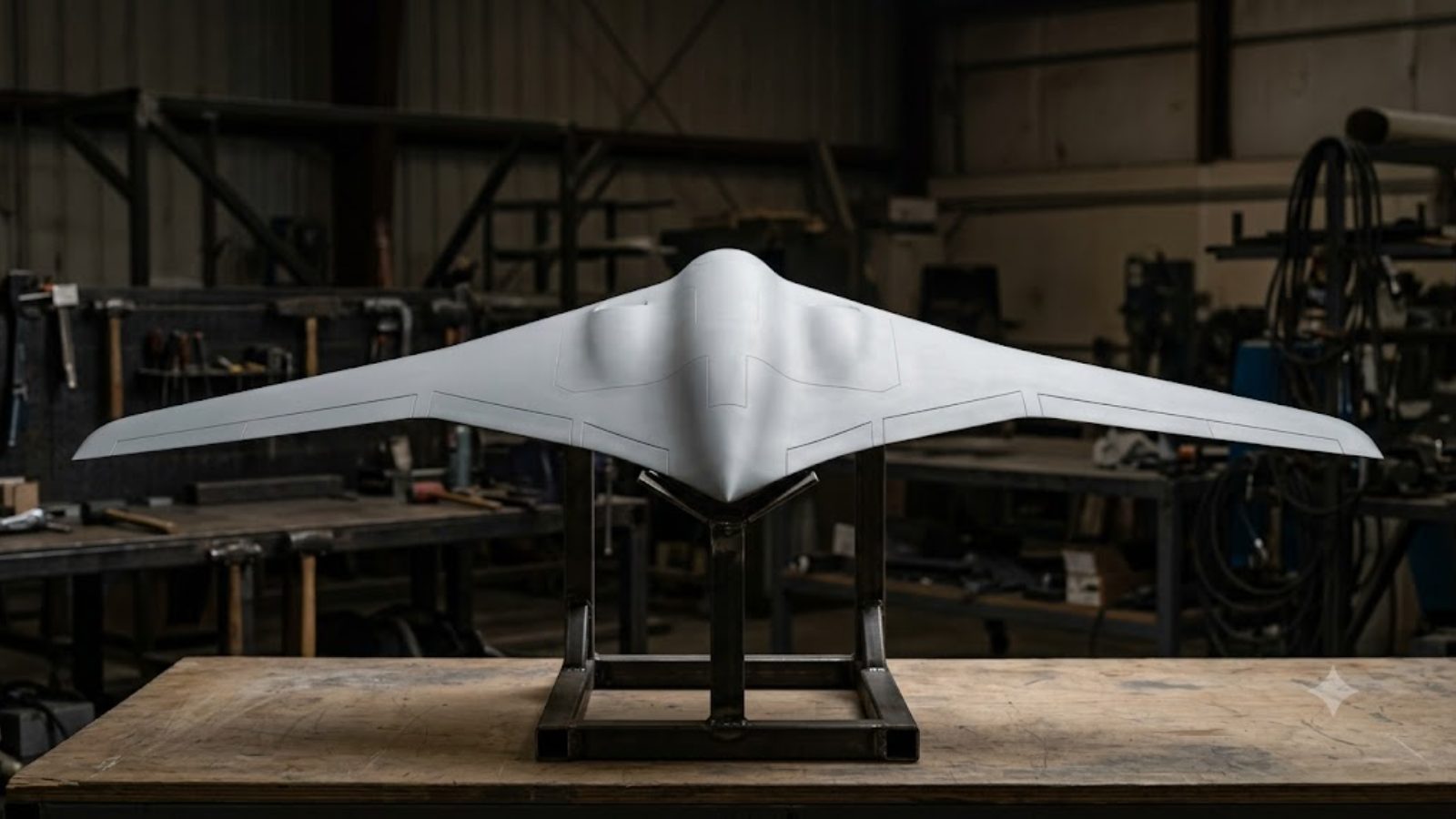
The default shape of a passenger airplane — a tube with wings bolted to it — has gone unchallenged for over seventy years, which is roughly seventy years longer than most industrial designs survive. This week the United States government decided to pay someone to challenge it.
The Airplane
The aircraft JetZero wants to build is no less radical than its ambition. It looks more like a manta ray than the tube-with-wings blueprint that has been the default. If JetZero can cross the line, the blended-wing aircraft would mark the biggest shift in passenger-jet design since the supersonic Concorde.
Forget one or two aisles: this one has four, and is set to fly about 10,000 feet higher than current jets. There are no physical windows — there is a skylight instead. Each seat has its own overhead luggage compartment. Each toilet has a dedicated waiting space. The proposed airplane would seat about 250 passengers and fly about 5,000 nautical miles, fitting between the biggest narrow-bodies and the smallest wide-bodies that Boeing and Airbus sell — a segment that has largely gone unserved since Boeing halted plans to replace its 757 and 767 at the pinnacle of the 737 MAX crisis.
The trick up JetZero’s sleeve is that its radical new aircraft is not actually that new at all. Almost all of the Z4’s parts — from controls to the use of previous-generation engines on its demonstrator — are taken from existing planes, meaning they already have signoff from the Federal Aviation Administration. The main new thing, chief executive Tom O’Leary said, is the shape in which JetZero is piecing those parts together. NASA began updating research into the concept about 30 years ago, spending more than $1 billion and test-flying prototypes; working with Boeing, it sought to learn how much fuel efficiency a more aerodynamic design could extract. The answer, according to JetZero, is about 30% compared with later-generation jets like the 787.
Where the Money Comes From
JetZero, based in Long Beach, Calif., last week reached an early deal with the U.S. Export-Import Bank as part of its Make More in America initiative for as much as $3 billion in loans and guarantees that the company needs to build its first factory. The Ex-Im Bank chairman said he wants the loan deal fast-tracked.
The preliminary agreement is helping JetZero’s chief executive answer a question that has been plaguing his view. He is targeting a first prototype flight of the aircraft, known as the Z4, by the end of next year. “How real it is is effectively, ‘Where’s all the money coming from?’” O’Leary said.
It is not only the Ex-Im Bank. The company separately has $235 million from the U.S. Air Force to build its prototype, and is backed by Northrop Grumman and RTX (RTX), which is providing Pratt & Whitney engines for the first demonstrator. JetZero has the backing of about 20 airlines including Delta Air Lines (DAL), Alaska and United (UAL) — the last with a conditional order for 200 of the Z4. In June it broke ground on a manufacturing facility in Greensboro, N.C., slated to produce the first Z4s by 2030 for use in testing and certification. The full-scale prototype is set to fly toward the end of 2027, with entry into service possible from the early 2030s — though O’Leary is deliberately vague about when passengers might see it at their gates, because that depends on the FAA’s safety approvals.
One Titan Left
The ambition comes after a bruising few decades for American plane making. Once dominated by three titans that produced about 90% of the world’s airliners, Boeing (BA) now fights solo as America’s only major maker of commercial airliners. Its European rival, Airbus (AIR.PA), controls more than half the market — and this week posted sharply higher earnings for the second quarter, with adjusted earnings before interest and taxes up 54% on the year to €2.43 billion and net profit more than doubling to €1.66 billion. Second-quarter revenue grew 28% to €20.53 billion. Boeing’s own second-quarter net loss of $428 million narrowed from the $612 million loss a year earlier.
There is also a new competitor in China, Comac, which is getting aircraft into the hands of regional carriers and has set its sights on its own blended-wing design. And there are real skeptics of the shape: critics point out that passengers in the wings could be exposed to higher gravitational force when the plane turns, that the lack of physical windows might worsen motion sickness, and that a quad-aisle layout changes how an evacuation would play out. Airport jetways were not designed to handle such planes. Airbus promoted a similar-style jet as one of the futuristic concepts it was studying, then decided the aircraft would need to be too big to take advantage of the aerodynamic efficiencies, and shelved it.
“I think everybody’s ready for something new,” said Aleksey Matyushev, chief executive of Natilus, another California startup working on a smaller blended-wing aircraft. That is the sentiment the money is buying. Whether it is also the engineering is a different question, and it takes a decade to answer.
Governments have decided aviation duopolies are a strategic risk, and they are now funding the challenger directly — the same industrial-policy pattern as the chips. A $3 billion Ex-Im package does not make a certified airliner; certification is a decade and tens of billions. But it does make Boeing’s monopoly on American commercial aircraft a policy question rather than a fact.
Action: HOLD Boeing (BA) — the commercial recovery plus defense floor thesis from this edition’s restock story stands, and a challenger a decade from certification does not dent a seven-year backlog. But the defense sleeve discipline applies here too: we own the aerospace complex, not a single fuselage shape. WATCH JetZero’s milestones as a proxy for how serious Washington is about manufacturing challengers generally — that policy current also runs under our defense and industrial sleeves.
- BA · Boeing · hold · commercial recovery plus defense floor
- AIR.PA · Airbus · reference · index exposure only
- GE · GE Aerospace · the complex, not the fuselage
- RTX · RTX · Pratt & Whitney engines on the demonstrator
Related from this edition: the Pentagon’s $120 billion restock order