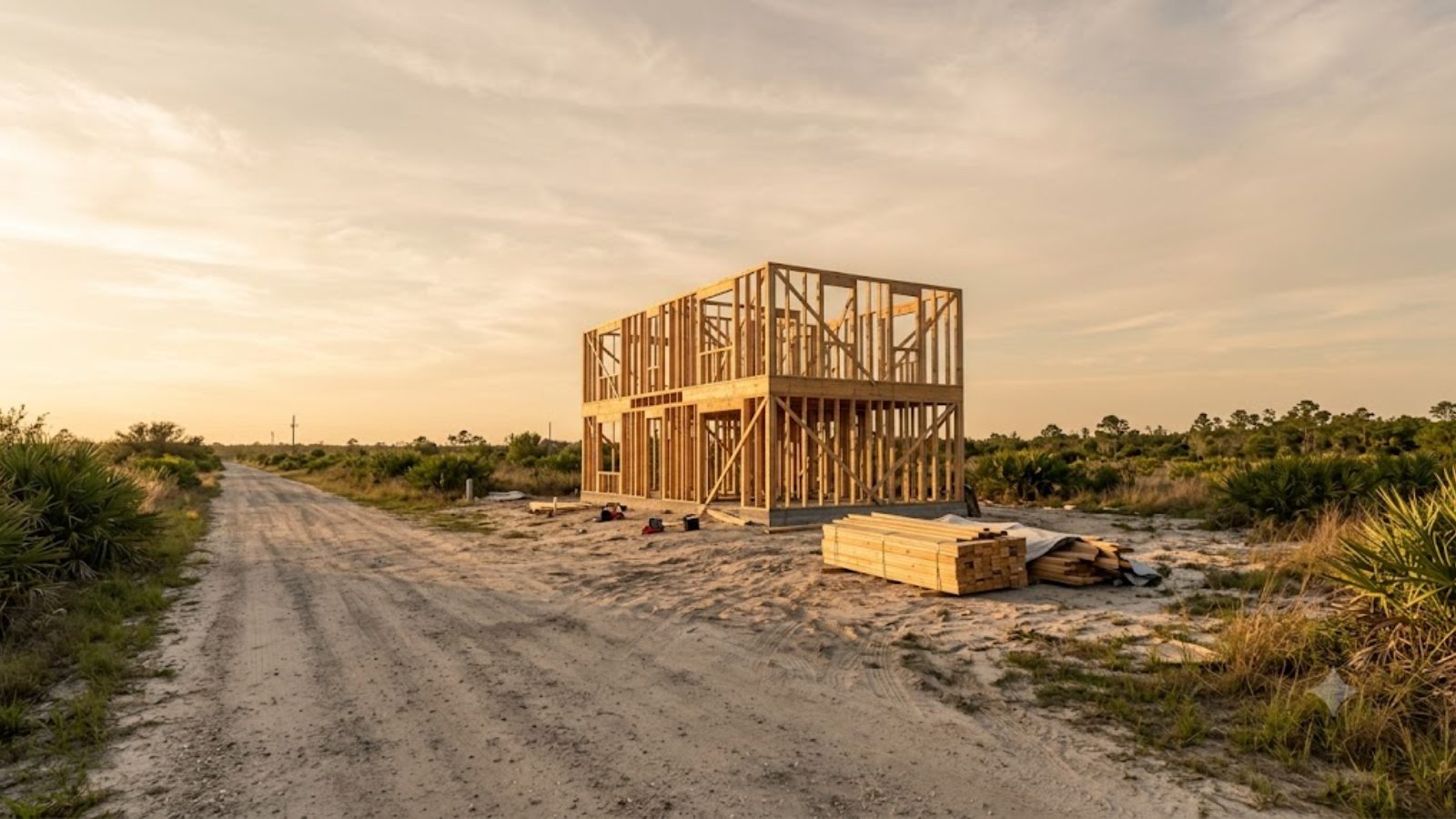
The American housing story has quietly become two stories. There is the coastal affordability crisis everyone writes about, and there is the inland supply response almost nobody does. This week the Journal went and stood in the second one.
A place built before it was needed
Lehigh Acres is an unincorporated community carved out of the Florida wilderness in the 1950s, when wealthy Chicago businessman Lee Ratner and some partners began buying thousands of acres of ranchland and eventually divided it into more than 100,000 residential lots. They invested little in infrastructure, leaving most homes to rely on private wells and septic systems. The lack of urban planning produced a sprawling, disjointed feel — a seemingly endless network of roads unfurling in a massive grid, generally without sidewalks, curbs or landscaping, with sleek new homes standing next to 1970s ranch houses and empty, overgrown lots. There is no downtown, just strip malls dominated by dollar stores and mom-and-pop shops; only recently have Starbucks and Chipotle arrived.
The place has ridden a full economic roller coaster. It mushroomed beginning in the 1990s, went into a frenzy of construction in the 2000s powered by easy credit, cratered when the subprime crisis hit in 2007 and foreclosures skyrocketed, and has been climbing back ever since as new buyers arrived to snap up cheap homes. The Covid pandemic and the state’s growing affordability problems turbocharged development.
The arbitrage, in dollars
Here is the number that explains everything else. In Lehigh Acres, three-bedroom homes in one new development start at $264,000, and the median sale price in May was $310,000 — compared with $652,000 in Miami, according to Redfin. There were 3,659 building permits issued for new single-family homes in Lehigh Acres for the year ended in March, a 14% increase over the previous year, according to real-estate firm LSI. By comparison, 3,500 such permits were issued in total between 2012 and 2020.
Melissa Orta moved from Miami five years ago, bought a three-bedroom house for $280,000, and became a real-estate agent specializing in the area. She has been busy ever since. “After Covid and the affordability crisis, families were like, ‘Where can I have my American dream?’” Orta, 26, said. One of her clients moved to Fort Myers from Cincinnati in 2024 to take a job as an operations manager, then bought a three-bedroom house with a two-car garage and a lap pool for $330,000; a friend plans to buy in the area, and his mother and grandmother are thinking of following.
The population grew to 114,000 in 2020 from 87,000 in 2010, according to census data, and local leaders put the current count at about 135,000. The makeup is 49% Hispanic, 28% white and 18% Black. Median household income of $66,890 trails the state figure of $74,568, and the 17.1% poverty rate exceeds Florida’s 12%.
Growth outrunning the pipes
This is not a real-estate brochure. Growth is moving faster than the roads, water lines and services can handle. “The growth is phenomenal,” said Michael Welch, chairman of the East Lee County Chamber of Commerce. “I think it caught everyone off guard…And the infrastructure hasn’t kept up with it.” The area serves as a bedroom community for employment centers in Fort Myers and Naples, so its main thoroughfares are choked with outbound traffic in the morning and inbound traffic in the afternoon.
Law enforcement is stretched, the multitude of wells is draining the aquifer, and low wages mean reliance on social services. Some homes are packed with occupants sharing costs, leaving driveways and yards clogged with a half-dozen or more vehicles. Residents have pushed for Lehigh Acres to incorporate as a city, but the lower home values mean it lacks the property-tax base to support the move; it relies instead on funding from surrounding Lee County, which funded roughly $370 million of projects there in 2023 and 2024 and plans to work with the water utility to get more residents off wells and septic systems. Private investment is arriving too — healthcare providers have built facilities so residents don’t have to drive to Fort Myers. “Lehigh Acres is now reinventing itself,” Welch said. “It’s tough, but they’re doing it.”
The investable half
The supply response has a name and a ticker. The large public homebuilders — D.R. Horton (DHI), Lennar (LEN), NVR (NVR) — have spent two years proving they can earn money in a 6% to 7% mortgage world by building smaller, building further out, and buying down rates for the buyer. Lehigh Acres is what that strategy looks like from ground level: 3,659 permits in a single year in a place that issued 3,500 in the preceding eight.
We are not adding a homebuilder here. The book’s real-asset exposure stays in REIT and index sleeves, and buying a cyclical into a strong permit print is exactly the sort of thing that feels smart for two quarters. But this is the demand data that keeps us from ever being short the American homebuilder, and it is the reason we treat “housing is unaffordable” as an incomplete sentence.
There is a planning version of the same trade, and it is the more reliable one. A retirement dollar goes considerably further in Lehigh Acres than in Naples. Households can execute the move-inland arbitrage without a brokerage account, and for clients within a few years of retirement it is frequently the single largest lever available — larger than any allocation decision we could make on their behalf.
The American housing story is now two stories: coastal affordability crisis, inland supply response. The supply response is investable — it is called a homebuilder, and the big ones (D.R. Horton (DHI), Lennar (LEN)) have spent two years proving they can make money in a 6-7% mortgage world by building smaller, further out, and buying down rates. Action: no new position — the book’s real-asset exposure stays in REIT and index sleeves — but this is the demand data that keeps us from ever shorting the American homebuilder. The planning angle for clients: the move-inland trade works for households too. A retirement dollar goes further in Lehigh Acres than in Naples, and that arbitrage is the most reliable one in this newspaper.
D.R. Horton (DHI) · Lennar (LEN) · NVR (NVR)
Tickers are named to identify the businesses discussed. They are not recommendations, and a name appearing here does not mean it is held in any model.