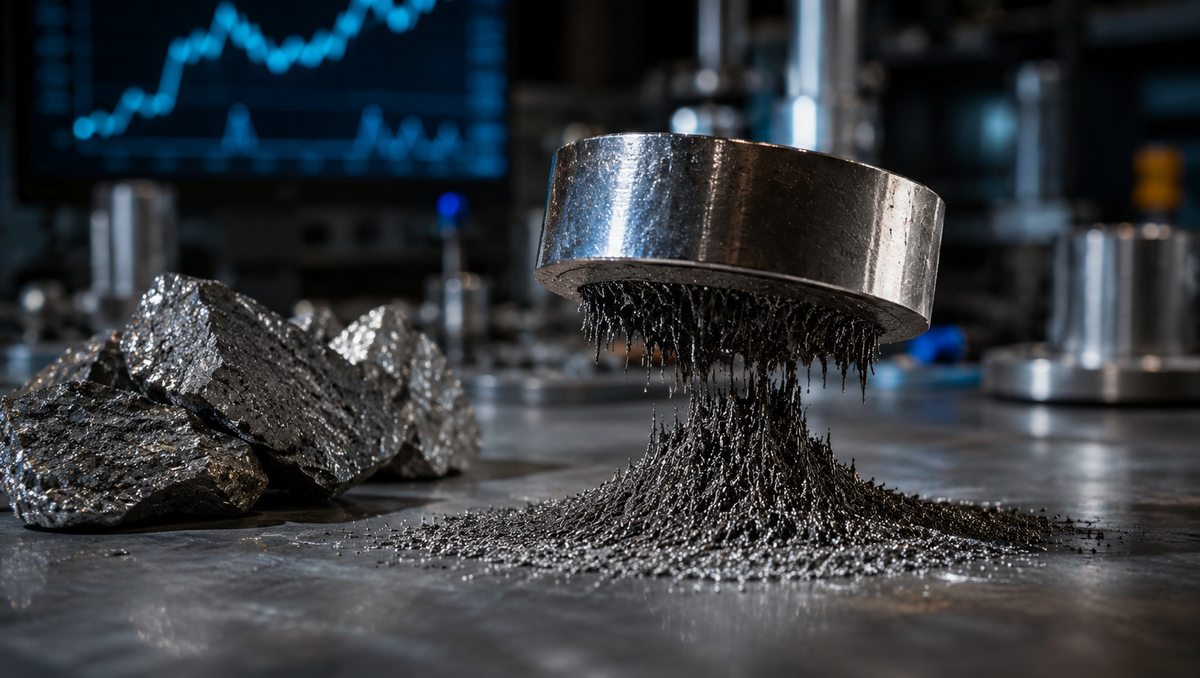
America Is Trying to Build Magnets Without China. It Matters More Than It Sounds.
The powerful magnets inside motors, missiles and turbines mostly come from rare earths — and China controls about 90% of that chain. A handful of companies are trying to change that. We found a way to own the theme.
Based on WSJ reporting (Yang Jie, Sherry Qin) · Capital Wealth analysis by Sean Anees Saifi · June 3, 2026
Breaking the rare-earth chokehold: magnets without China.
The Sentence That Runs the Modern World
Here's something that quietly powers your car, your dishwasher, a wind turbine, and a guided missile, and that almost nobody thinks about: the small, intensely powerful magnets inside their motors. Most of those magnets are made from rare-earth elements, and China controls roughly 90% of the mining and processing. That is one of the single biggest points of leverage Beijing holds over the West, and every few months it reminds everyone of that fact with a new export rule.
Wednesday's Journal ran a strong feature on three companies trying to break that grip. The most striking is a Minnesota startup called Niron Magnetics, which makes a powerful magnet out of iron and nitrogen — with no rare earths in it at all. The U.S. Department of Energy is helping fund the work. If iron-nitride magnets scale, they remove a chokepoint that has worried defense planners and automakers for a decade.
How to Own a Theme When the Best Company Is Private
Niron itself is privately held, so you can't buy its shares. That's a common problem with the most exciting part of any new trend — the purest play is often a startup. The move, then, is to find the best public expression of the same theme. For “magnets and rare-earth materials that don't run through Beijing,” we like MP Materials (MP). It runs the only operating rare-earth mine in the United States and is building domestic magnet-making capacity.
What we like about MP is that it sits at the intersection of three durable stories at once: defense (the Pentagon wants a domestic magnet supply), the energy transition (EVs and turbines need these magnets), and geopolitics (a China hedge). Multi-engine theses like that tend to age well. The catch is that MP is volatile and its fortunes swing with commodity prices, so we're treating it as a thematic starter, not a core holding.
What This Means For The Book
We added MP Materials (MP) at a ~1.5% thematic weight in the Aggressive Growth tactical tiers. It's our cleanest public answer to the question clients keep asking: “what's our China hedge?” We're keeping the position small and patient, because commodity-linked names can be choppy — the thesis is a multi-year one, not a multi-week trade.