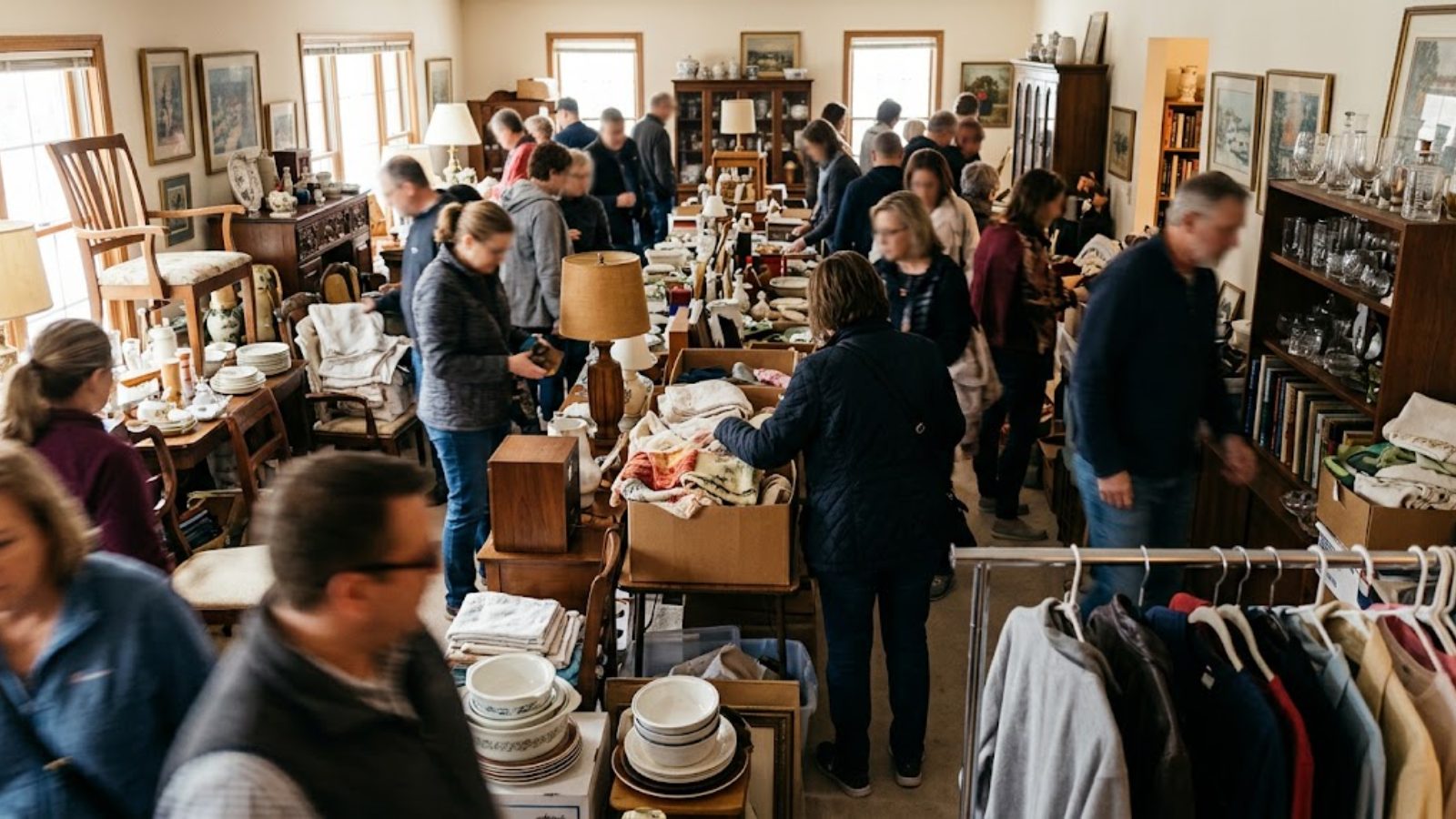
Somewhere in America this Saturday, a line will form at dawn outside a perfectly ordinary suburban house. When the doors open, grown adults will sprint — actually, physically sprint — toward the china cabinet. Welcome to the estate sale, the last store in America with genuine suspense.
An estate sale, for the uninitiated, is what happens when the entire contents of a home go up for sale at once — usually because the owner died, downsized, or moved. Everything gets a price tag. Everything must go. And every so often, something tagged at $5 turns out to be a treasure.
The trophies are real, which is what keeps the lines forming. A Baccarat crystal shaker, tagged at $5, was flipped for $850. A first-edition copy of The Velveteen Rabbit, plucked from a table for $1, resold for $750. One dollar.
Returns like that would make a hedge fund blush. The estate-sale circuit is, in effect, a market where nobody double-checked the prices — and every single person in line at 6 a.m. knows it.
Of course, for every $850 shaker there is a garage full of exercise equipment that nobody wants at any price. That is what makes it sporting. You never know which house is the jackpot, so the regulars line up at all of them, coffee in hand, in the dark, as if it were a playoff game. In a sense, it is.
The four Ds
Where does the merchandise come from? The industry has a shorthand, and it is not a cheerful one: the four Ds — death, debt, downsizing, and divorce. Every folding table of teacups was once somebody’s household, dissolved by one of the four.
The supply keeps booming, which tells you something about the moment. An enormous generation is downsizing all at once, and the contents of several million attics are headed for the driveway.
Naturally, the internet has arrived. TikTok influencers now film the dawn lines, the sprints, and the hauls for audiences of strangers. Treasure hunting has become spectator content. The china cabinet has a fan base, and the fan base has merchandise.
It is worth pausing on how strange and tender the whole scene is. The dawn line is a market, but the merchandise is a life — the wedding china, the good silverware that only came out in December. Both things are true at once. That is the estate sale in a single sentence.
Now, about your stuff
Here is the twist, which you may have seen coming: every object at that sale belonged to someone who meant to deal with it later.
The Baccarat shaker priced at $5 was almost certainly not meant to leave the family at $5. Nobody wrote down what it was. Nobody told the kids. So a stranger with a sharp eye collected the difference — an $845 inheritance, transferred at dawn, outside the family, no paperwork required.
The fix costs nothing but a Sunday afternoon. Make a list of the good pieces. Note which ones are genuinely valuable, and which are merely sentimental — a fine thing to be, but a different thing. Decide who should receive what. Then ask whether that person actually wants it. Ask out loud. The answer is no more often than anyone expects.
In our experience, that list is also the gentlest possible on-ramp to the family money conversation. The china is easier to talk about than the brokerage account. But it opens the same door — and the families who walk through it early never have to watch a dawn line price their history.
Go enjoy an estate sale, sincerely — they are a blast, and somebody has to rescue the Baccarat. Just make sure that when it comes to your own attic, the appraisal happens at your table, on your schedule, and not at 7 a.m. in someone else’s cash box.