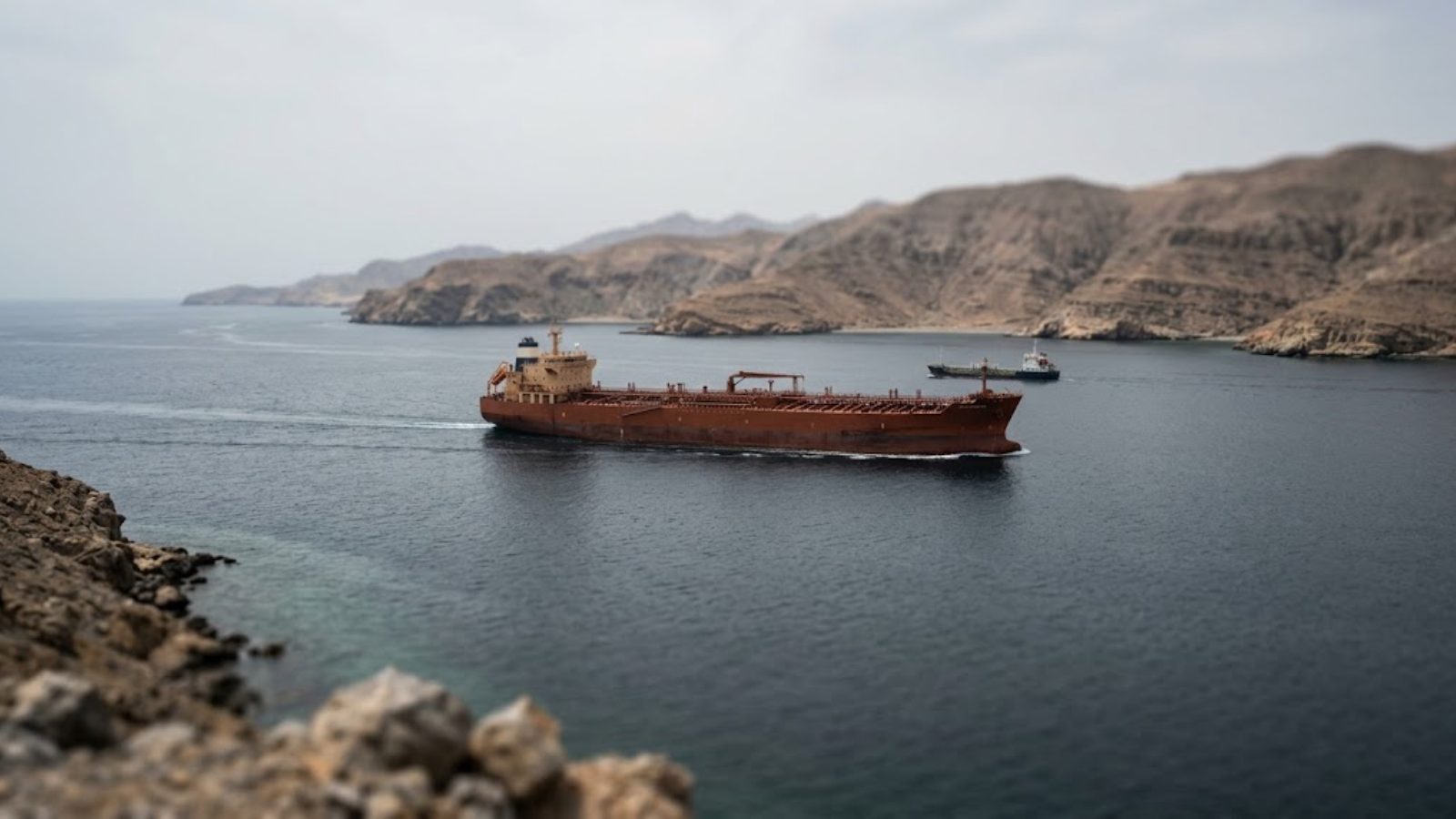
The United Arab Emirates has left OPEC, the club of oil-producing countries that coordinates supply. Not threatened to leave. Not formed a committee to study leaving. Left. And the reason is not a quarrel over production quotas — it is a stretch of water. Gulf producers have concluded that Iran’s grip on the Strait of Hormuz is permanent, and the UAE is rebuilding its entire energy business around that grim assumption.
The numbers explain the urgency better than any press release could.
The strait, by the numbers
| Measure | Before the war | Now |
|---|---|---|
| Crude flow through Hormuz | ~20M bpd (crude + products) | 2.2M bpd last week; 8.5M a month earlier |
| Iranian oil exports | — | 47,000 bpd |
| War-risk insurance | 0.25% of ship value | Up to 10% — $3M–$10M per trip |
Sit with that first row. A waterway that carried roughly 20 million barrels a day of crude and fuel before the war moved 2.2 million barrels of crude last week. A month earlier it managed 8.5 million. That is not a dip. It is a staircase going down, one month per step.
The insurance line explains why. Insuring a single tanker’s trip can now cost up to 10% of the ship’s value — three to ten million dollars per trip, for a policy that used to cost a quarter of one percent. The strait is not closed. It is priced like a haunted house. Ships can enter. The premium just assumes some of them shouldn’t.
And the country doing the haunting is paying dearly too: Iran’s own oil exports have collapsed to 47,000 barrels a day. A rounding error. The gatekeeper has locked itself out.
Markets did the obvious thing. U.S. oil jumped $3.95 to $82.13, and Brent, the global benchmark, rose 5% to $87.72.
The pivot to gas
The UAE’s answer is to spend its way onto dry land. Its gas company, Adnoc Gas, is investing more than $8 billion on top of a $13.2 billion gas project already underway. The money develops the Umm Shaif and Bab fields, adds a processing unit at Habshan, and expands Ruwais. The target: more than $12 billion in yearly earnings by 2030.
The reason is written in its latest report. Second-quarter profit fell to $665 million from $1.39 billion a year earlier, largely because of the Hormuz mess. More than half the profit, gone, because of one waterway’s mood. When a strait can do that to your income, you stop lobbying about the strait and start building a business the strait cannot touch. OPEC membership solves a pricing problem. It does not solve a geography problem.
The neighbors are running the same play at bigger scale. QatarEnergy is putting $30 billion into liquefied natural gas — gas chilled into liquid so ships can carry it. Shell (SHEL) sees global demand for it reaching roughly 700 million tons a year by 2050. Treasury Secretary Bessent went further, predicting the strait becomes irrelevant within two years, with 50% to 70% of the region’s flows eventually moving by pipeline.
Toll collectors endure
There is a pattern worth keeping. Chokepoints look permanent right up until enough money decides they are not. Pipelines, gas terminals, new fields — boring, multi-year answers to a dramatic problem. They tend to work.
The lesson for investors is not to bet on the drama. It is to own the businesses that collect fees on energy however it travels — through a strait, through a pipe, or on a ship paying haunted-house insurance. Chevron (CVX) and Exxon Mobil (XOM) sit in the Capital Wealth Growth Portfolio for exactly that reason. They are toll collectors on the world’s energy, not bettors on any single road staying open.