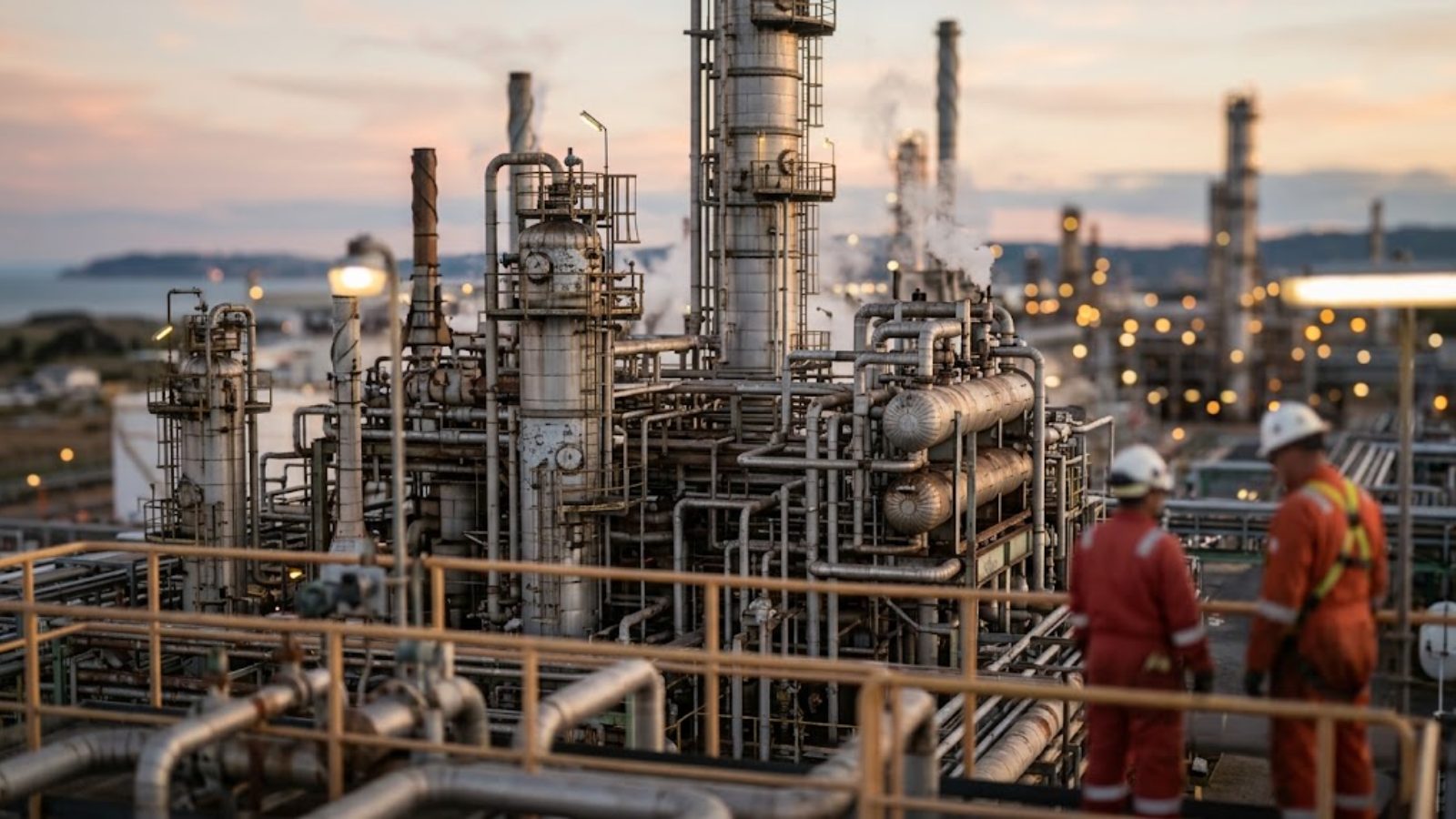
Oil closed Wednesday at $83.27 a barrel, down seven cents. Calm. Boring, even. Meanwhile the average American gas station is charging over $4 a gallon, up from $3.16 a year ago, and parts of California are flirting with $7. If that math feels broken, congratulations — you found the story. The world is not short of oil. It is short of the machines that turn oil into gasoline.
The industry’s scoreboard for this is called the crack spread — roughly, the profit a refinery makes turning three barrels of crude oil into two barrels of gasoline and one of diesel. In a normal year, that profit sits in the teens per barrel. Right now it is above $70.
American refineries are also running at 90–95% of capacity, which is the industrial version of a redline on a tachometer. Two things follow. First, refiners are earning several times their normal margin on every barrel they push through. Second, there is no slack. At 90–95%, a fire, a storm, or an unlucky maintenance week does not get absorbed somewhere else in the system. It gets absorbed at your pump.
Where refineries went
Piece by piece, and mostly on purpose. Iran’s oil exports fell to near zero in July, from $4.5 billion in June. No tankers loaded at its Kharg Island terminal, and a Hellfire missile strike on the blockade-running ship Vela Nova served as the deterrent.
Russia’s refining is at its lowest in more than 20 years, courtesy of Ukrainian drones, and Moscow has banned jet-fuel exports to keep its own planes flying. China is keeping its fuel exports tight. And one detail historians will circle: Saudi Arabia shipped zero oil to the United States in July — the first month that has happened since 1985.
| The squeeze, in numbers | Now | Normal / year ago |
|---|---|---|
| 3-2-1 crack spread | >$70 per barrel | teens |
| U.S. refinery utilization | 90–95% | — |
| U.S. average gasoline | >$4.00 | $3.16 a year ago |
| California average / worst cities | $5.60 / ~$7 | — |
| California diesel | $6.86 | — |
| Iran July exports | ~zero | $4.5B in June |
| July global supply deficit | 1.8M barrels per day | stocks <7.9B barrels |
California, the case study
Nowhere is the squeeze squeezier than California: $5.60 a gallon on average, roughly $7 in some cities, diesel at $6.86. The state has lost 20% of its refining capacity in under a year — Phillips 66 (PSX) shut its Los Angeles refinery in December, and Valero closed its Benicia plant in April. You cannot regulate a refinery out of existence and keep its gasoline. That is not politics; it is plumbing.
Watch the diesel number, because it travels. Diesel at $6.86 a gallon is not a trucker’s problem. It is a lettuce problem, a lumber problem, and eventually a grocery-receipt problem. Almost everything you buy rode in on that fuel. Gasoline makes people angry. Diesel makes things expensive.
The proposed fix is more plumbing. Phillips 66 and Kinder Morgan (KMI) want to build Western Gateway: a $5 billion, 900-mile pipeline carrying 230,000 barrels of fuel a day from the Texas Panhandle to Colton, California, by 2029. Governor Newsom has embraced it — yes, a Texas-to-California fuel pipeline, embraced in Sacramento. Scarcity is persuasive.
Now read the date again: 2029. Pipelines are not microwaves. Between the announcement and the first gallon sit permits, lawsuits, steel, and 900 miles of somebody’s backyard. Every summer between here and there gets priced with the refineries we already have.
Demand is falling too
Here is the strange part. The IEA — the world’s energy statistics agency — expects oil use to fall by 1.6 million barrels a day in 2026. And yet July still ran a supply shortfall of 1.8 million barrels a day, with global stockpiles slipping below 7.9 billion barrels.
When the market tightens while demand shrinks, the problem is entirely on the supply side. And supply problems built from strikes, sanctions, and shuttered refineries do not fix themselves by Labor Day.
Until the new pipes and plants arrive, every gallon pays a toll at a narrower gate. The question for investors is not who wins the oil argument. It is who owns the gate.