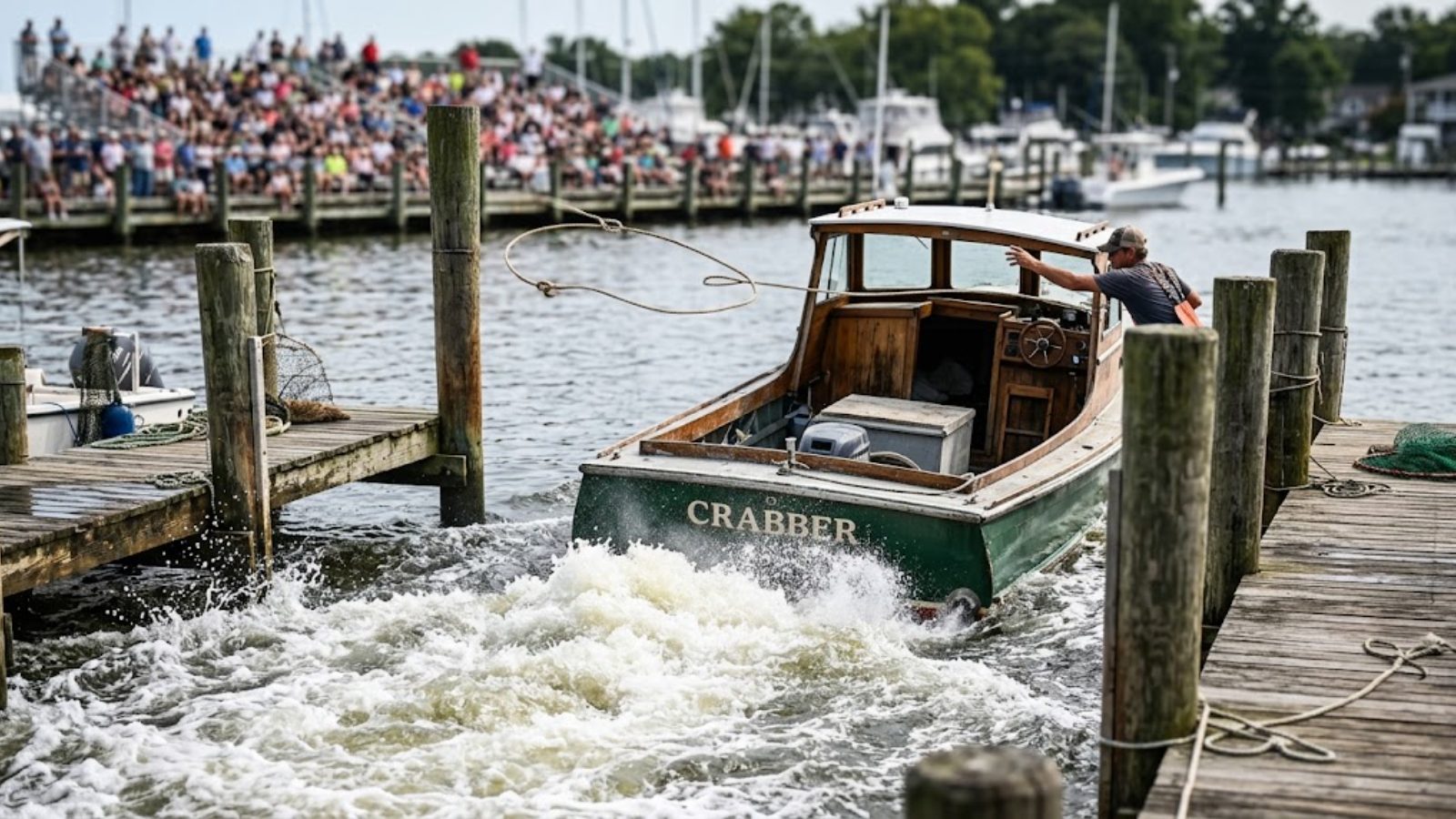
Pocomoke City, Maryland, is where you go to watch a grown man back a commercial fishing boat into a slip at full throttle, throw a rigid hoop over a piling, and get scored on it by a crowd in lawn chairs. It is, the Journal’s Scott Calvert reports, akin to Nascar on the water with a jolt of monster-truck energy. Every summer it takes over the Chesapeake Bay.
The rules are simple. One at a time, captains race toward the dock, turn sharply, and reverse into the slip. Then they toss hoops onto the pilings. Fastest time wins, and when everything goes right it takes barely twenty seconds.
It often does not go right, and that is the draw. Hoops fall short and have to be fished out. Boats have toppled pilings. Hard landings have cracked sterns. Wind and tide do what wind and tide do. “I ran into a tiki bar one time,” said Derrick Hoy, 55. “That wasn’t too good.”
The cast
Danny Haddaway, 38, a commercial waterman, won the small-boat singles with a 23-second run. “You get the trophy, you get to rub it in everybody’s face.” Jamie Marshall, 51, docking since 1998 and the son of the 1971 winner, sprinted off his boat after a run, high-fived a line of spectators, and playfully nuzzled a woman in a lawn chair. Heath, who has had a prosthetic leg since a 2022 motorcycle crash, took first in large boats.
Sydney Hughes, 22, competes under the slogan “Dock It Like a Girl,” runs a boat named Wild Child carrying the names of about ten sponsors, and has sold T-shirts to fans in Norway. She fell short in both her heats and said it was a good time anyway.
And Peyton, an eighth-grader, won the medium-boat class and collected her tenth trophy. Her winnings go into a college fund.
The household-finance section, which is all of it
Read the economics and it is a little parable about hobbies and money. Organizers pay each captain a flat $2,000 — partly because fuel is so expensive that some spent $800 just motoring to and from the event, and partly to draw bigger fields, since the competitions raise money for volunteer fire departments and the like. Some captains say they can net up to $20,000 a season. Others just want to break even. Most are in it for the adrenaline and the bragging rights.
John Ashton, 53, competed with a cigarette in his mouth in Miss Julie, his 1978 boat, which is also what he crabs from. The transmission let go mid-run. Repairs could cost $2,700. “Had the worst day I believe I’ve had in years.”
That is the line to keep. The boat is the hobby and the livelihood, which means a bad day at the hobby is a bad month at the business. There is a lesson in there about keeping the thing you play with separate from the thing you eat with, and it applies to a surprising number of portfolios that have one account doing both jobs.
Meanwhile an eighth-grader is turning trophies into tuition. She has figured out the whole thing already: the fun pays for the future, not the other way round. The rest of us should dock it like Peyton.