Walmart (WMT) sees more American spending than the Federal Reserve does, and on Thursday it said the thing the Fed has been trying to figure out for months: the customer is still here, but the customer is being careful. Comparable sales rose 2.6%. That is the smallest quarterly gain the company has posted since 2020, and the stock fell 9.2%, its worst day in more than four years.
The chief financial officer put it with admirable plainness: the results “sort of state the obvious” — incremental pressure on the consumer versus the start of the year, with higher fuel prices the main culprit.
The gasoline bill
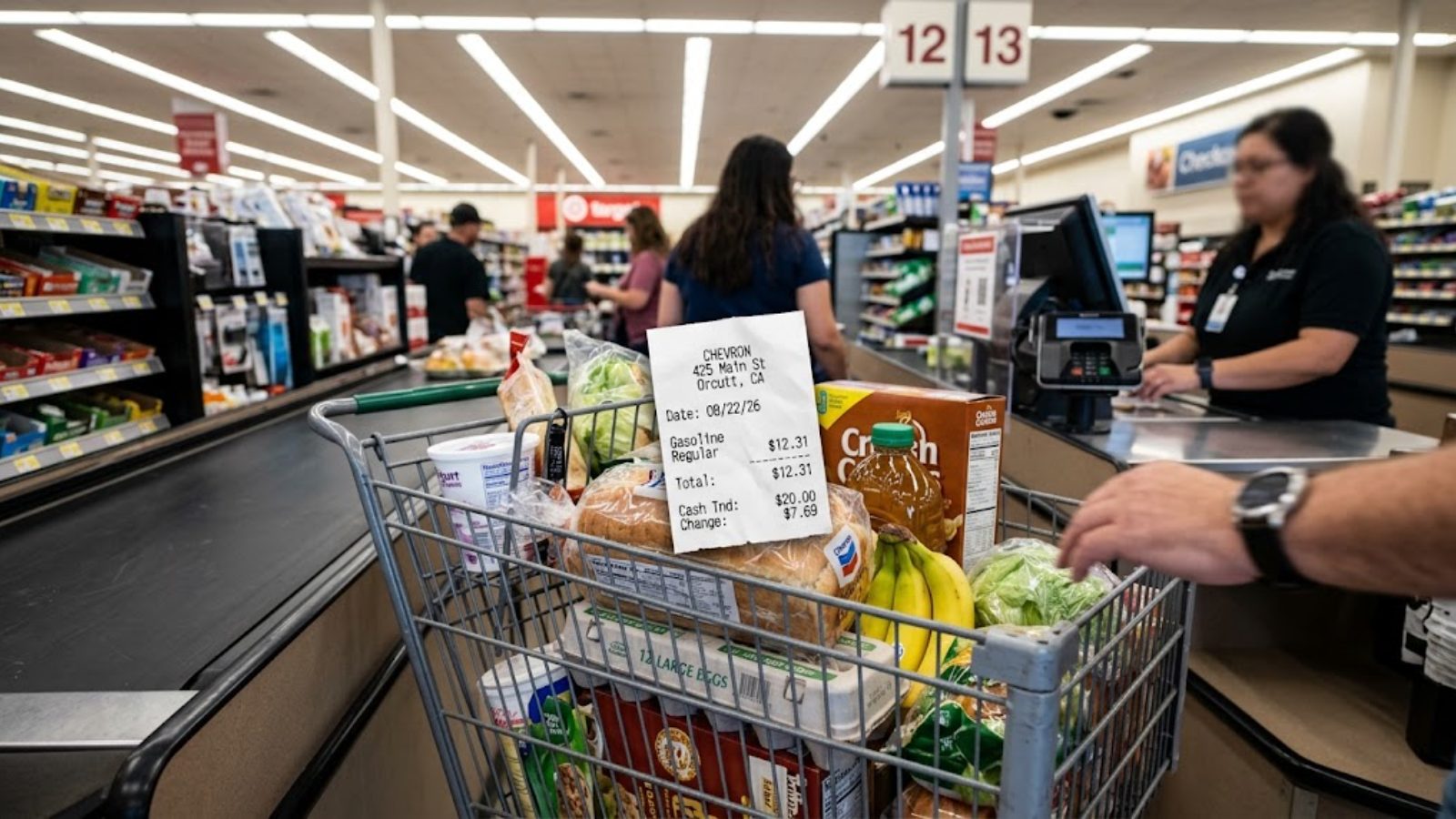
This is the number to carry around. According to Brown University’s Climate Solutions Lab, Americans have spent an estimated $88 billion more on gasoline and diesel in 2026 than they would have without the energy shock tied to the Iran war. Records the American Automobile Association (AAA) has kept since 2000 show nominal gas prices have never been this high this late in the year. And crude is climbing again — Brent rose 2.4% Thursday to $93.78.
Eighty-eight billion dollars is real money leaving other categories. It is not surprising that the store-level numbers at a big-box retailer softened. It would be surprising if they had not.
The detail that changes the story
Most of the coverage stopped at “consumer gloom.” Read one paragraph further and it gets more interesting. Walmart raised its full-year estimates partly because of gains from upper-income households. Meanwhile a Bank of America Institute analysis of customer card data found that discretionary spending by middle- and lower-income households jumped in July, while growth among the top 5% of earners dipped slightly after a long run — narrowing the gap between the two.
So: the wealthy are still shopping at Walmart, the middle is spending again on things it wants, and the whole thing is tilting away from physical stores. U.S. e-commerce sales at the company grew 24%. The in-store number is what shrank. That is a channel shift and a fuel tax, not a collapse.
| Signal this week | Reading | Direction |
|---|---|---|
| Walmart comparable sales | +2.6% | Slowest since 2020 |
| Walmart e-commerce | +24% | Where the growth went |
| Weekly jobless claims | 206,000 | Fell 6,000; no layoff wave |
| Leading Economic Index, July | +0.2% | First positive 6-month trend in 4 years |
| Philadelphia Fed manufacturing | 47.4 | Forecast was 25; employment index highest since 2022 |
Why the rest of the data matters
On the same Thursday, jobless claims fell to 206,000 — no layoff wave. The Conference Board’s Leading Economic Index rose in July and its six-month trend turned positive for the first time in four years. The Philadelphia Fed’s manufacturing survey came in at 47.4 against a forecast of 25, with its employment index at the highest since 2022.
One economist summarized the combination well: strong enough to avoid recession, not strong enough to push inflation higher. That is the setup that keeps the Federal Reserve on hold, and it is why equity investors have stayed calm even while the bond market has not.
For your plan
Two practical notes. If you are retired and your budget was built with a fuel line from 2024, it is under-counted by a lot; the fix is a ten-minute conversation, not a portfolio change. And if you hold consumer staples for their stability, this quarter is a reminder that “stable” describes the business, not the stock price — a 9% single-day move in Walmart is a thing that happens to staples too.
We hold Walmart in several of the model books and are not changing that. The company raised its full-year guidance on the same day the stock fell 9%. That combination has, historically, been a better friend to patient owners than to nervous ones.