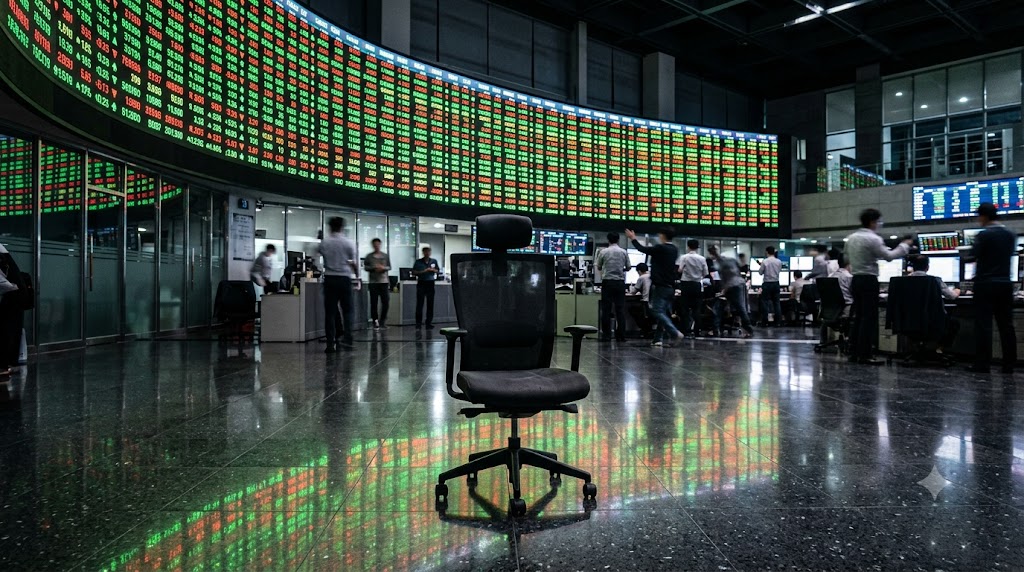

The two-and-twenty machine explained in plain English — the four strategies underneath it, the ten-year scoreboard nobody frames, and the two dials it sells that a transparent book already has.
What the exclusivity is guarding, and what ten public years said it was worth.
Left is the mystique. Right is the mechanism. Most of what a hedge fund sells is an exposure you can already hold in daylight.

Two And Twenty Is A Business Model, Not A Strategy
In 1949, a sociologist and financial journalist named Alfred Winslow Jones set up a private partnership with a then-novel idea: own the stocks he liked, sell short the stocks he did not, and let the shorts pay for the longs’ market risk. He called it a “hedged fund.” He also charged his partners 20% of the profits — a cut he justified by pointing to the ship captains of antiquity, who took a fifth of the cargo for bringing it through. Both inventions survived. The hedging is optional now. The fifth of the cargo is not.
Legally, a hedge fund is a private limited partnership. It isn’t registered like a mutual fund, it doesn’t publish daily holdings, and it isn’t open to the public: you generally must be an accredited investor (a $1 million net worth excluding your home, or roughly $200,000 of income), and the funds people have actually heard of typically require qualified purchaser status — $5 million of investments — before the paperwork begins. Your money is then subject to lockups and quarterly redemption windows, and in a bad year the fund can invoke a gate and decline to give it back on schedule. Thousands of investors discovered that clause for the first time in 2008, when funds that had marketed liquidity froze redemptions to avoid selling into the fall. The gate isn’t a scandal; it’s on page forty of the documents. The scandal is how few people had read page forty.
The industry that grew out of Jones’s partnership now manages more than $4 trillion, and the standard toll is still recognizably his: about 2% of assets every year regardless of results, plus about 20% of the profits when there are profits. The arithmetic of that toll compounds against the investor with a force that the marketing never quite conveys, so it’s worth doing once, slowly, with round numbers.
That’s the hurdle. For the wrapper to be worth it, the manager must beat what you could own in daylight by enough to cover a 2% annual drag, a fifth of the upside, the lockup, and the opacity — every year, for decades. Some managers have. The question a household should ask isn’t whether such managers exist. It’s whether the ones still accepting money are the ones who do.
The exclusivity isn’t guarding the returns. It’s generating the demand. Exclusivity is the one feature of a hedge fund that never has a bad year, and for a certain kind of investor it’s the feature actually being purchased — the dinner-party sentence, not the net-of-fee compounding. There’s no line item for the sentence, but you’ve now seen roughly what it costs.
We hold no grudge against the structure. For strategies that genuinely can’t run in a liquid wrapper — distressed debt, activist campaigns — the lockup is honest engineering. Our objection is narrower: paying a private toll for an exposure that trades publicly. Most of what’s sold on exclusivity now fails that test.

Under The Hood: Four Machines, Each Of Them A Dial
Strip away the mystique and the vast majority of hedge fund assets run one of four machines. None of them is secret. All of them are taught in business schools and replicated in public funds. What they have in common is the part the marketing skips: each one is a dial on market exposure, not a machine for producing extra return.
Long/short equity is Jones’s original: own what you believe in, short what you don’t, and run the difference. A fund that’s 100% long and 60% short has 40% net market exposure — it should fall less in a bad year and rise less in a good one. The product isn’t outperformance. The product is less market, plus whatever stock-picking skill survives the fees. In a decade when the index compounds at double digits, “less market” is a drag that looks like incompetence; in the other kind of decade it looks like genius. Same dial, different weather.
Merger arbitrage buys a company that has agreed to be acquired — at the small discount to the deal price the market leaves open — and collects that spread when the deal closes. It’s insurance-underwriting economics: many small probable wins, punctuated by an expensive loss when a deal breaks. The return has little to do with the stock market’s direction, which is the point; it’s a premium earned for carrying deal-break risk that other investors pay to shed.
Market neutral takes the dial to zero: long one stock, short a related one, in matched dollars, so the market’s move cancels out and only the gap between the two positions pays. Done at scale with hundreds of paired bets, it produces a return stream that ignores the index entirely — usually a modest one, which is why the wrapper adds leverage, and why the failures in this category tend to be spectacular rather than gradual.
Managed futures — trend is the strange one: a rules-based system that goes long whatever has been rising and short whatever has been falling, across hundreds of futures markets — grains, currencies, bonds, metals — with no opinion about any of them. It loses small amounts frequently in sideways markets and earns its keep in long, grinding dislocations. In 2022, when stocks and bonds fell together and the classic 60/40 portfolio had one of its worst years on record, the leading trend index finished up roughly 27%. That’s the honest case for the category: not a better engine, but a different weather pattern.
Notice what all four have in common. Long/short sells you less market. Merger arb and market neutral sell you no market. Trend sells you a different market. Nobody in the room is actually selling more return — and the sales material never quite puts it that way.
The strategies are real and the diversification math behind them is legitimate. But every one of them now exists in public form: long/short, merger arb, and trend all trade as public funds and ETFs at a fraction of two-and-twenty, with daily liquidity and published holdings. The wrapper premium once paid for a scarce skill. Today, for most of these categories, it pays for a mailing address.
The question we ask before any “alternative” is: which dial is this, and do we already own it? A strategy that reduces market exposure competes with our dividend book and with plain bonds. A strategy that adds directional conviction competes with our tactical sleeve. Named that way, most alternatives stop being exotic and start being comparable — and comparable is where they lose.

The Industry Was Graded In Public For Ten Years. Then We Checked Our Own Books.
In 2008, Warren Buffett bet $1 million — proceeds to charity — that a plain S&P 500 index fund would beat any collection of hedge funds a professional cared to assemble, over ten full years, net of fees. A firm called Protégé Partners took the bet and selected five funds-of-funds representing positions in roughly two hundred hedge funds. The decade that followed included the financial crisis, the recovery, and everything in between — exactly the mixed weather hedge funds are marketed for.
The result wasn’t close. The index fund returned 125.8%. The five funds-of-funds averaged about 36% — the best of them made roughly 88%, the worst under 3% — and not one of the five beat the index. Buffett’s post-mortem said the quiet part: the hedge fund managers’ performance wasn’t evidence of stupidity, it was evidence of arithmetic. Two layers of fees were being extracted from returns that were, before fees, unremarkable. The investors absorbed the shortfall; the managers were paid either way.
The standard rebuttal is that the great funds weren’t in the sample — and it’s true. The best-documented money machine in the industry’s history, Renaissance Technologies’ Medallion Fund, compounded at roughly 39% a year net for three decades, charging fees that make two-and-twenty look charitable. It could do this because it stayed small — and it stayed small by returning every outside investor’s money. For over twenty years Medallion has managed only its own employees’ capital. That’s the industry’s structural secret: genuine edge has limited capacity, and funds with genuine edge eventually stop selling it. The capacity that’s still for sale is, disproportionately, the capacity without the edge.
So what’s the honest residual case? Diversification — the dials from section two. A pension fund holding a trend allocation through 2022 wasn’t foolish. But for a private household, the dials no longer require the membership, and some of them were sitting in plain portfolios all along. Which brings us to ours.
The Midterm Dividend book — the fall flagship — runs at a measured beta of 0.39. That’s the “less market” a long/short fund charges two-and-twenty to manufacture, built instead from dividend payers with balance sheets we can read, in accounts with daily liquidity and no gate. The Aggressive Tactical book runs at a beta of 1.17 — the concentrated-conviction sleeve, the honest version of what the directional funds sell, with every position and every reason published to clients. Both books are on the fall positioning page with their stress numbers shown against a −16% index shock, because we’d rather show the dial than narrate the mystique.
Most households don’t need a hedge fund. They need the two dials a hedge fund sells — less market in one pocket, so a bad year doesn’t dictate your decisions, and more conviction in another pocket, sized so it can’t hurt the first one. That’s a portfolio-construction problem, and it’s solved in daylight: a defensive book, a tactical book, and a written reason for every holding.
If you hold an alternative fund today — or you’re being shown one at a dinner — the review question is one sentence: which dial is this, what does it cost, and what public version did the salesman not mention? Bring us the fact sheet. Grading products against their published results is, as regular readers know, something of a house habit.
Being shown an “alternative”? Bring the fact sheet.
Fifteen minutes is usually enough to name the dial, price the wrapper, and find the public version. No prep required, and nothing to bring but the pitch.