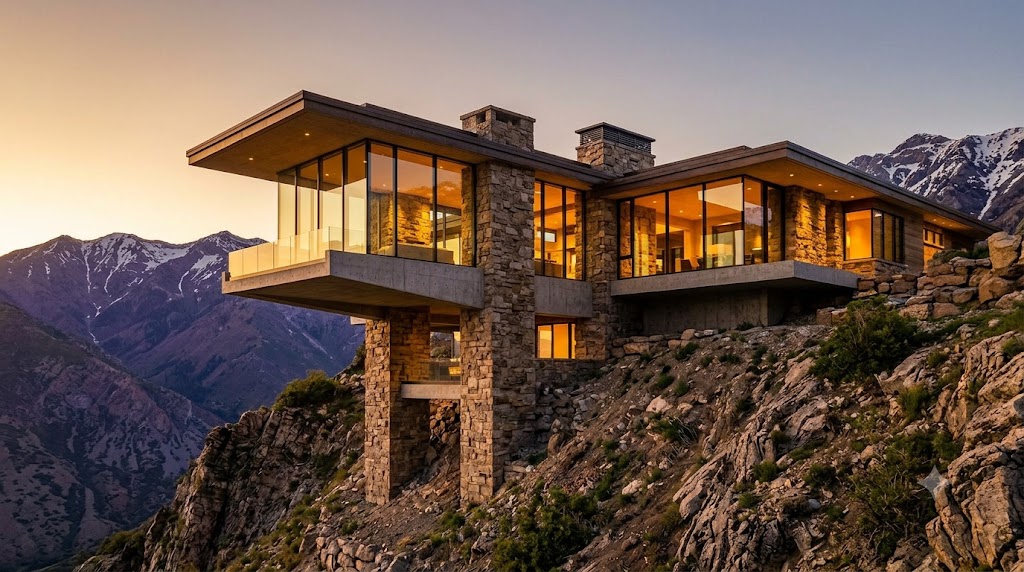
In 1959, an 11-year-old in California watched Cary Grant scale a spectacular Modernist house in Hitchcock’s “North by Northwest.” He promised himself he’d visit one day. There was a problem: the house didn’t exist.
The Vandamm House — Frank Lloyd Wright by way of a movie villain, perched absurdly atop Mount Rushmore — was a couple of soundstage rooms and some matte paintings. Hollywood built the dream in paint.
John Boccardo saw the film nearly a dozen times. He drew the house from memory in grade school. As an architecture student, he learned the crushing truth: there was nothing to visit.
So, decades later — career built, semiretired in Utah — he and his partner Derek Esplin built it themselves, above Park City.
The specs are gloriously absurd. Six bedrooms. A living room cantilevered 40 feet into thin air on 160-foot steel-reinforced concrete beams. An eighteen-seat theater. A heated gravel dog run for their three dogs.
“Many houses are built without stories,” Esplin says. “This house has a story.” He calls it his life’s work.
They moved in this February, spent four months making sure everything works, and listed it at $45 million. The broker expects full price. And the two of them are already back at the last dream house they built, in southern Utah, occasionally wondering whether they really want to sell this one.
What retirement is for
Strip away the price tag and this is the best retirement story in the paper this year.
A man “semiretired” at the height of his skills didn’t downshift into waiting. He took the thing he’d wanted since he was eleven and spent his seventies building it, with a partner who made the logistics his own life’s work.
The research and the annuity tables agree here: purpose predicts a good retirement better than the withdrawal rate does — that’s the percentage of savings you spend each year.
Dreams have line items
Now the other honest lesson: the dream had a budget.
Roughly $2 million bought the lot, which is now worth $7 to $10 million. Even dreams benefit from buying land early.
Over $1 million went to fire-hardening the house. Over $1 million more went into walnut cabinetry. A structural engineer was hired to make 40 feet of cantilever stand up in the sky.
Dreams that get built are dreams that got budgeted. The ones that stay foggy — “someday,” “eventually,” “when things settle down” — stay unbuilt.
Name your house
We ask every pre-retiree a version of Boccardo’s question: what’s your Vandamm House? The thing you’ve quietly promised yourself for decades?
A workshop. A year in Italy. A business. A boat. A grandchild’s wing of the house.
Then we do what Esplin did: turn it into financing, phases and line items.
A plan that only covers expenses keeps you alive. A plan that budgets the dream is the reason the discipline was worth it.
And here’s the quiet bonus: clients who name the dream stay invested through rough markets better than any risk quiz predicts. The portfolio stops being a number and becomes a house with a story.
Ask yourself what you promised the eleven-year-old. Then let’s budget it.