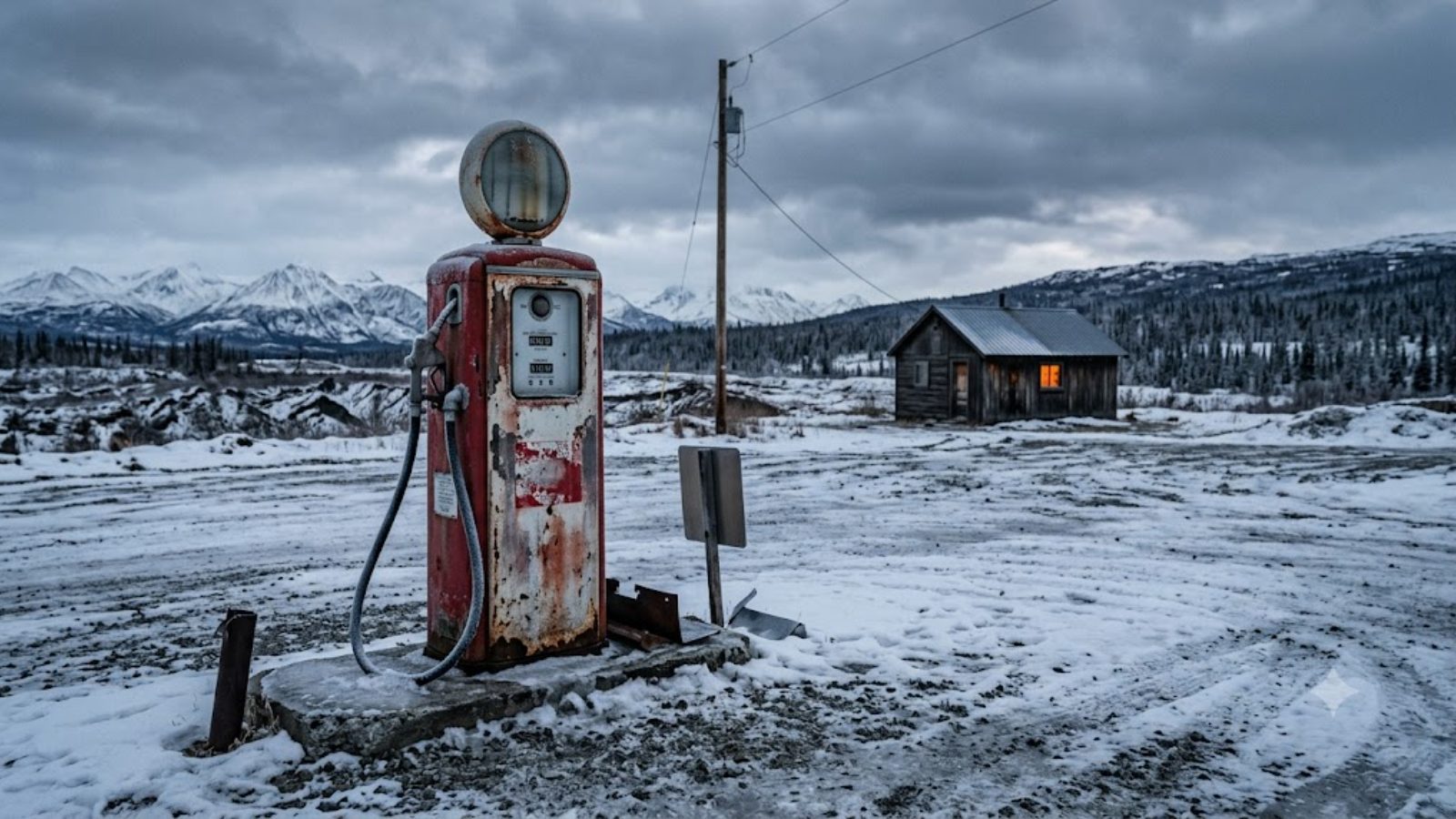
Dillingham, Alaska has about 2,000 people, three gas stations, and no road in. All three stations charge about $9 a gallon. The national average is $3.80.
The town off the average
Up the river in New Stuyahok, the local distributor sells fuel at $10. When the national number fell from its $4.56 May peak, Dillingham’s did not budge. Averages are where economists live. Retirees live in their own zip code.
The Journal introduced two people every advisor should think about. A 67-year-old retiree paid $1,000 a month to heat her house last winter — against a Social Security check of $1,483 a month. She is now weighing a return to part-time work.
An 84-year-old paid $600 a month for heat. He finally fired up the wood stove he bought eight years ago.
Even the town government is bracing. Dillingham budgeted an extra $166,015 in fiscal 2027 just for heat and vehicle fuel.
The oil irony
Here is the twist: Alaska’s oil business is booming while Dillingham freezes at $9. The Pikka project starts flowing 80,000 barrels a day later this year. ConocoPhillips’ roughly $9 billion Willow project starts in 2029, at up to 180,000 barrels a day.
March’s federal lease auction drew a record $164 million. S&P Global says state output could more than double to a million barrels a day, and Alaska expects $2.5 billion in petroleum revenue in 2035. Eligible Alaskans even collected a $1,000 oil-wealth dividend in 2025.
Oil wealth in the ground, $10 diesel in the tank — because pipelines and profits do not deliver to a town without a road. Nationally, WTI crude closed Monday at a perfectly ordinary $68.55.
Strip away the parka and this is the anatomy of the risk we write about constantly: a fixed check meeting a spiking, non-negotiable expense. She cannot skip heating an Alaskan winter. Heat alone ran 67% of her only paycheck.
The deficit has to come from somewhere. Back to work at 67. Burning wood at 84. Or, for a retiree with investments, selling at whatever price the market offers that month.
That last one is sequence-of-returns risk — being forced to sell at the wrong moment because an expense would not wait. It is not the average return that kills a retirement. It is the forced sale.
Your Dillingham test
You do not need a bush plane to meet this risk. A CalSTRS retiree faces the same arithmetic when the utility bill doubles or the insurance premium jumps 40%. In parts of California, gasoline reliably runs two dollars above the national average. The pension is the $1,483 check in this story.
So run the test. Budget your basket, not the CPI: list your five must-pay expenses — housing, heat and power, food, medicine, insurance — and shock each one by 50%.
Keep a cash sleeve: one to two years of essential spending in short Treasurys, still paying north of 4%. Then a price spike gets paid from cash, not from stocks sold in a downturn.
Own an energy hedge. If energy prices are your enemy at the pump, let them pay you dividends through the Capital Wealth Growth Portfolio’s energy sleeve.
And mind the fixed check. A Social Security COLA — the annual inflation raise — lags a local spike by a year or more. Claiming strategy is partly about making that check as large as possible before it has to fight alone.
The households that sail through never predicted the spike. Their plan just did not require predicting it. Inflation is personal. Plan for yours.