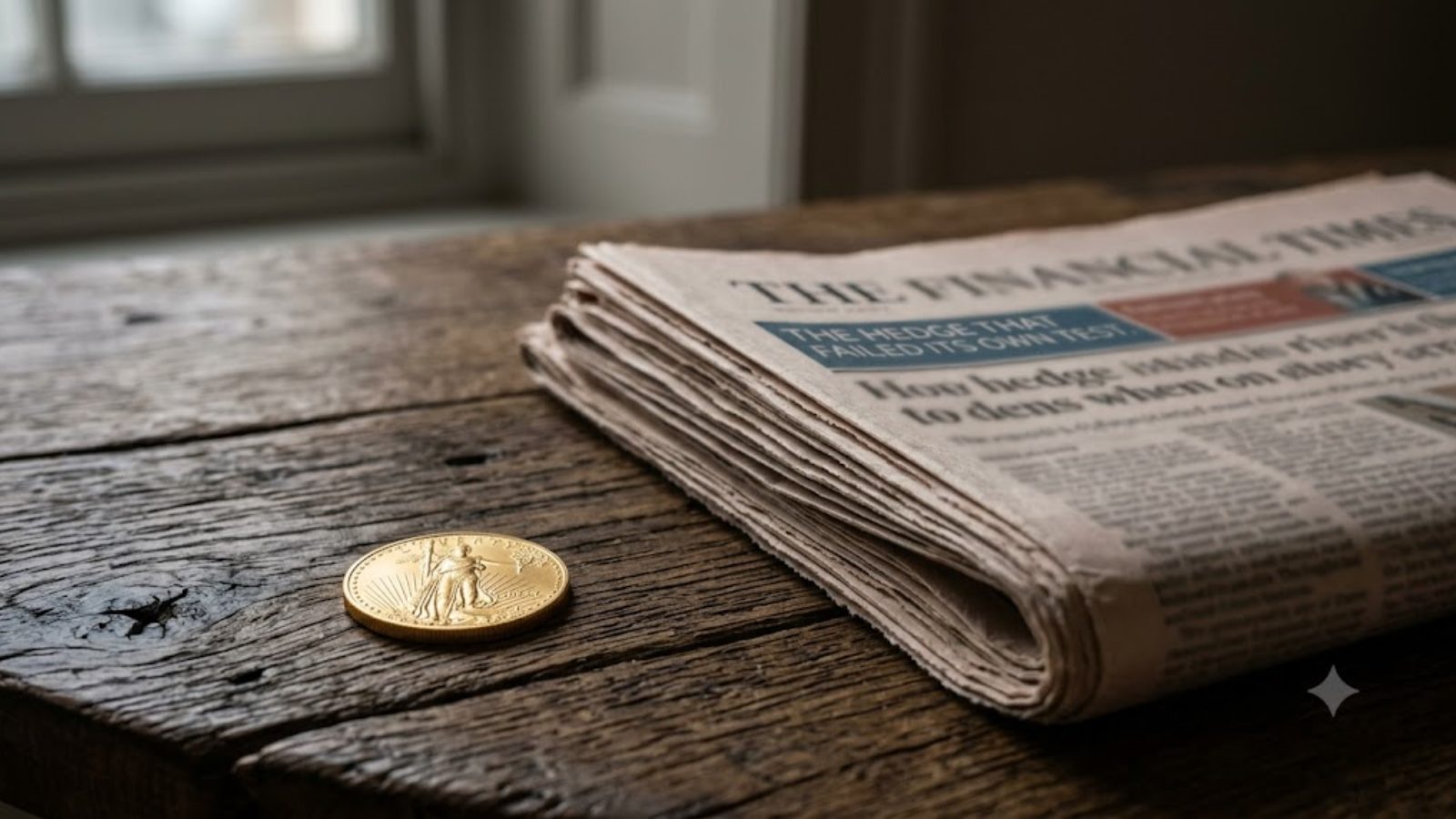
Gold is what people own so they never have to think about a weekend like this one. No earnings report. No dividend to cut. No board of directors. Just a metal that is supposed to rise when the world gets scary.
The world got scary. The U.S. and Iran traded fresh attacks over the weekend, and oil prices jumped. Gold fell anyway — 2.6% on Monday, to $3,997 a troy ounce.
That stings because gold is the classic haven — an investment you hold to feel safer when the news turns bad. A haven is supposed to work on exactly this kind of Monday. This one went the wrong way.
The damage runs deeper than one day. Gold is down about 25% from the record of $5,318 it set in January. GLD, the big gold fund, is down the same 25% from its January high. Silver is worse — down 49% from its $115 record.
Blame rates
The reason has less to do with the fighting than you would guess. Investors worry the war keeps energy prices up, energy keeps inflation up, and inflation stops the Federal Reserve from cutting rates. Fed officials broadly agreed at their June meeting that they would need to raise rates if inflation stays elevated this year.
Here is the mechanical part, and it is the whole story. Gold pays no interest. A two-year Treasury pays 4.261%. When safe, cash-like holdings pay that much, gold has to compete with them — and gold has nothing to pay you with.
Suki Cooper, head of commodities research at Standard Chartered Bank, put it plainly. This has “increased the opportunity cost of holding gold or the perceived opportunity cost of holding gold,” she said, “and that’s weighed on prices in the near term.” Opportunity cost — the return you give up by choosing one investment over another — is the fancy name for that math.
Aakash Doshi, head of gold strategy at State Street Investment Management, said Fed rate decisions will matter more for gold than daily geopolitical shifts. His read on a temporary break in a ceasefire: “It’s just day-to-day noise.”
Two calm owners
Two men in Tuesday’s paper own gold, and neither is doing anything about the drop.
Stu Bradley is 83, a retired financial adviser in Michigan. He did his selling earlier this year, when gold rallied above $5,000 and he doubted it could climb much higher. “It’s one of those things. You say, ’God, should I just keep all this money? It’s going so well.’ But then you say: ’No, I’ve seen this happen before,’” he said. He still keeps 10% of his portfolio in gold and silver, and he is sitting tight. “Gold’s fairly stable,” he said.
Richard Elias is 76, a retired financial adviser in St. Louis. He put around 3% of his portfolio into gold after the 2008 financial crisis and has not looked back, except to move some into physical coins. “To hold a gold coin in your hand is different from owning a proxy for it,” he said. On the drop: “The pullback doesn’t strike me as anything other than normal.”
A percentage, not a bet
Notice what neither man did. Neither guessed where gold goes next. One holds 10%, the other about 3%, and a bad Monday changed neither number.
That is the general principle, and it is ours rather than the Journal’s. A haven works best as a percentage you choose and rebalance back to — rebalancing means trimming what grew to refill what shrank. It works worst as a conviction you ride.
If you cannot say out loud what percentage of your money sits in gold, that is the thing to find out first. It has nothing to do with the news. Bring the statement to a review and we will work it out together.