Varun Sivaram runs Emerald AI, a startup whose software exists to keep data centers from straining the power grid — the good guy in this story, if the story has one. He was a few minutes into a Climate Week panel at New York's Javits Center when a man in the audience stood up and shouted “You are stealing resources from us!” Security dragged him out; other activists took turns interrupting until the session limped to a close. Yuliya Chernova's Monday report on the backlash to AI is full of moments like that — Silicon Valley, she writes, is used to “Twitter fights, not town-hall brawls” — and it matters to anyone whose money rides the build-out, which, if you own an index fund, is you.
The Montreal tech conference ALL IN, some 10,000 attendees, had its closing session interrupted and protests outside. A Gallup poll in partnership with Microsoft finds people in the U.S., Canada, the Netherlands and the U.K. the most worried about AI anywhere — about electricity costs and the environment, about jobs, about safety. Sophie Purdom of Planeteer Capital calls it “the smash-the-looms moment” and expects more of it over the coming year. Sivaram, whose company was valued at more than $1 billion in its Series A round this year, now calls event organizers in advance to ask about security.
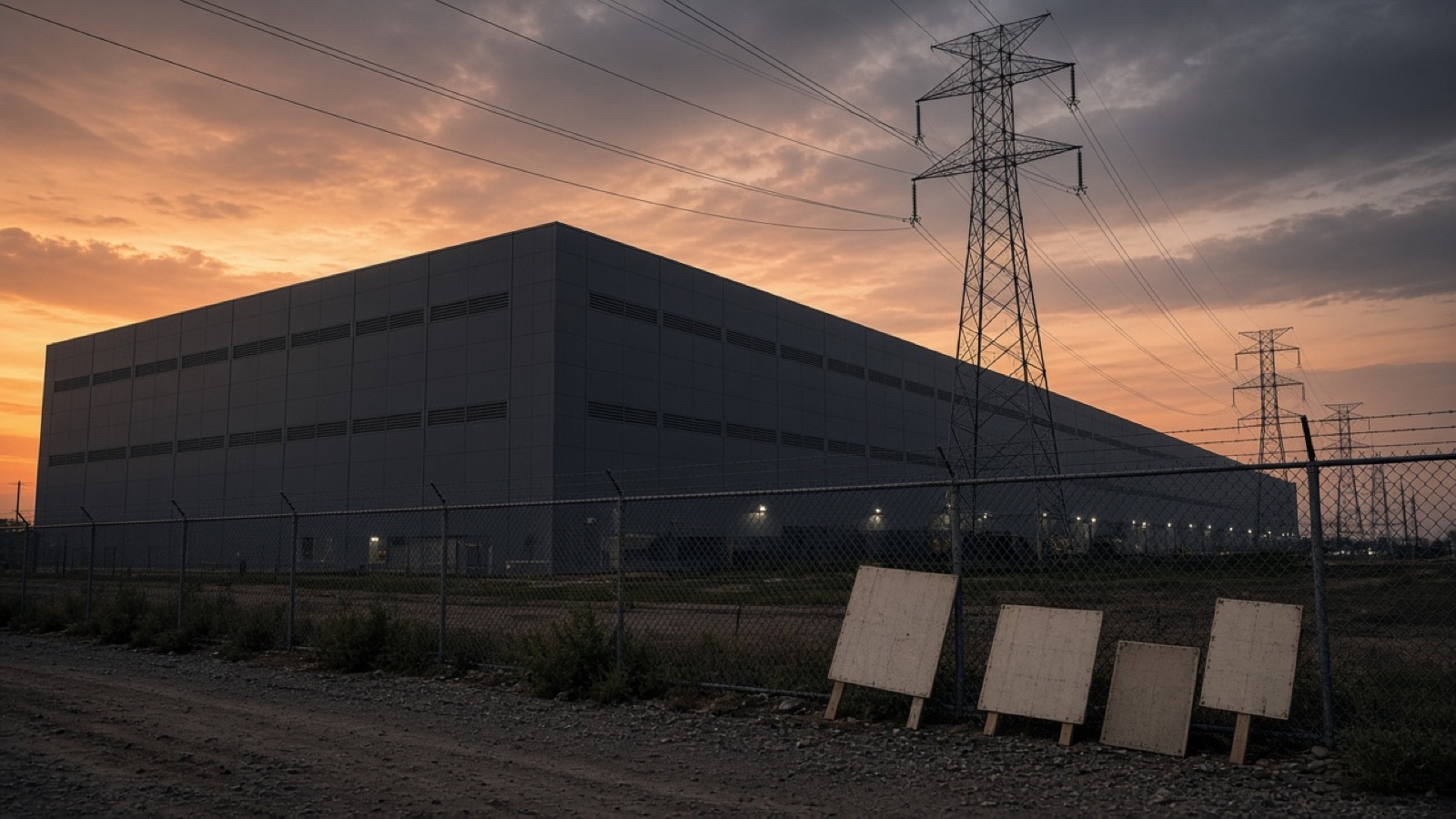
The money hasn't blinked. Brookings estimates as much as $10.3 trillion could go into AI infrastructure through 2032, and this week's papers carry the proof: Google's 20-year deal with Constellation Energy (CEG) to lift output at 11 reactors sent that stock up 12% on Tuesday. But the same papers carry the other side. Amazon (AMZN) walked away from a data-center campus beside Maryland's Calvert Cliffs nuclear plant last month after community opposition, settling for a power agreement instead. New York's governor has put a moratorium on building data centers in the state. And Tuesday's story on energy costs notes electricity prices up 3.8% in August from a year earlier against 3.4% for consumer prices overall — data centers get much of the blame, deserved or not, and a utility bill is the most political document in any household.
Political risk, priced by nobody
Venture capitalist Charlie O'Donnell's advice to the protesters is telling: don't bother the founders, who are built to keep going; pressure the politicians, who can actually slow things down. He means it as consolation. For an investor it's the risk statement. Permits, moratoriums, rate cases and the question of who pays for the new transmission line are now the binding constraints on the fastest-spending industry in history, and none of them shows up in a chip company's earnings model.
Our read
This is Investments/Risk (IN04), and it's about a kind of risk the books carry a lot of. Nvidia (NVDA, 31 books), Microsoft (MSFT, 29), Alphabet (GOOGL, 28), Meta (META, 20), Amazon (AMZN, 19), GE Vernova (GEV, 30), Vertiv (VRT, 20), Constellation (CEG, 9) and NextEra (NEE, 21) are all, one way or another, long the build-out. They're held at weight; nothing is added this edition. What the backlash changes isn't the thesis — the spending is still happening — it's the tail. A state that says no to data centers, or a rate case that makes the hyperscalers pay for the grid, is now a scenario with real probability rather than a thought experiment.
The practical response isn't to sell the future. It's to size it. If your tech and power lines have grown past the weights you chose because the stocks ran, the market has made a decision for you, and the review is where you take it back. Know what fraction of your money rides one idea, and decide that number when it's quiet — not at the first heckle, and not at the first drop.