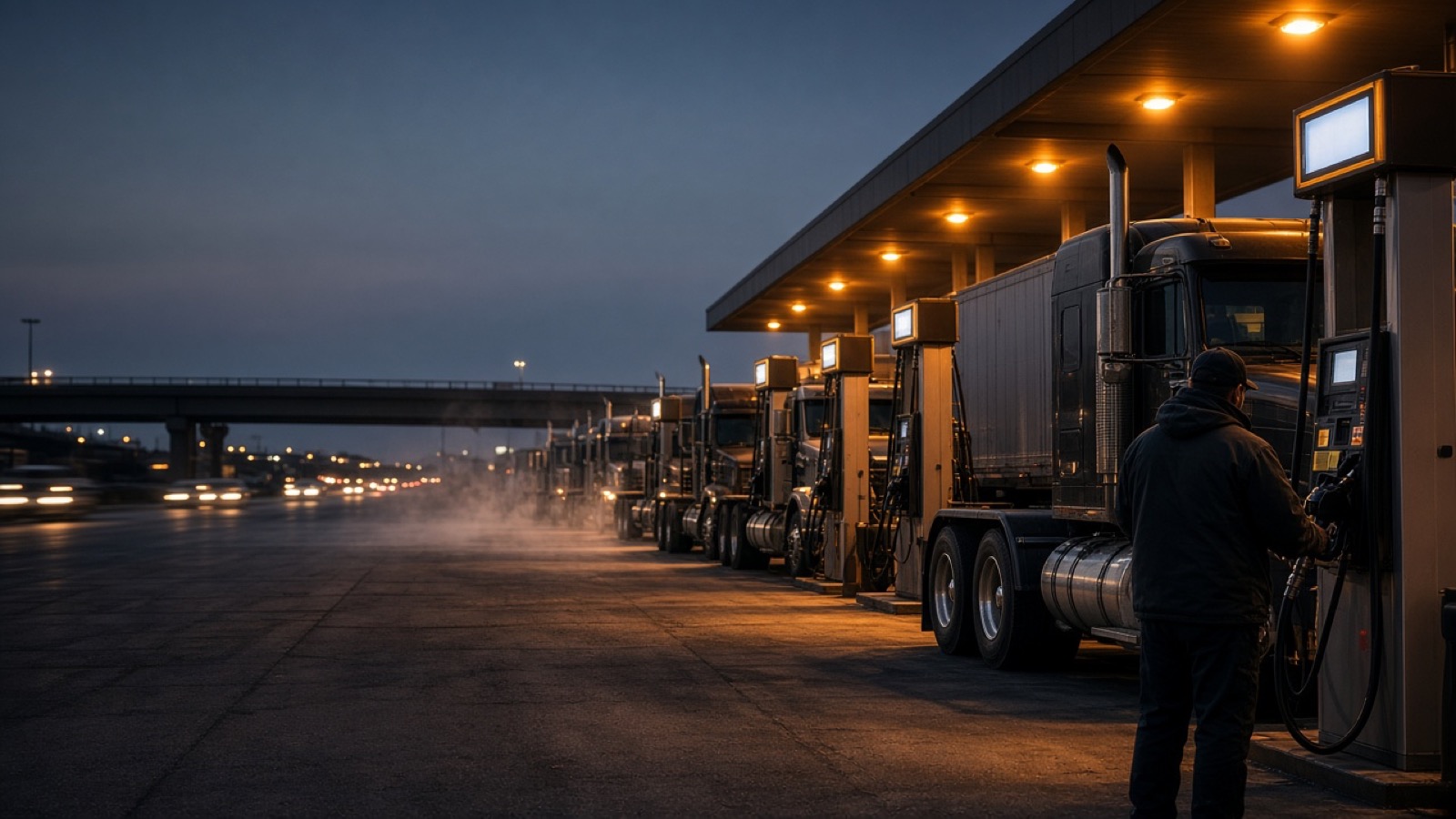
The pump screen at the Flying J off Interstate 10 in Orange, Texas, read $944.44 when Agron Berani finished filling his 18-wheeler — 151 gallons — and he groaned at it. A year earlier, the Journal’s Rachel Wolfe notes, that tank would have cost roughly $500 in Texas. He put it on a credit card already carrying about $8,000; the steel and electrical supplies bound for Beaumont weren’t going to deliver themselves. “I can’t sell the truck,” said Berani, 56, of Yonkers, N.Y., and asked what he’d do without it. That’s the whole story of being self-employed with one big, thirsty asset.
Diesel’s national average recently hit a record $6.53 a gallon, up nearly $3 from a year ago; at the Flying J on Thursday it hovered around $6.26. A floated diesel export ban seemed to fade Friday after the G-7 agreed to release 100 million barrels from emergency stocks, but the truck stop had already absorbed the hit. Twelve fuel lanes busy, concourse near-empty, the 14 showers mostly idle — a parked truck earns nothing, so nobody lingers. The economizing is grim: meals cooked in the cab, nights spent wherever the trailer was dropped to dodge parking fees, a rainstorm standing in for the $100 wash. Some have parked for good; more than a dozen small carriers filed for bankruptcy in the past month, and the owner-operators’ association warns more are coming if fuel doesn’t ease.
Gross is not income
Kevin Smith, 50, was hauling 37,000 pounds of potatoes to a Walmart (WMT) distribution center in Louisiana for a flat $4,600. The round trip from Lake Charles to Colorado and back burned more than $2,500 of fuel. Behind that sit $1,800 a month on the truck loan and $1,300 a month in insurance — more than three grand before a drop of diesel. “If my wheels ain’t turning, I ain’t earning,” he said. Spot-market operators pay fuel up front and get reimbursed later; surcharges protect bigger fleets, but small carriers lack the leverage to demand full protection, so thin reserves front thousands while they wait. Amandeep Singh, 51, who’s driven almost 23 years, has watched mechanic rates climb to $175 an hour from around $55 and parts prices double; a minor repair ran $707.67, paid by Zelle to dodge a 3.5% card fee. His arithmetic: $200,000 of gross revenue a year becomes about $45,000 of take-home pay.
Then there’s Delano Hunt, 38, one week into the job, hauling GMC panels from Detroit to Baton Rouge in a company rental with the fuel covered, cheerfully collecting loyalty points toward free showers after 1,000 gallons. “Trucks run the world,” he said. He isn’t wrong, and he isn’t paying for the diesel. The gap between his mood and Singh’s is the gap between an employee and an owner-operator.
Our read
This is Cash Flow · M5 with a Career footnote, and it applies to anyone who bills for their work — contractor, consultant, anyone with a truck or a van. Three rules fall out of the Flying J. First, gross isn’t income: Singh keeps less than a quarter of what he invoices, and a plan built on the $200,000 figure is built on sand. Second, fixed costs run whether or not the wheels turn, so the reserve has to cover the loan, the insurance and the fuel float — the gap between paying a cost and getting paid for it. Third, a credit card is the most expensive working capital there is; Berani’s $8,000 balance is what happens when the reserve was never built.
A note on the names: the Flying J is part of Pilot, which belongs to Berkshire Hathaway (BRK.B) — held in 22 books — and Walmart is held in 12; both at weight, nothing added, and neither is the point. The point is that the calm trucker is the one whose fuel is somebody else’s problem. If you’re self-employed, that somebody has to be a reserve you funded before the price spiked. You don’t build the levee while the water’s rising.