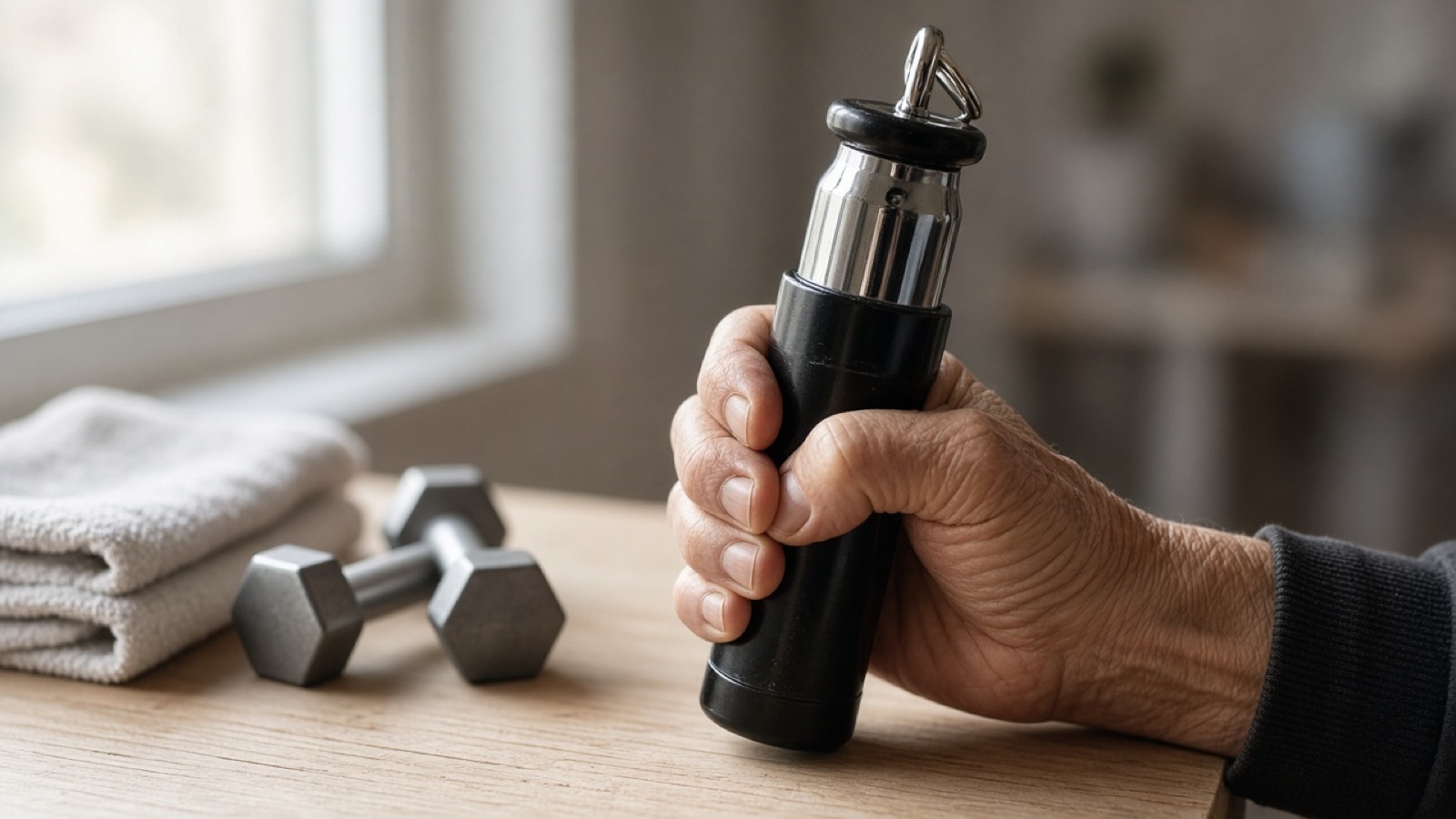
Your cardiologist probably hasn’t asked about your forearm. Sumathi Reddy’s Your Health column on Tuesday suggests that may change. A grip-strength reading — a few seconds of squeezing a hand-held gauge — is turning into one of medicine’s favorite cheap biomarkers, associated in study after study with heart disease, diabetes, stroke, dementia and how long you’re likely to live. Dr. Michael Fredericson of Stanford’s Center for Longevity puts it plainly: “It’s like another vital sign for us.” And the instrument costs less than the dinner out you’d skip to buy it.
The device is a handgrip dynamometer. Squeeze as hard as you can for a few seconds, repeat two or three times per hand, and the gauge’s best reading, in kilograms, is your score. A consumer model costs under $100; the clinical-grade instruments go for several hundred. For context, studies put a 50-year-old man’s median at about 48 kilograms (100 pounds) and a 50-year-old woman’s at about 29 kilograms (64 pounds), with plenty of variation by age, sex and body size.
Here’s the part that matters. The number isn’t there to crown the strong; it’s there to find the weak. Mark Peterson, a University of Michigan professor of physical medicine and rehabilitation, told the Journal that nobody cares about forearm muscles as such — a weak grip tracks weakness everywhere, and whole-body weakness is the on-ramp to frailty. He calls it a better predictor of cardiovascular disease than blood pressure and has been urging geriatricians to make it routine. Columbia’s Dr. Linda Fried, who directs the Robert Butler Columbia Aging Center, draws the line from a poor grip to falls, lost mobility and trouble with everyday activities. Muscle mass starts slipping naturally in our 50s and 60s; the clinical word for the progressive version is sarcopenia.
Build the reserve before you need it
The prescription is not to squeeze a tennis ball. Ryan McGrath of North Dakota State says that won’t move your overall strength, and Fredericson adds that a stronger grip in isolation won’t buy you years. The idea is a buffer of whole-body strength — dumbbells, squats — so that when an injury or hospital stay drains you, you don’t fall to the level where sarcopenia sets in. Lose that reserve, Fredericson says, and things go downhill fast.
Our read
This is Health Costs, with a Retirement (M10) tail. Frailty isn’t just a medical state; it’s the gateway to the most expensive line in a late-life budget — the hands-on help, the move to assisted living, the long-term-care spending most plans either ignore or wave at with a hoped-for inheritance. The doctors in Reddy’s column are describing a functional reserve: capacity above the line of need, built in good years so a bad year doesn’t push you under. We’d use exactly those words about money. A retiree with margin — a short-term bucket kept out of the stock market, a care-funding plan written before anyone needs it — absorbs a hospital stay the way a strong 65-year-old absorbs a stumble.
So treat the two reserves as one project. Spend the $100 if your doctor won’t; a low reading is early information, and early information is cheap to act on. Then look at the plan the same way: what happens to the budget if one of you needs help at home for a few years? Where does that money come from, and is it already doing another job? Nothing to buy here. But a weak grip and an unfunded care plan are both best found while there’s still time to train — the roof is easiest to fix in the dry season.