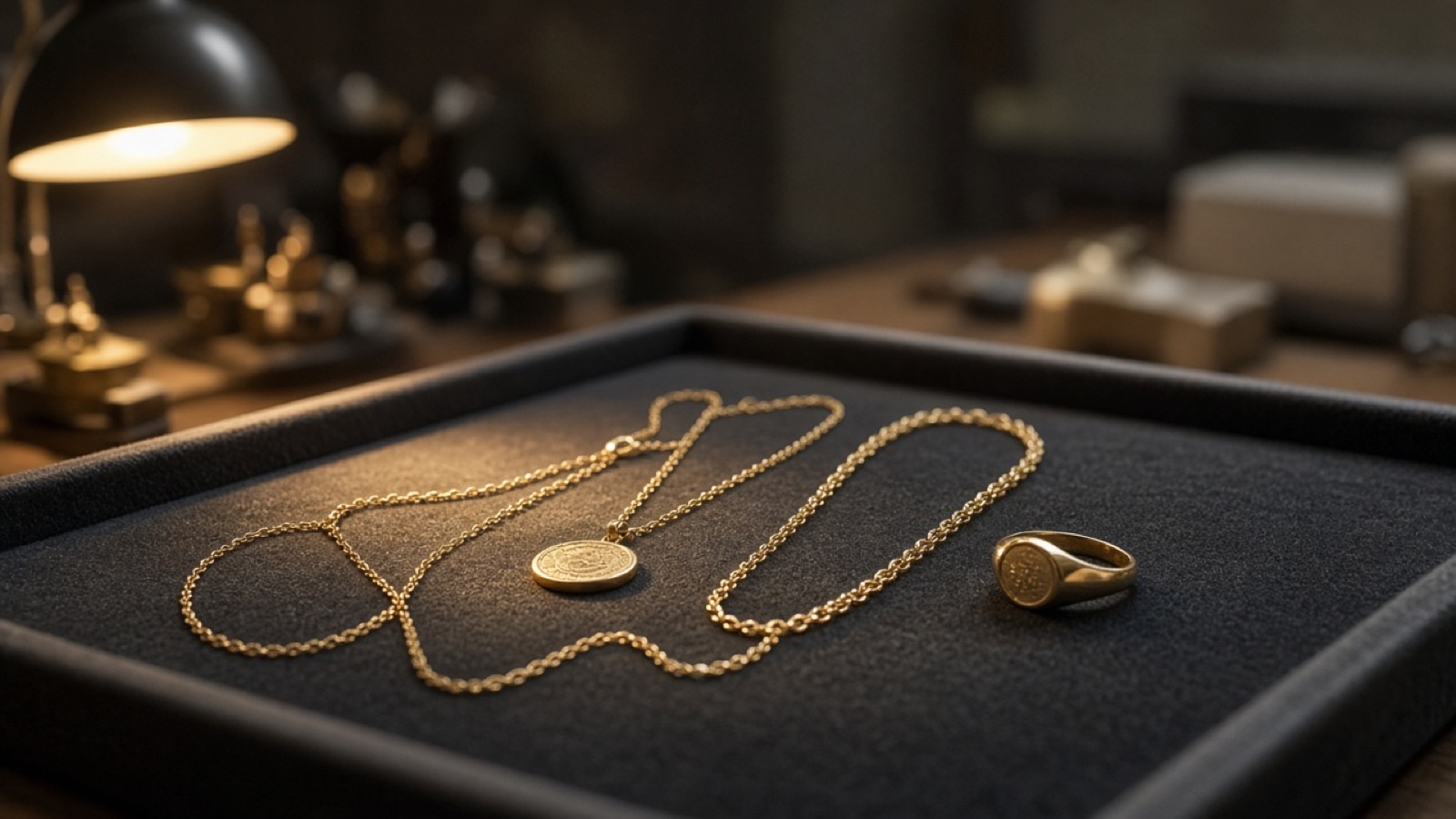
Somewhere a young woman is layering three thin gold chains she bought online, and she has no idea she’s running a commodity book. Mejuri, the Toronto jeweler that sold them to her — the brand Taylor Swift wears — spent the past year learning what that feels like. The margins were already pinched with gold at $3,000 a troy ounce. Then came $4,000. Then $5,000. David Uberti’s story in Tuesday’s Journal has chief executive Noura Sakkijha putting it plainly: “It would kill a business if you don’t act very quickly.”
So Mejuri acted. Cheaper inputs came first — 10-karat gold, vermeil plating, silver and, for a house built on gold, stainless steel. It rerouted a supply chain that moves tens of thousands of ounces a year, slowed expansion of its roughly 60 stores, and, after Washington ended the tariff exemption for goods under $800, stopped routing U.S. orders through Canada in favor of a fulfillment center in Ohio. Prices still went up. About 55% of monthly revenue comes from repeat buyers, and most of them stayed. One TikToker with a quarter-million followers didn’t go quietly, rating a 14-karat necklace’s new price “DIABOLICAL.”
The stable asset that wasn’t
Here’s the line we’d circle. In the half-century before 2025, gold futures moved by $100 or more in a single day on exactly three occasions. In 2026 alone they’ve done it 42 times. That isn’t how a store of value is supposed to behave, and the people who notice first aren’t traders — they’re the ones who have to buy the metal to make something. Mejuri’s planners now run a case that would’ve sounded absurd two years ago — another near-doubling, to $8,000 an ounce. Co-founder Majed Masad calls it a wake-up call and won’t cut prices on dips he doesn’t trust. “Value doesn’t equal price,” he says.
The dip is real, for now. Gold settled Tuesday at $4,159.20 an ounce, up 0.75% on the day but down 3.85% for the year and about a fifth below its 52-week high of $5,318.40 (Monday’s paper, carrying Friday’s close, had it off 4.44%). The wedding ring didn’t get cheaper, though — Masad’s whole point is that a jeweler can’t chase the metal down and back up every week, and neither should you.
Our read
This is an Investments/Risk (IN04) story wearing a necklace. Gold earns its spot in the books as insurance — the sleeve that’s supposed to do its own thing when the rest of the portfolio moves in lockstep. But insurance that moves by triple digits on 42 days a year is insurance with a deductible, and the deductible is volatility. IAU, the books’ gold sleeve, is held in 46 books, at weight; nothing is being added here, and nothing is being sold because a jeweler is nervous. The size of the sleeve was set for a reason, and this year is the reason.
The planning move is Mejuri’s, scaled down: substitution and patience. If the gold line on your statement has grown past the weight you chose for it, that’s a rebalancing question, not a conviction question. If you’re buying the metal as a thing — a ring, a graduation gift — 10-karat and vermeil are the consumer’s version of the same discipline, and there’s no shame in it. And if the year’s swings have you wondering what the sleeve is for, that’s a conversation for before the next triple-digit day, not during it. The umbrella gets checked on a dry afternoon.