Karl Deisseroth was drifting off to sleep around 12:30 a.m. Monday when his phone rang, and for about 30 seconds the Stanford neuroscientist couldn’t form words. The Nobel committee, he said, was courteous and gave him a moment. A day later the physics committee called Francis Halzen, a Belgian particle physicist at the University of Wisconsin-Madison, about a telescope he first proposed burying more than a mile under the South Pole in 1988. It was finished in 2011. The Journal covered both prizes this week — Betsy McKay and Gareth Vipers on medicine Tuesday, Ginger Adams Otis on physics Wednesday — and read together they’re a short course in a subject this desk cares about more than neutrinos: how long a good idea takes to pay.
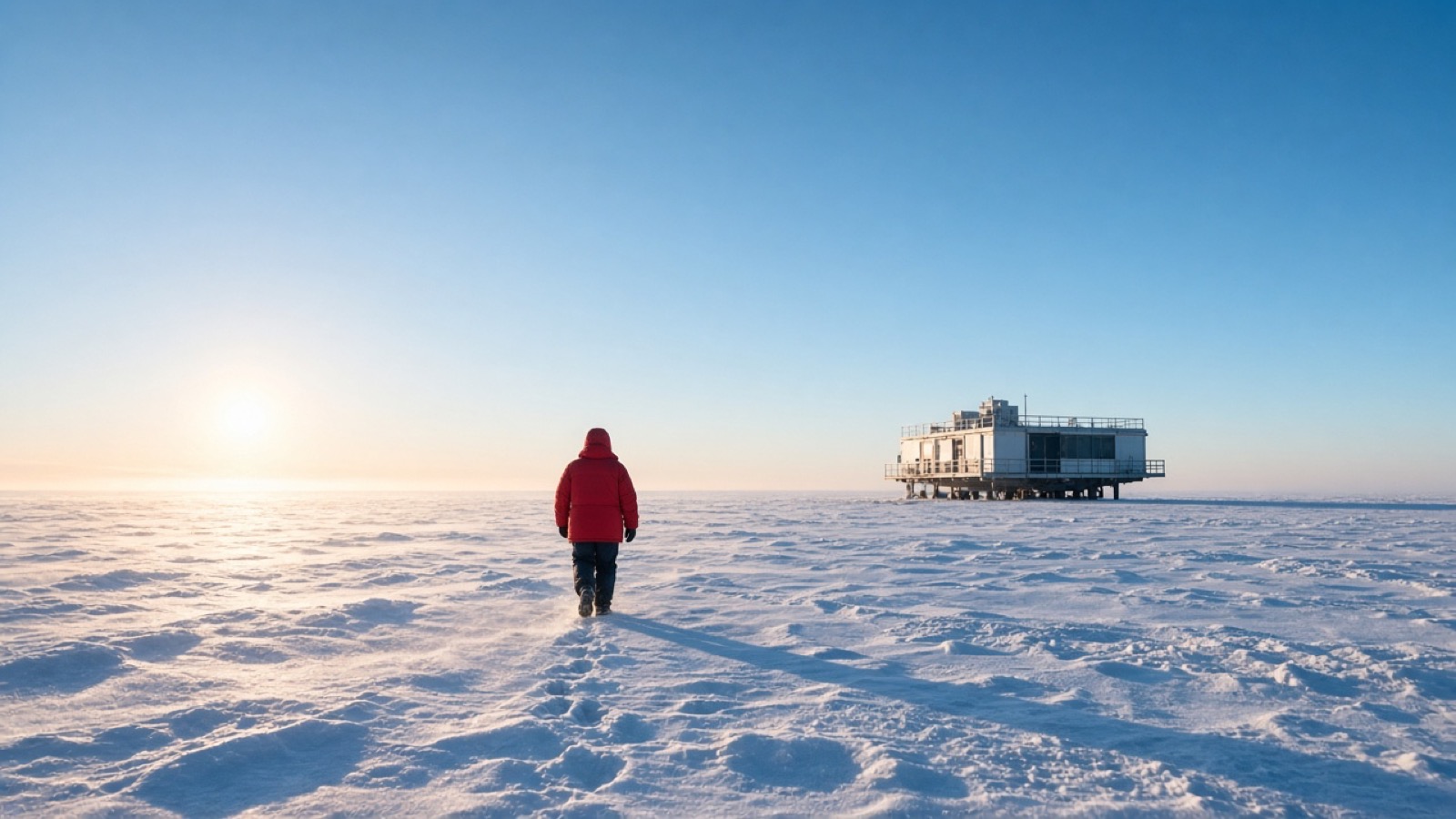
IceCube is as strange as it sounds. Neutrinos are tiny, electrically neutral particles that cross the universe without bending or losing energy, which makes them a clean messenger from distant galaxies — and nearly impossible to catch. When one hits an atomic nucleus it throws off a flash of light, so Halzen’s answer was a cubic kilometer of clear glacial ice at the Amundsen-Scott South Pole Station, sensors buried about 1.24 miles down, where nothing interferes with the signal and the ground never shakes. The committee’s chairman, Mark Pearce, called it “a fantastic instrument” and credited Halzen’s “tenacity and scientific vision.” Tenacity is the word. Twenty-three years passed between the pitch and the finished detector, and 38 between the pitch and the prize.
The medicine prize ran the same arc on a different clock. Deisseroth shares it with Peter Hegemann of Humboldt University and Georg Nagel of the University of Würzburg, and the whole field began with Hegemann’s curiosity about why a single-celled green alga swims toward light. In the early 2000s he and Nagel found the protein responsible, channelrhodopsin, which blue light opens like a switch. In 2005 Deisseroth put its gene into rat nerve cells and fired them with light; two years later it worked in the brains of living mice. In 2021 came the first partial restoration of sight in a person with retinitis pigmentosa. Trials in autism and schizophrenia are under way, with Parkinson’s and depression behind them. From a pond organism to a human eye: two decades, no shortcuts.
Patience is a plan, not a mood
Note what neither laureate did. Halzen didn’t bury a cubic kilometer of sensors on faith; the Journal records that preliminary tests on a few sensors in the ice came just a few years after the 1988 pitch, and the full build followed the evidence. Deisseroth moved from a dish of rat cells to a living mouse before anyone talked about patients. The patience was real, but it was staged — test small, confirm, then commit — and the idea underneath never changed.
Our read
This is a Behavioral piece with a Time Value of Money (M3) spine. A retirement account is an IceCube: for the first several years it detects nothing you’d call a result, the contributions look like money disappearing into ice, and the payoff is set by a decision you made decades earlier and then declined to unmake. The savers who get the Nobel-shaped outcome are the ones who treat a 23-year build as the plan rather than an ordeal — and who, like Halzen, keep testing the small things (the savings rate, the allocation, the fee line) without rebuilding the detector every winter.
The house books are held at weight this edition and nothing is added; the reserve buys on its published dates and drawdowns, not on prize announcements. If your plan was pitched in a different decade — a 401(k) set up at a first job, a target date chosen once — it deserves the review IceCube got from its test sensors: a few checks, early, so the full build is sound. You don’t dig the hole after the flash of light has passed.