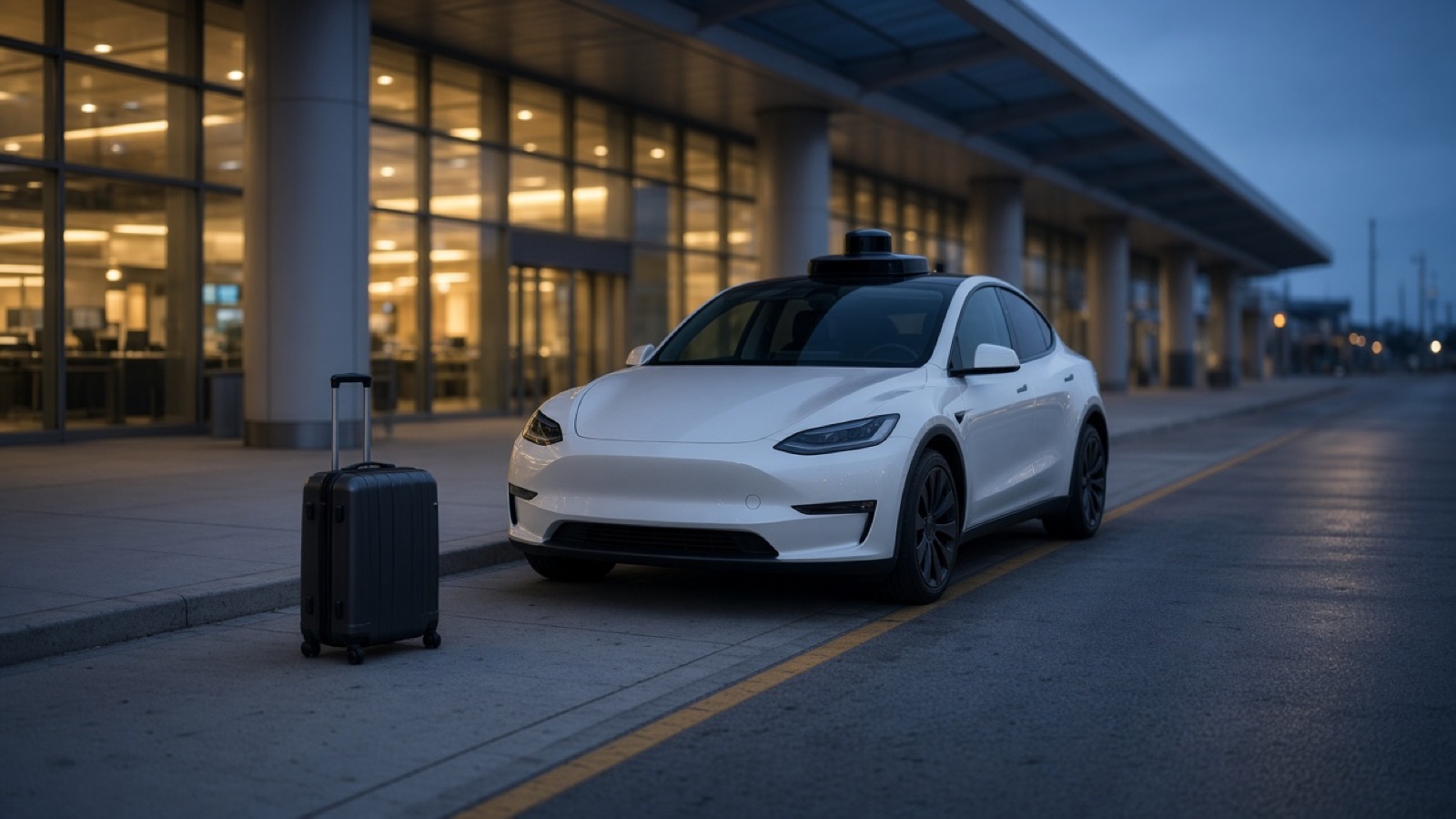
A pre-dawn rideshare to the airport comes with its own anxieties: the driver who never accepts, the one who cancels, the back seat that smells like last night. None of it happened to Dawn Gilbertson on her 5:30 a.m. ride to Phoenix Sky Harbor in late September, because nobody was driving. What did happen, she writes in Wednesday’s Carry On column, is that the Waymo — Alphabet’s (GOOGL) robotaxi, a driverless Jaguar — met her in a golf-course parking lot a three-minute walk from her condo, then took more than 30 minutes longer than normal getting there. That’s the robotaxi deal in one ride: it fixes what you hate about the human and bills you in minutes.
The money is real, sometimes. For a midweek afternoon trip from the airport to her house, Waymo charged $25.21 against $41.99 for the comfort tier at Lyft (LYFT) and $63.99 at Uber Technologies (UBER) — well under half the Uber fare, before you count the tip she’d normally add and the robot doesn’t ask for. But pricing is dynamic: on a Saturday afternoon from a Scottsdale resort, Uber and Lyft were significantly cheaper. Sky Harbor was the first U.S. airport to allow robotaxi rides, in late 2022; Waymo has since added San Jose, San Francisco and San Antonio, has five more airports in final testing and says it’s negotiating with dozens. Amazon’s (AMZN) Zoox just started at the Las Vegas airport. Tesla (TSLA) is eyeing San Francisco.
The bill comes in minutes
Then there’s the route. Her two rides home from the airport each ran 48 minutes — twice what the 15-mile freeway trip normally takes — because the car skipped the freeway it’s cleared to use, headed south before it headed north, U-turned by an industrial park and toured a few neighborhoods. Add a 15-minute pickup wait after one business trip and she texted her daughter she’d be over an hour. Home pickups were their own comedy: the app kept assigning a different address no matter how many times she entered hers, and she’s been dropped on the correct side of her street once. Her daughter’s reply — “Obviously don’t take that” — is the only skeptic in the column, and Gilbertson ignored her.
She’d do it again. The cars were new, spacious and quiet, the driving cautious enough that a self-described skittish passenger found it restful; the only glitch was a slightly ajar door that made the car think something was wrong. The airport zones were easy, right beside Lyft and Uber. San Francisco’s are a hassle — rental-car center or airport hotel, then the train — of the kind that eases as a service matures.
Our read
Cash Flow (M5) first, because the fare table is a planning tool. On a dynamic-priced ride the cheapest option changes by the hour and the day, so the habit that saves money is checking three apps, not loyalty to one. For a traveler with time — and retirees often have exactly that — a $25.21 ride that takes 48 minutes is a good trade; for someone with a 7 a.m. gate and a connection, it isn’t. Price your time honestly and the choice makes itself.
Investments (IN04): the column is also a field report on three theses we hear about constantly. Alphabet (GOOGL) is the one actually carrying passengers to airports in four cities — held at weight here in 28 of our 81 model books; nothing added. Tesla (TSLA), held in 13 books, is still at the eyeing stage in this story, and Amazon’s (AMZN) Zoox, held in 19, just opened in Las Vegas. Uber (UBER) and Lyft (LYFT) aren’t owned here; one rider’s receipts aren’t a verdict on their airport business, but a ride that undercuts their comfort tier by half and skips the tip is the competitive question in miniature. The desk watches the rollout city by city and buys nothing on a column. Worth confirming your own weights haven’t drifted while the robots were touring Phoenix.