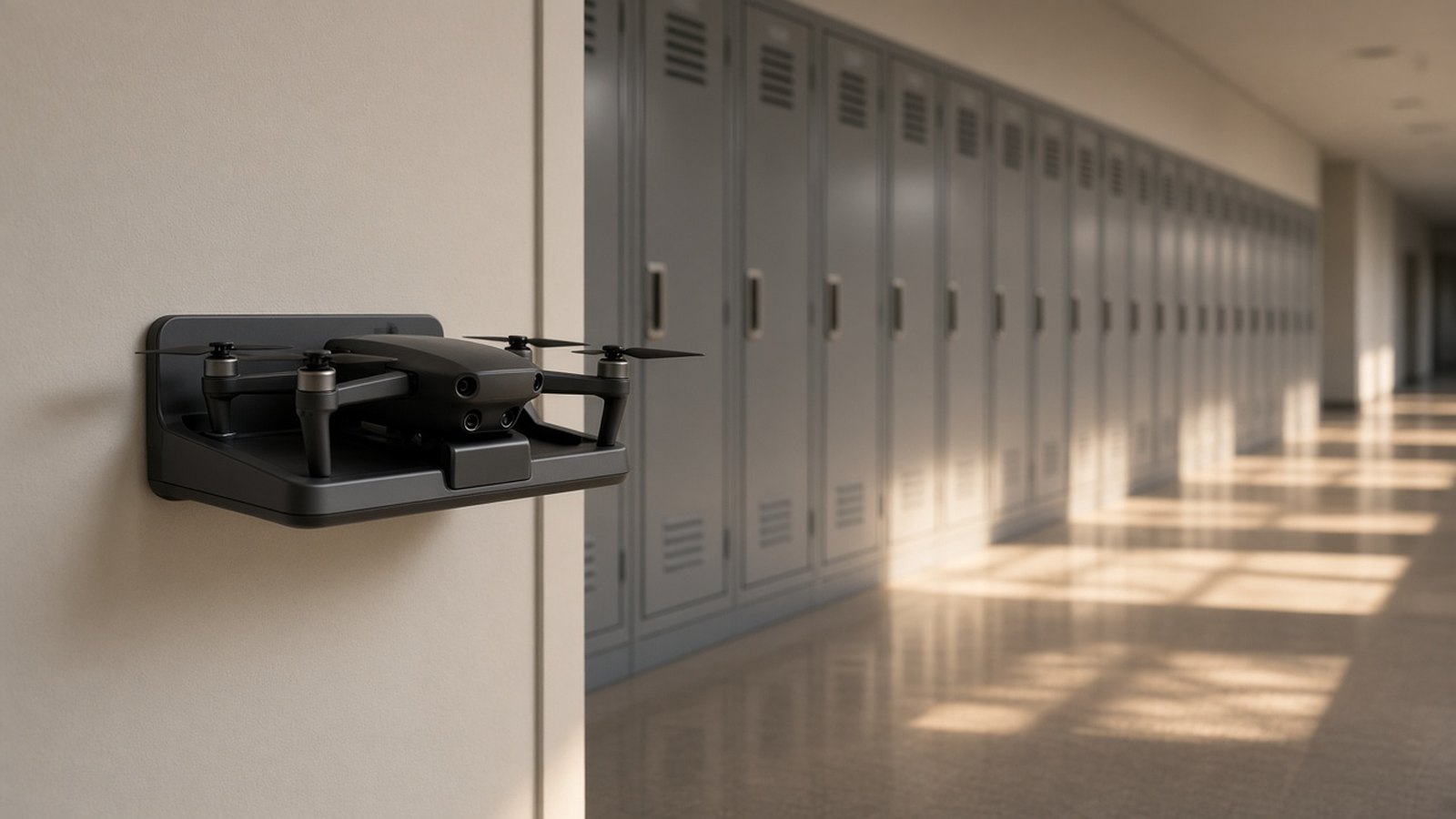
Deltona High in Florida Installed Security Drones. The Maker's Own Figures Add Up to About 80 Seconds to Stop an Attacker.
Deltona High School in Florida added remotely piloted drones this fall, built to stop an armed attacker. The company's own figures add up to about 80 seconds. The planning point is the gap before help arrives, and what covers it.
By Sean Anees Saifi · Capital Wealth · Published Sunday, October 11, 2026 · Source: The Wall Street Journal, October 10–11, 2026 weekend edition, whose market figures are the Friday, October 9 close (Opinion)
Key Points
Deltona High School in Deltona, Florida, installed security drones this fall. School officials say it's the first school in the nation to do so. Kate Farmer of the Journal's editorial page watched a demonstration.
The system is Campus Guardian Angel, from Mithril Defense. Pilots in Austin, Texas, fly the drones by hand, using the school's cameras and 3-D maps. A teacher or guard calls them with a button on a lanyard or an app.
The company's figures are 5 seconds to unlock the drones, 15 to reach an attacker and 60 to subdue him. Add them up and you get about 80 seconds. That sum is ours. FBI data put the usual wait for police at three to five minutes.
The drones can fly at 60 miles an hour, break a window and fire a pepper gel at the eyes. The writer notes they don't remove human error, and may make a school feel more threatening than comforting.
Next are three more Florida schools and five in Georgia. The company also sells a workplace version and plans to add houses of worship and stadiums. The paper prints no price and no independent test.
About 80 sec.
to unlock, reach and subdue an attacker. Our sum of the company's three figures (5 + 15 + 60)
3 to 5 min.
the usual time before police arrive in a school shooting, per FBI data
60 mph
the speed at which a drone can hit an attacker, by the company
5 to 10
schools that approach the company each week, by its chief executive's count
By the company's own figures, the drones take about 80 seconds to reach and subdue an attacker. Police usually take three to five minutes, per FBI data.
In one line: A Florida high school installed security drones this fall. The maker's own figures add up to about 80 seconds, against three to five minutes for police.
Deltona High School in Florida looks like any school in its first weeks. What's new is out of sight. This fall the school installed security drones. School officials say it's the first in the nation to do so. Kate Farmer of the Journal's editorial page went to see them work.
The system is called Campus Guardian Angel. Its parent company is Mithril Defense, and the idea came from the war in Ukraine. Ms. Farmer watched a demonstration in the school library with about 50 people. A woman used an iPad to reach a drone operator. Two drones then came in through a doorway and circled a dummy. They kept it busy until a police officer arrived.
Here's how the company says it works. A teacher, an administrator or a guard calls the operator. The call goes out from a button on a lanyard or from an app. Pilots in Austin, Texas, fly the drones by hand. They can see the school's cameras and 3-D maps. The drones can break through a window and hit an attacker at 60 miles an hour. They can fire a pepper gel at the eyes. A speaker lets the pilot give orders until police arrive.
The numbers, and whose they are
The company gives three figures. Five seconds to unlock the drones. Fifteen to reach the attacker. Sixty to subdue him. Add them up and you get about 80 seconds. The sum is ours, and the three figures are the company's. FBI data put the usual wait for police at three to five minutes, and longer in remote areas. No independent test is printed, and neither is a price. Ms. Farmer notes two things herself. Drones may make a school feel more threatening than comforting. And they don't remove human error. Her hopeful close is her own view. The piece ran on the Opinion page.
The company is growing. Three more Florida schools and five in Georgia are next. One school in Colorado and two in Texas raised the money without state help. Chief executive Justin Marston says about 5 to 10 schools come to the company each week. It now sells a version for workplaces too, built after two high-profile shootings in 2024 and 2025. It plans to reach houses of worship and stadiums next.
Our read
This is Insurance and Consumer Protection (M11), the risk-management half. Strip the technology away and the story is about one number. The gap between the moment something goes wrong and the moment help arrives. The school's answer is a faster first layer, judged in seconds. A household plan has the same shape. The first days after a fire, a flood or a death are covered by what you set up before. Cash you can reach the same day. A policy you can find. A list of who to call, and who can sign if you can't. No one arrives in 80 seconds at home. The plan is what covers the wait.
For educators there's a plainer point. Ask your school what its plan is, who makes the call, and how fast the first response comes. For business owners, protecting people is becoming a budget line, and it belongs in the same review as key-person coverage. We'd keep the drone claims in the company's own column until someone tests them. And we'd check our own first layer this month. You find the flashlight before the power goes out.
What It Means For Your Portfolio
Watch. Know what covers the first minutes, at school and at home.
No portfolio action. Protection comes in layers, and the first layer is judged by how fast it answers, at a school and in a household plan.
General planning principles, not advice for anyone in particular. Write down what covers the first days after an emergency at home. Same-day cash, the policy numbers, the people to call and who can sign for you. Keep it where two people can find it.
If you teach, ask your school for its plan in plain words. If you run a business, put the cost of protecting people in the same review as key-person coverage. Treat any vendor's timing claims as claims until someone else tests them.