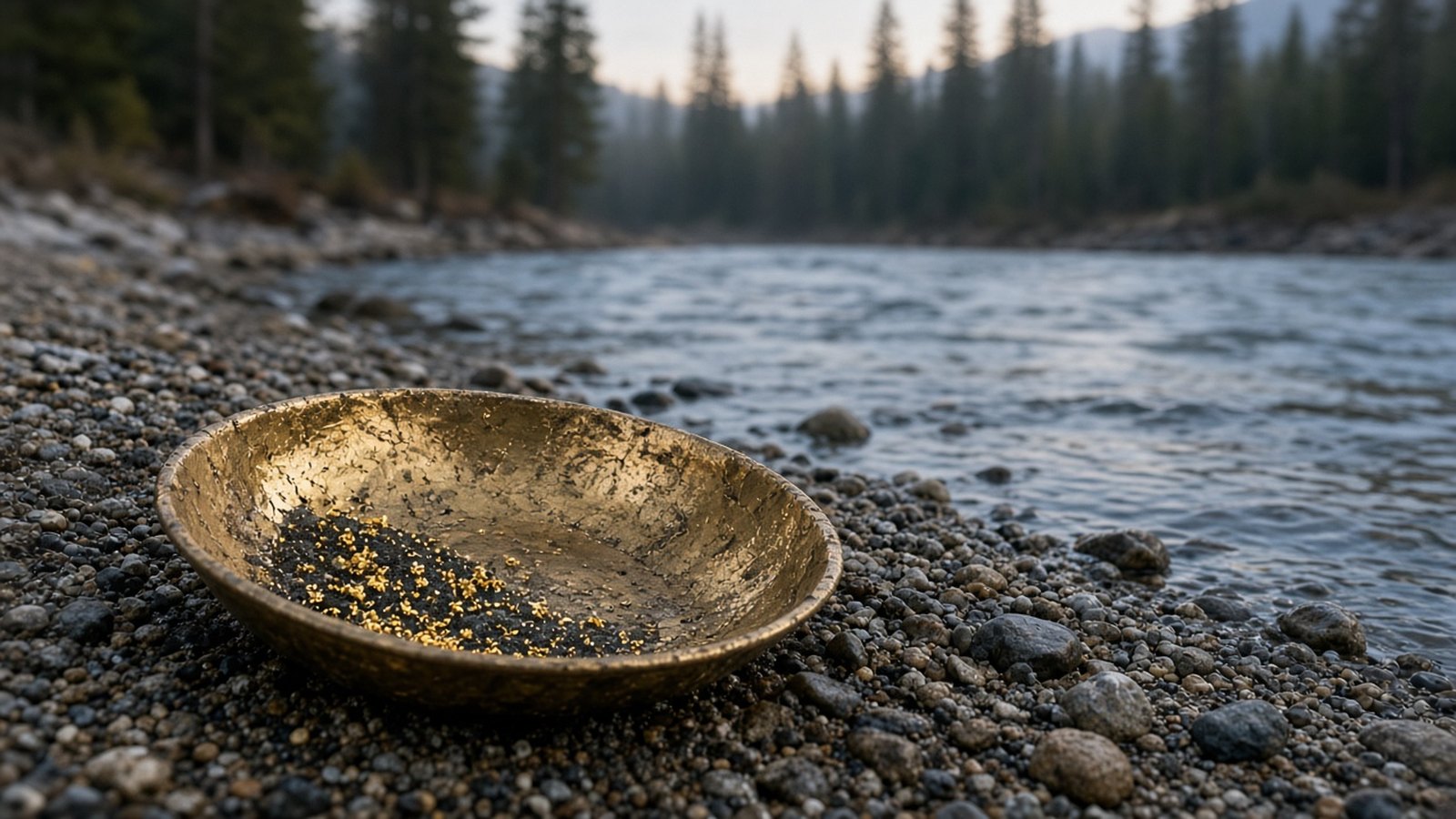
Monday, Jan. 24, 1848. James Marshall climbs out of a mill ditch at Coloma, holding his hat against his chest. “I have found it,” he says. Within weeks the man getting rich isn’t him. It’s Samuel Brannan, a local Mormon leader. Brannan heard the news and bought up every pick and shovel he could find. Only then did he run through San Francisco shouting about it.
That’s the opening of Nathaniel Philbrick’s The Rush, the cover review of the Journal’s Fall Books section. Richard Snow, the reviewer, says only the Civil War keeps the Gold Rush from being the most interesting American event of its century. Marshall was 37 and from New Jersey, the book says. He had been hired to build a sawmill about 45 miles above Sacramento. The ditch he was checking led straight into the Mother Lode. That’s a vein of gold-bearing quartz running more than 150 miles down the Sierra Nevada. Most of the earth holds gold at five parts per billion, the reviewer writes. The Mother Lode held it at 100 million parts per billion. In 1854 a nugget found on Carson Hill weighed 195 pounds.
Here the reviewer does some math of his own. With gold near $4,300 an ounce, he writes, that nugget would fetch nearly $13.5 million today. Both figures are his. The paper’s own markets pages printed gold at $4,191.00 for Friday’s close, up $59.20. And his sum uses kitchen ounces. Gold trades by the troy ounce, and a pound holds fewer of those, so a strict version comes out lower. We’ll leave the nugget at his number and move on to who got paid.
Who got paid
Brannan was on his way to a million within weeks, the book says. He set up a trading post and charged the Mormon miners a 30% tithe on what they found. Philbrick notes the tithes never seemed to reach Brigham Young. By mid-1849 more than 50,000 prospectors had arrived from every continent. In 1853 the flood of gold pushed San Francisco property prices up 25%. The easy gold didn’t last. Pans gave way to heavy equipment, and then to water cannons that blasted whole hillsides apart. By 1861, the book says, 17,000 Californians were ready to fight for the Union, more per head than any state. The gold paid for the war effort and set the stage for the transcontinental railroad, the reviewer writes.
Our read
This is an investments and risk story (IN04) with a behavioral core. Look at who got paid. Marshall found the gold. Brannan sold the shovels and took 30% at the trading post. San Francisco’s property owners saw prices rise 25% in one year. The railroad came after. In most rushes since, the steady money has gone to the supplier, the toll-taker and the landlord. The easy pickings ended once the work needed capital and machinery. Today’s rushes have their own shovel sellers. Before you buy into one, ask yourself which you’re buying, the claim or the shovel.
Gold itself sits in 46 of our model books through IAU, held at weight as insurance. Nothing added. The reviewer’s price near $4,300 is his. The paper’s markets page printed $4,191.00 for Friday. Insurance doesn’t need a hot number to earn its place. It needs a size you can hold through a dull decade. If gold or anything else has grown into a bigger slice of your plan than you meant, that’s the review to have now. You check the roof while the sky is still clear.