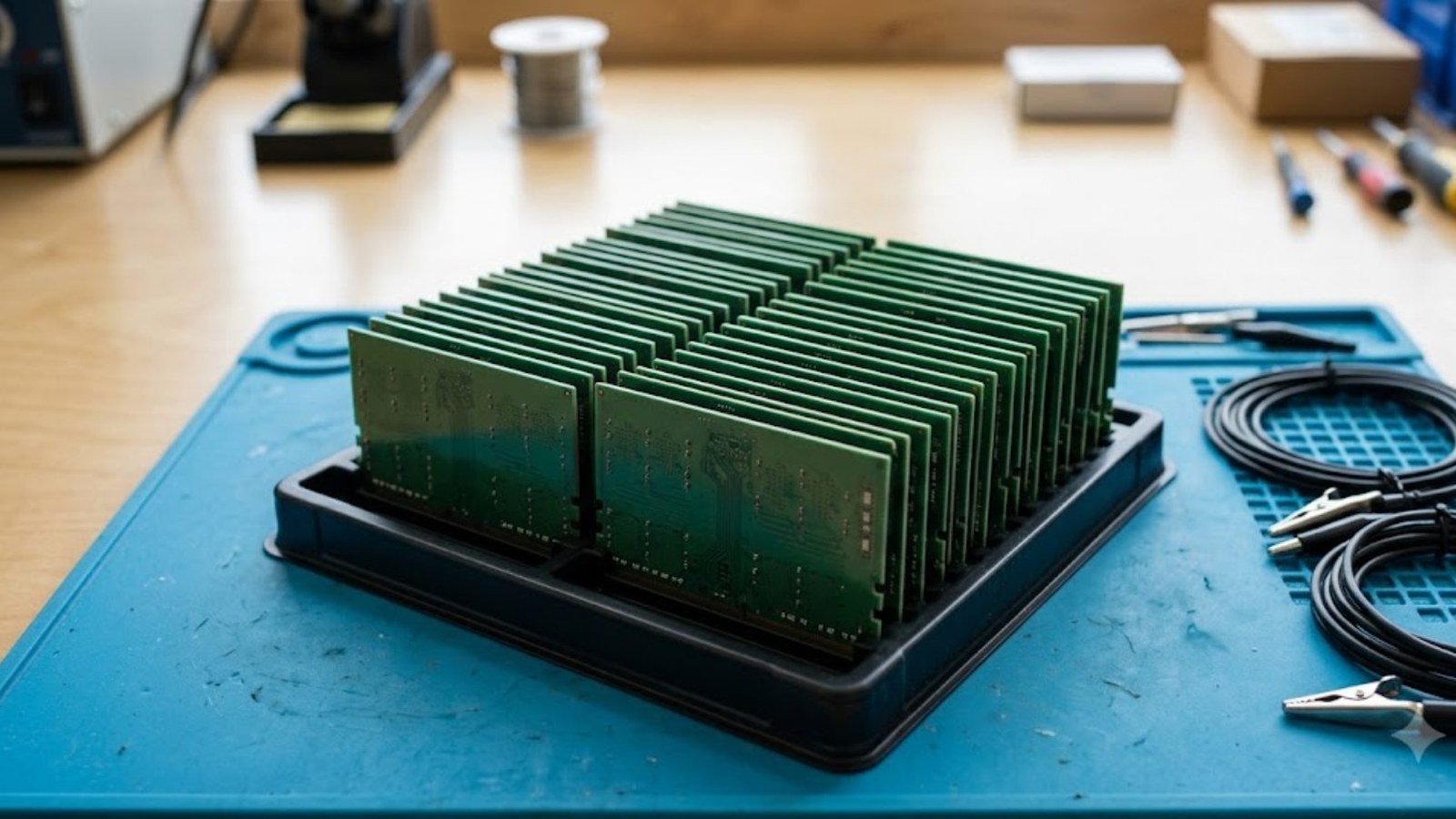
It took one sentence in Shanghai. The president of CXMT, one of China's biggest memory-chip makers, said the company plans a new type of DRAM, the working memory in computers and phones. Samsung and SK Hynix slid in Seoul. By Tuesday's close in New York, Micron, Sandisk, Seagate and Western Digital had followed them down. Rebecca Feng's market note in Wednesday's Journal calls it fresh jitters. We'd call it the AI trade's nerves showing.
The numbers were sharp for one remark. South Korea's KOSPI fell 5.46%. Micron (MU) dropped $35.85 to $953.19, after losing $39.96 on Monday. The Nasdaq slipped 0.15%, and the S&P 500 was little changed. Chips had already had a bad week before this one. The PHLX Semiconductor index lost 4.30% in the week ended Oct. 9. In Singapore, Broadcom (AVGO) CEO Hock Tan said many AI investors don't understand what they own. His own stock rose $2.58 to $357.31.
The glue is the new edge
The same page carried Asa Fitch's Heard on the Street column, and it explains where the real contest has moved. For decades chips got better by shrinking transistors, the famous doubling every two years known as Moore's Law. That's slowing. The gains now come from advanced packaging, which means stitching many pieces of silicon into one big chip. Without it, Fitch writes, Nvidia (NVDA) could not have made its AI chips at all. Taiwan Semiconductor (TSM) developed the methods that bind the computing power to stacks of high-bandwidth memory, and packaging capacity has been a bottleneck for Nvidia's sales.
TSMC has turned old factories into packaging plants and multiplied its capacity several times over. It's bringing in-house work that used to be farmed out, even though packaging has long been a low-margin business. Next comes stacking silicon on top of silicon. Applied Materials (AMAT) CEO Gary Dickerson said in August that packaging revenue would grow more than 70% this year. TSMC reports results Thursday. Part 2 of this edition has them.
Our read
This is Investments and Risk (IN04), with a Behavioral edge. The books hold the build-out at weight: Nvidia in 31 books, TSM in 30, Broadcom in 29, ASML (ASML) in 18, Micron in 17, Applied Materials in 7. Held, nothing added, nothing trimmed. Tuesday is a reminder of what owning these names means. A memory stock can lose $35.85 in a day on a competitor's conference remark, and the remark may or may not turn into a product. Fitch's column is the steadier read. The bottleneck has moved from the transistor to the package, and the firms that do the packaging may hold the chokepoint. That argues for holding the makers and the toolmakers together, as the sleeve does, instead of betting on one memory name.
Your own check is about size, and it's a specific one. If you bought a chip stock in the past year, find out what percent of your whole account it is now. The PHLX Semiconductor index ended last week at about twice its 52-week low, per Monday's paper, so a position bought as a sliver may be a large slice today. Our rule of thumb for any single stock is a cap you set in writing before a day like Tuesday, and most plans land under a tenth of the account. If one chip name sits above your line, trimming back to it is housekeeping. It isn't a call on AI. Do it on a quiet day, or bring the number to your next review. You patch the roof while the sun is out.