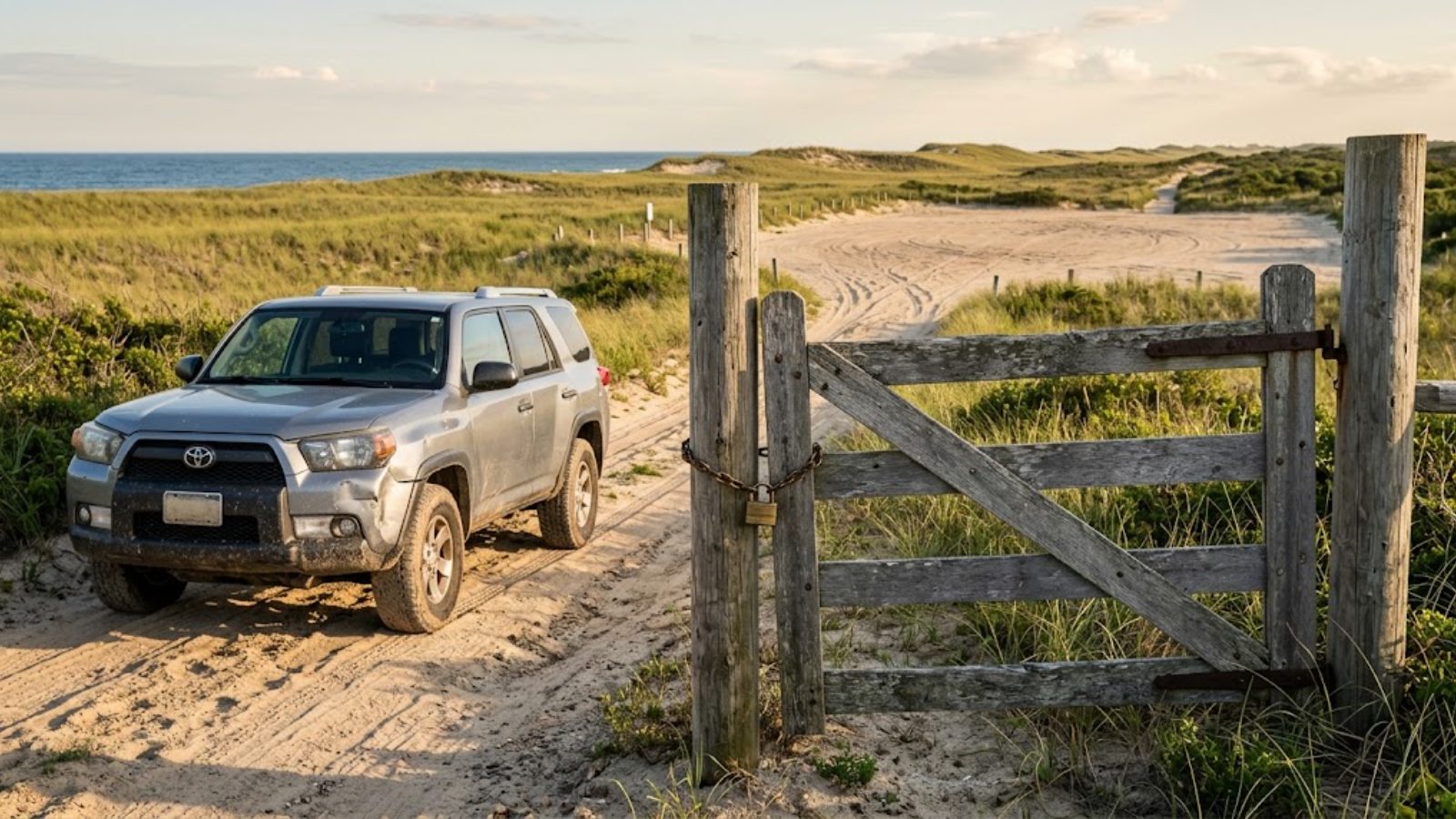
On a brilliant August afternoon, Tyler Smith, a retired architect of 84, hops into his beach car — a dented, sandy RAV4 with 130,000 miles on it — and drives less than a mile from his house to Black Point Beach in Chilmark. He stops at a weathered wooden fence, fits a saw-toothed key into a padlock and swings the gate open onto a nearly empty parking lot and one of the most coveted private beaches on Martha’s Vineyard. ‘We used to spend all day here, swimming and riding the surf,’ he says of his kids’ childhood. The car is worth very little. The key is worth close to half a million dollars.
E.B. Solomont’s Mansion cover is about ‘beach keys,’ the island’s ultimate status symbol. A key comes with deeded ownership of a sliver of non-buildable beachfront, and most stay in the same family for generations; a handful sell each year, by word of mouth. In 2003 a key to Quansoo Beach in Chilmark could be bought for $200,000, says Abby Rabinovitz of Tea Lane Associates. Last year one sold for $475,000, and a key to nearby Hancock Beach fetched $650,000, property records show. ‘There’s more demand than supply. Prices reflect that,’ says Tea Lane’s Alexis Holden, who has two clients who have waited well over a year for the chance to buy a Chilmark key. Roughly 40 beach lots have sold since 2019, and a key can add several hundred thousand dollars to a home sale.
What the key actually buys
Not beauty, says Rabinovitz. Seclusion, quiet and easy parking. The island has 124 miles of shoreline and more than two dozen beaches; the key beaches date from decades ago, when families who owned big swaths of oceanfront farmland divvied up beach lots and sold strips to neighbors and friends. Lisa Herrick, a clinical psychologist who lives mainly in Washington, D.C., inherited a key to an Aquinnah beach with six or seven parking spots. A key ‘doesn’t feel like a club, because you don’t go there to socialize with other people — but it feels like an incredible thing to have.’ In her association the keys cannot be sold at all. Her parents gave it to her; she means to give it to her kids.
The people who hold keys are candid about the optics. ‘It seems elitist maybe,’ says Julie Flanders, a 13th-generation Vineyarder with a Goff Beach key, but the island absorbs a crush of people every summer: ‘It’s just management of traffic flow.’ Filmmaker David Heilbroner, 69, past president of the Hancock Beach Association, is both appreciative and uncomfortable: ‘Now people are building $20 million houses routinely, so a $600,000 beach key is closer to a rounding error.’ And: ‘The starting line for everybody isn’t equal.’ Mike Peters, a retired National Grid worker from Albany, N.Y., who has rented on the island every summer since the 1990s, sees it from outside the fence: ‘For the common people, you just visit and go home. You can’t own a piece of it.’ At Moshup, the public beach, parking is $30 a day, and the attendant, Lisa Stewart, says: ‘There’s beach stress related to it.’
The whole estate syllabus in one padlock
Now read the same facts the way an estate planner would. A beach key is a deeded real asset that produces no income and has no daily price. It trades a few times a year, by word of mouth, so the last print is a comp, not a valuation: a $650,000 sale at Hancock does not make a Black Point key worth $650,000 on an estate return. It may carry a covenant that forbids its sale, which makes it worth a great deal to the family and nothing to anyone else. It sits on a coastline that is physically eroding; the Hancock association bought its parking lot when it came up for sale as a bulwark, because, Heilbroner says, ‘there is the reality that the island is eroding.’ And it passes by inheritance, through families who may not agree about who gets it.
Four plain points follow. First, get the estate an appraisal from someone who knows the island, because the step-up in basis on inherited property is only as good as the number you can defend, and on an asset with a $200,000-to-$650,000 range the fee is trivial next to the tax. Second, an asset three siblings own and one uses is a fight with a padlock on it — one wants the August weeks, one wants the money, one wants to be asked. Third, a specific bequest in the will, this key to this child with an equalizing gift to the others, beats ‘the kids can sort it out’ every time; the kids sort it out with lawyers. Fourth, some beaches issue a new key each summer to limit circulation, and some forbid sale outright, so the documents have to say who the member is, because a key that cannot be sold cannot be split.
The softer point is about second homes generally. The $30-a-day lot and the $650,000 key get you to the same ocean. One is paid for with cash flow and a little beach stress; the other is paid for with capital, forever, and the capital does not come back as a dividend. It comes back as an empty parking lot on a Tuesday. That is the clearest illustration of paying for convenience with capital we have seen in a while, and it is not a criticism — it is a price. The planning job is to know you are paying it, to know what else the capital could be doing, and to make sure the padlock lands in the hands the family intended rather than the ones a probate court picks. In May, Smith and his brother Whit listed their jointly owned 46 acres for $16 million; Tyler’s key, likely worth $450,000 to $475,000, is in the offering. Whit is holding on to his own key for now.