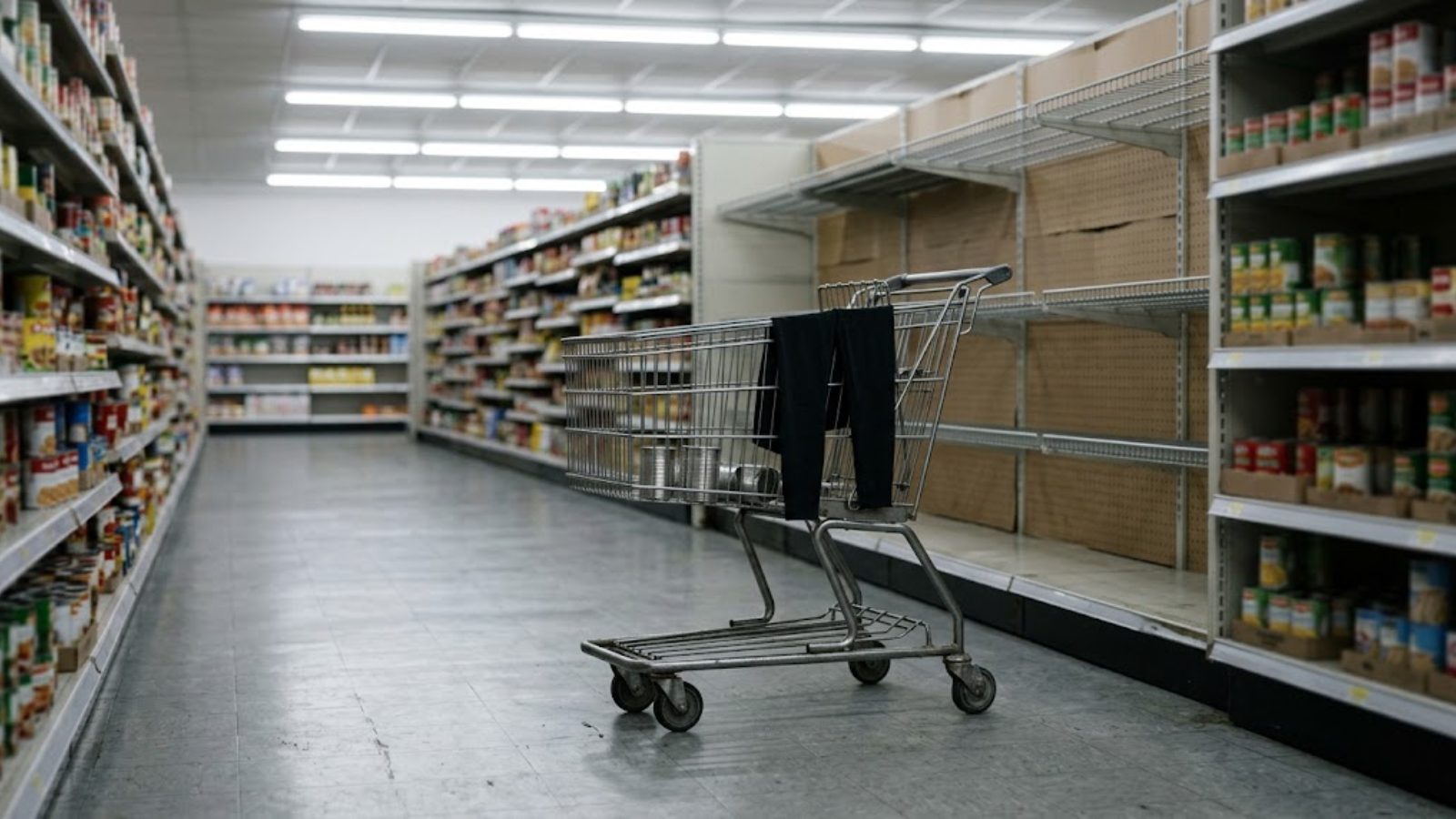
At roughly the same hour Thursday, The Campbell’s Company (CPB) told its shareholders it was cutting their quarterly check to 25 cents from 39, and Docusign (DOCU) told its shareholders it was raising guidance for the second time this year. That’s the consumer in one afternoon. Not weak — split. The physical-goods middle got hit from three directions, and the share-takers and the AI-adjacent software names raised.
Lululemon Athletica (LULU) cut its outlook for the second time this year after another quarter of shrinking sales in the Americas, and the stock fell about 18% after hours. Second-quarter revenue slipped 4% to $2.42 billion against $2.46 billion expected; Americas sales fell 8% while international rose 4%; same-store sales dropped 9% against a 4.6% decline expected. The company earned $329.2 million, or $2.92 a share, versus $370.9 million and $3.10 a year earlier — and that $2.92 included 86 cents a share of tariff refunds and associated interest. The problem is competitive, not cyclical: executives have said the brand lost North American customers to Alo and Vuori and that several product launches missed. Heidi O’Neill takes over as chief executive next week.
| Company | Thursday’s news | The number |
|---|---|---|
| Lululemon (LULU) | Second guidance cut this year; Americas sales -8%, comps -9%; shares -18% after hours | Sales $10.35-$10.50B from $11.00-$11.15B; EPS $9.48-$9.73 from $10.95-$11.15 |
| Campbell’s (CPB) | 1,750 jobs cut (13%); $69M loss; dividend to 25c from 39c; shares -7% | Adj. EPS $1.65-$1.80 vs. $1.83 expected; sales -2% to -4% |
| Tyson Foods (TSN) | Cattle shortage widens the beef loss; chicken cut on ‘consumer caution’; shares -7.3% | Revenue +1.5% to 2% from +2.5% to 3.5%; beef loss $625-$775M |
| Victoria’s Secret (VSCO) | Raised again; sales +10%, comps +9%; $140M-plus tariff refund; shares +13% | Sales $7.10-$7.18B from $7.03-$7.13B; adj. EPS 95c vs. 77c expected |
| Docusign (DOCU) | Second raise this year, citing AI demand | Revenue $3.50-$3.51B |
| Zscaler (ZS) | Narrower loss; restructuring, cutting 3% of staff to fund AI | Revenue $898.2M, +25%, vs. $877M expected |
Three misses, three different diseases
Campbell’s swung to a $69 million loss, or 23 cents a share, from a $145 million profit a year earlier, on sales down 8% to $2.14 billion. The snacks division fell 12%, meals and beverages 4%. It’s cutting more than 1,750 jobs, about 13% of the workforce, has closed two snack plants, wants $500 million of costs out by fiscal 2030, and guided the coming year to adjusted EPS of $1.65 to $1.80 against $1.83 expected, with sales down 2% to 4% against the roughly 1% decline analysts had. ‘Our performance is not where it needs to be, and we are taking decisive action to improve it,’ Chief Executive Mick Beekhuizen said. Shares fell 7% and are down more than a fifth this year. That’s a demand problem for pantry brands.
Tyson Foods (TSN) is something else: a supply story. It cut its fiscal 2026 revenue outlook to growth of 1.5% to 2% from 2.5% to 3.5%, and now expects the beef segment to lose $625 million to $775 million on an adjusted operating basis, worse than the prior $500 million to $650 million, citing ‘one of the most severe cattle shortages in U.S. history.’ The demand note is buried in the chicken line, trimmed to $1.85-$1.95 billion from $1.9-$2.05 billion ‘due to consumer caution,’ and pork came down $50 million to $200-$250 million. Shares fell 7.3% and are off about 12% this year.
The beats, and the asterisk
Victoria’s Secret (VSCO) raised its full-year outlook again, to sales of $7.10-$7.18 billion from $7.03-$7.13 billion, on net sales up 10% to $1.61 billion — just shy of $1.62 billion expected and slowing from 15% the prior quarter — and comps up 9%; adjusted EPS of 95 cents beat 77 cents. The stock rose 13% and is up about 57% this year. ‘Our brands are stronger and more relevant, our customer file is growing and we are gaining market share,’ Chief Executive Hillary Super said. Docusign lifted its annual revenue view to $3.50-$3.51 billion; Chief Executive Allan Thygesen said the company ‘is raising its outlook as AI accelerates momentum across the business.’ Zscaler (ZS) grew revenue 25% to $898.2 million, beat the $877 million consensus, narrowed its loss, and still said it would cut 3% of its workforce to move money toward AI and growth.
Now the asterisk. Two of the six results were flattered by tariff refunds. Lululemon’s $2.92 included 86 cents from refunds and associated interest, so the underlying quarter earned closer to $2.06 against $3.10 a year ago. Victoria’s Secret collected more than $140 million, nearly all the tariffs it paid under the International Emergency Economic Powers Act. That’s one-time cash, not demand. And the honest read on demand is narrower than the headlines: Lululemon is losing share, Campbell’s is losing the snack aisle, Tyson’s chicken buyers are cautious at the margin. The share-takers raised. That’s a barbell, not a collapse.
A high yield on a shrinking business is a warning label
The household lesson is about the dividend. Campbell’s stock was already down more than a fifth this year before Thursday, which meant its yield had been rising all year for the wrong reason. A payout that grows because the price falls is not a coupon; it’s the market pricing a cut before the board announces one. General planning principles for an income sleeve say look at the payout against free cash flow and at the sales trend, not at the yield, and treat a household name as no exception.
For the book, this is confirming evidence, not a new signal. Costco (COST), Walmart (WMT), Procter and Gamble (PG), Coca-Cola (KO) and PepsiCo (PEP) are the share-takers in the aisles where Campbell’s is losing, and on Sept. 1 we already trimmed the consumer weighting by about a third in the midterm dividend books and seated defensives and dividend-paying tech in the freed seats. Consumer discretionary rose 1.5% as a sector on the Waller rally the same afternoon three consumer names fell 7% to 18% on their own numbers — a tape sorting winners from losers, not selling the consumer wholesale.