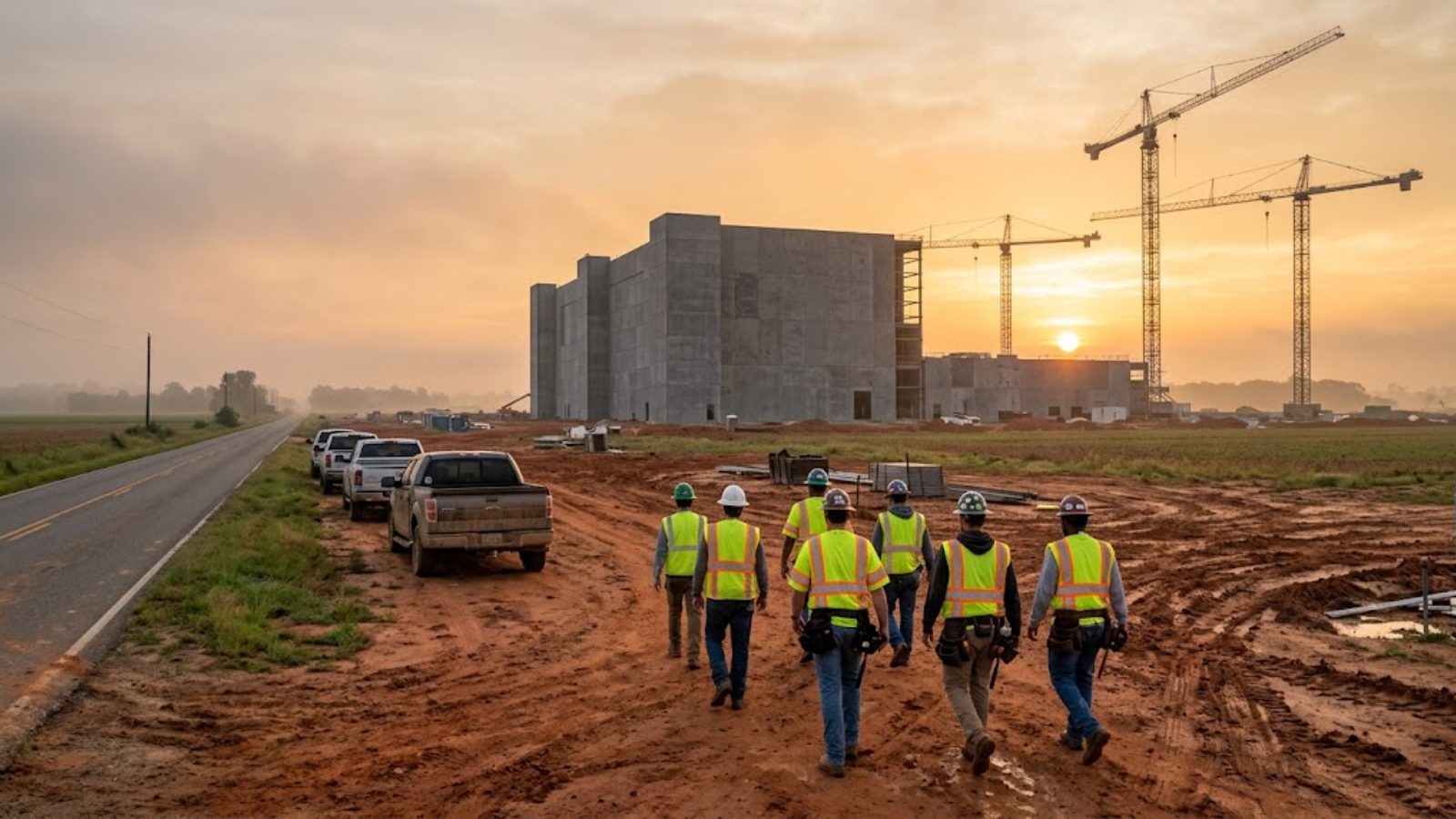
Somewhere in Richland Parish, Louisiana, there’s a construction worker who got a raise of about $86,000 this year. Not over a career — this year. That’s what a 182% jump in average weekly construction wages works out to, and it’s the number that stopped us cold in the Journal’s editorial on the new Bureau of Labor Statistics county wage data through March. The president took a beating on Monday for saying towns that block data centers end up ‘backwards and poor.’ Hyperbole, the board allows. Then it shows its work.
Start with Loudoun County, Virginia — Data Center Alley — where permitted data-center space grew about 150% between 2020 and 2025. Since early 2020, employment in Loudoun is up 17.4%. Fairfax County, Va., and Prince George’s County, Md., which caught some of the overflow, are up 15.9%. Arlington County, which has no alley, shed 7.3% of its jobs, and Montgomery County, Md., lost 5.6%. Construction tells it plainer: up 63% in Loudoun against 6.3% in Fairfax, 8.2% in Arlington, 8.3% in Prince George’s and a 12.8% decline in Montgomery.
The bartender’s raise
The part that matters for a household isn’t the crane operator. It’s the spillover. Leisure-and-hospitality employment rose 6.8% in Loudoun over the period while it fell in every other Washington suburb, and average weekly wages in that industry grew 69% — double Fairfax (26%), Arlington (29%), Montgomery (31%) and Prince George’s (27%). The board’s explanation is the honest one: if more construction workers are grabbing drinks after a shift, bartenders make more money.
The rural case is the one to lead with, and the board does. Since the first quarter of 2025, with Meta Platforms (META) building its data center in Richland Parish, private employment there has grown 41% and average weekly wages 61%. Neighboring parishes show little or no growth. In a single year the parish’s construction workforce rose more than tenfold. Leisure-and-hospitality jobs are up 21.5% and wages in that industry 34%. This is the same parish we noted on Sept. 1 was paying teacher bonuses of up to $50,000 out of Meta’s tax base.
What the board concedes, and what we’d add
The board raises its own caveats: building a data center isn’t lifetime employment, though somebody has to run and maintain the buildings and the power plants that feed them, and politicians in both parties fret that AI concentrates wealth and leaves rural places behind. We’d add the other half of the file. On Sept. 1 we covered the backlash as a real thing — more than 70% of Americans oppose a data center nearby, electricity costs are up more than 35% in five years, and Texas and Pennsylvania paused approvals. None of that is settled by a wage table.
What the table does do is draw the political map. The backlash is loudest in the places that aren’t getting the paycheck. Arlington and Montgomery lost jobs and got the higher power bill without the bartender’s raise; Loudoun and Richland got both. A voter who pays for the grid and never sees the payroll is behaving rationally, and so is the union steamfitter on the other side of the county line. That’s a fight about who gets the check, not about whether the check is real.
When your house and your paycheck sign the same contract
Here’s the planning point, and it’s for the winners. If you live in Loudoun or Richland, your wage, your home’s value and your county’s tax base now key off a single capital-expenditure cycle. That is concentration, even when it feels like luck. Construction booms roll off — the board says so itself — and the year the cranes leave is the year the local housing market and the local job market find out they were the same bet. General planning principles say treat a 182% raise as a windfall rather than a baseline: bank it, hold the emergency fund to the old wage, don’t size a mortgage to it, and keep the investment portfolio pointed somewhere your paycheck isn’t.
For the book, the wage data is the demand side showing up in a payroll. We don’t own the data centers; we own the picks and shovels of the electricity build — GE Vernova (GEV), Vertiv (VRT), Quanta Services (PWR), EMCOR (EME) and General Electric (GE) — and every tenfold construction workforce is a customer of theirs before it’s a customer of anyone else’s.