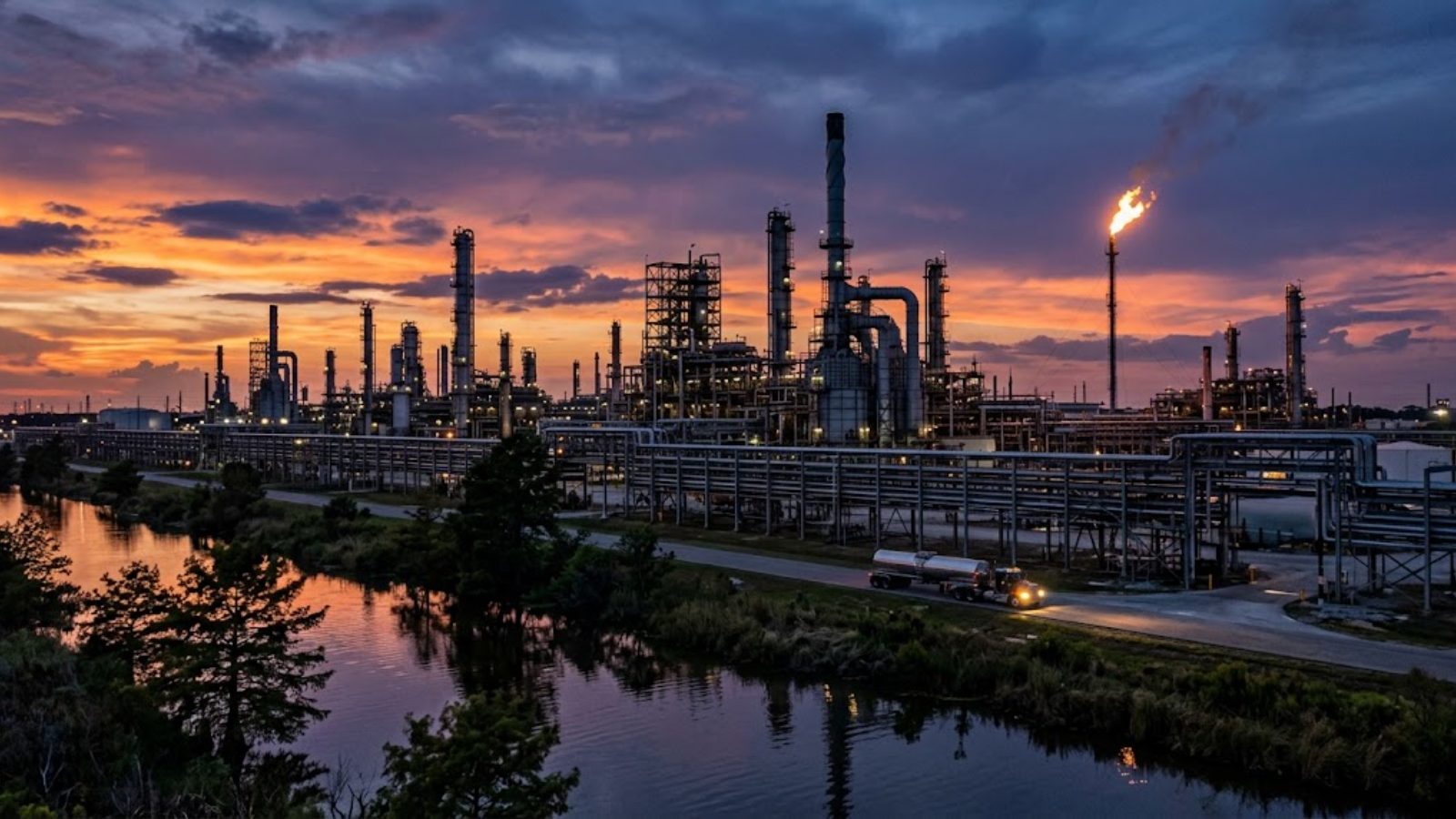
President Trump gathered oil executives at the White House on Tuesday and asked them to build refineries, to get gasoline down from $4.10 a gallon before the November midterms. Around the table sat Chevron (CVX), Valero Energy (VLO), Marathon Petroleum (MPC) and PBF Energy (PBF). It’s hard to imagine any of them doing it, and the reason is the calendar: the newest refinery in America was completed in 1977.
That’s the paradox the Journal laid out this week: owning an oil refinery is a wonderfully profitable proposition in the U.S. right now, and building a new one is not. Refiners have been running at more than 97% of collective capacity in recent weeks, near their highest rate in about eight years. Six months into the Iran war, the supply crunch for diesel, jet fuel and gasoline has overtaken upheaval in the crude market as the industry’s primary worry, and the crack spread — the difference a refiner pockets between buying crude and selling fuel — recently hit a record above $100 a barrel for diesel. Some companies are deferring scheduled maintenance to keep the units running. Americans paid about $4.10 a gallon Tuesday, per AAA, up from $2.98 before the conflict began.
Why nobody builds
Start with the arithmetic. The U.S. has 128 fewer refineries than it had in 1982; roughly a quarter of the survivors are more than a century old. A new one costs several billion dollars and three to five years of construction, so anyone who breaks ground today is betting on the fuel market of 2030, not the one on Tuesday’s whiteboard. “Nobody’s going to go out and make a huge multibillion-dollar investment based on three months of record margins,” said Robert Campbell, an analyst at Energy Aspects. “You really think there’s going to be another situation where Russia’s being attacked, and there’s a crisis in the Middle East, and China has slowly stopped exporting products?”
John Auers, marketing director at the oil-and-gas data firm Novi Labs, was blunter: “Who wants to invest in something that, by the time you build it, the demand is down?” Gasoline demand is expected to decline over the long run as drivers buy more electric vehicles and engines get more efficient. Auers figures the industry could add about 400,000 barrels a day by expanding existing Gulf Coast plants over the next 20 years — roughly one large refinery’s worth. Expansion, not construction, is how American refining grows now.
What the majors are actually doing
Exxon Mobil (XOM), the nation’s third-largest refiner, skipped the White House meeting. It expects to spend about $2 billion upgrading its Baytown, Texas, plant to make more diesel and lubricant base stocks and less gasoline, starting in 2028. CEO Darren Woods said in late July that “the utilization that we’ve seen can’t be sustained for the long term” and that “this refining challenge is going to be with the world for a while.” Chevron has a smaller, similar project at Pascagoula, Mississippi; CEO Mike Wirth says he loves the refining business but has “long had a view that we want to be a more upstream-weighted company.” Trump said in March that a startup called America First Refining would open the first new U.S. refinery in 50 years, in Brownsville, Texas. Analysts are skeptical.
The hole in our own book
Here’s what this story told us about ourselves. Capital Wealth owns the barrel — Exxon, Chevron, ConocoPhillips (COP), EOG Resources (EOG), Occidental Petroleum (OXY), Devon Energy (DVN), Diamondback Energy (FANG) — and it owns the drill bit, through Schlumberger (SLB) and Halliburton (HAL). It has never owned the spread between crude and fuel. Six months into a war in which that spread has become the whole story, that’s a hole, and this edition fills it with a starter position in Valero Energy (VLO), an independent refiner that owns the spread and not the barrel, at about 1.5% in the “+” sleeve.
The thesis is scarcity and replacement cost, not a margin forecast. Valero’s plants are assets nobody can build a competitor to in under five years, in an industry that has closed 128 of them since 1982; when the barrier to entry is measured in years and billions, the incumbent’s earnings are protected by the calendar. That’s a general planning principle, not a recommendation to anyone in particular. The honest bear case is just as plain: crack spreads this wide are a war premium, and war premiums end. If the Middle East supply shock unwinds and China resumes exporting fuel, the spread could give back most of what it gained, and the stock with it. That’s why it’s 1.5% and not 5%.