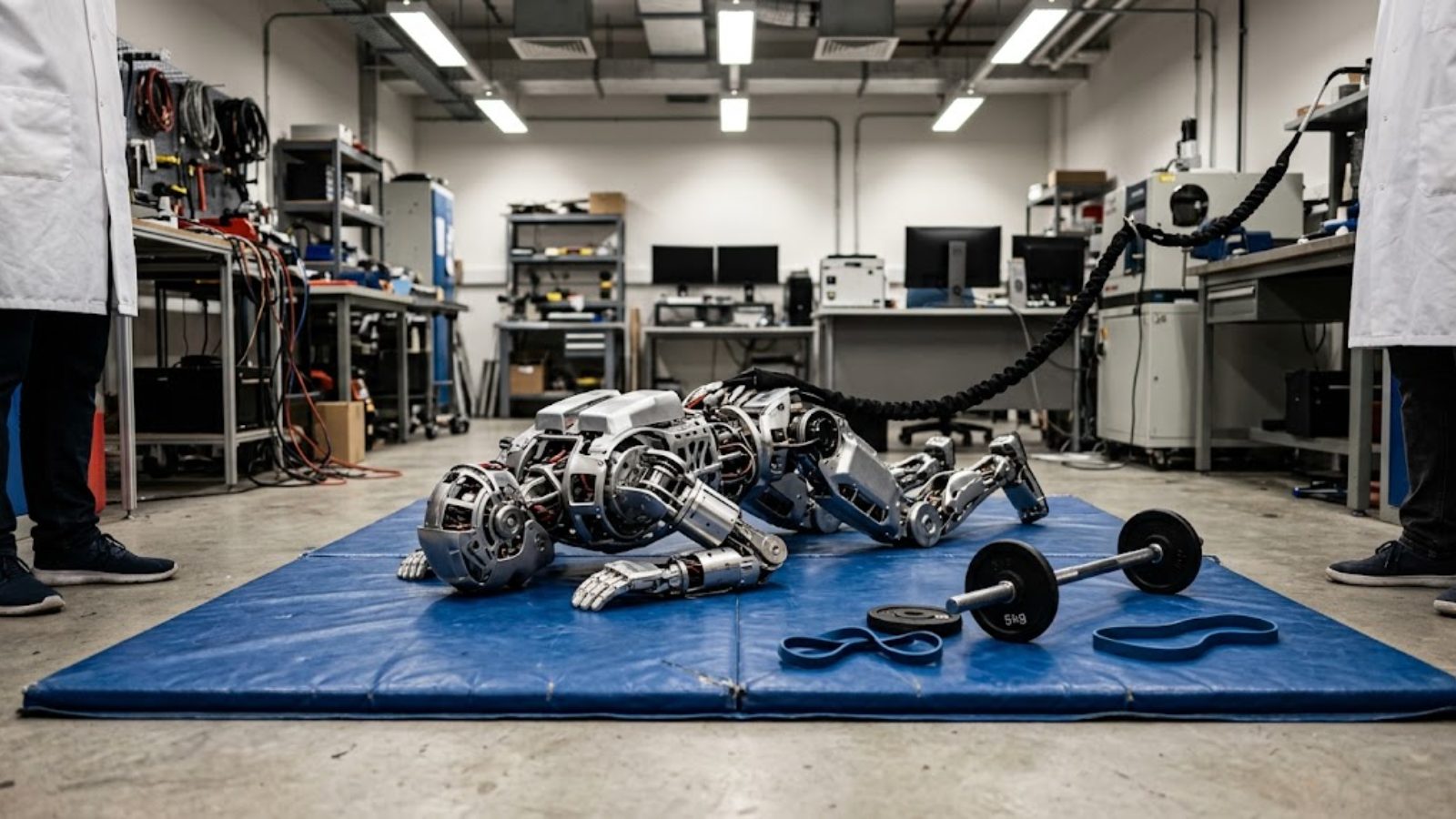
The humanoid weightlifter walked up to a barbell that would not have troubled a seventh-grader, staggered under it, dropped it, tripped over it and landed face first. Then a pair of solemn-looking humans carried the competitor away on a stretcher, and the Journal’s A-hed writer — along with, we suspect, everyone who has ever been asked to lift something in front of coworkers — laughed until it hurt.
The genre is deep. Sprinting robots that slam full tilt into a barrier and collapse. A delivery bot that drives off a pier. The writer’s all-time favorite is the ‘Billie Jean’ machine, a decent impersonation of a Michael Jackson impersonator that stumbles on some stairs, recovers, then slams completely on the steps and lies still, ‘as if dead from embarrassment,’ until its human handler drags it offstage. It was wearing a T-shirt and no pants. We watched it three times. We are not proud.
Why the washing machine gets no laughs
Dennis Hong, the engineering professor who directs UCLA’s Robotics and Mechanisms Laboratory, has the cleanest theory we have read. ‘If a washing machine breaks, nobody laughs.’ But when a humanoid faceplants botching a dance move, ‘there may also be a little bit of satisfaction: See? Humans are still better.’ Hong works tirelessly to make these machines better and still enjoys videos titled things like ‘Ranking Funniest Clanker Fails.’ ‘Oh, I laugh. Some of them are genuinely hilarious — if it is NOT our robot.’ He tells his students to embrace failure as a learning tool, ideally in a safety harness with cushions on the floor.
The physics is uncanny on purpose. Limbs programmed for specific movements flail in chaotic ways once the plan breaks, and a humanoid body has no self-protection reflex; it does not put its hands out. Changlu Liu, an assistant professor at Carnegie Mellon’s Robotics Institute whose specialty is human-robot safety, keeps a compilation for her students: a humanoid descending steps with apparent confidence, missing one, toppling like a tree and losing its head on impact; a little bot in a soccer jersey whiffing a kick and splatting on its back. She uses the clips to ask what could have gone worse in a real room. ‘It is when the robot gets out of those stages, when they get in the crowd, then problems happen.’
The crowd is where the mood has turned. A stubby robot in an electric-blue wig, showing off spins and thrusts at a street festival in China, clipped a kid with a kick to the stomach; an office bot sent coworkers scrambling by suddenly aiming kung-fu moves at them. ‘I do think there has been a shift,’ Hong says. ‘Robots used to be mostly something people were fascinated by.’ People who once wanted the butlers of the future now see attackers and job thieves, which is a bummer for the engineers building disaster-response bots. Liu says some young people at demonstrations are mostly interested in tricking the machine: ‘Once they do something to break the robot they feel very proud of themselves.’
The straw man we are actually punching
Here is the honest part of the essay, and the reason it belongs on the front of a financial paper. The writer admits it is tougher to laugh about how much faster a large language model could have written the article. There is nothing entertaining in footage of warehouse robots swarming a floor. Data centers are mushrooming, so numerous and monolithic they seem abstract — until one starts materializing on the Conodoguinet Creek in Pennsylvania, where the writer grew up. Robots struggling to cosplay people are ‘the ideal straw man for my anxieties about human obsolescence.’ The faceplant is funny because the robot is losing a contest we are afraid of losing.
That is a behavioral observation, and behavioral observations are planning inputs. Obsolescence anxiety is a forecast about your own earning power, and it deserves the treatment any forecast gets: write it down, put a range on it, see what the plan looks like if it is right. The one line we would underline: a plan that assumes your job exists in the same shape in fifteen years is the plan with the least cushion on the floor. On the same front page, Nvidia (NVDA) struck a $13 billion deal for an AI platform and closed up 1.8%. The desk is not cheering for the robots to fail. It owns the chips. Those two facts are supposed to live in the same plan, and the second is a good part of why the first is survivable.
The writer closes with a pang of empathy for the Billie Jean machine being dragged off by its handler: ‘I wonder what that robot is up to right now.’ Practicing the stairs, probably. That is the other thing the fail reels teach, and the reason Hong wants cushions on the floor: the robot gets up, gets patched and tries the step again. Nobody films that part. It is the only part that matters.