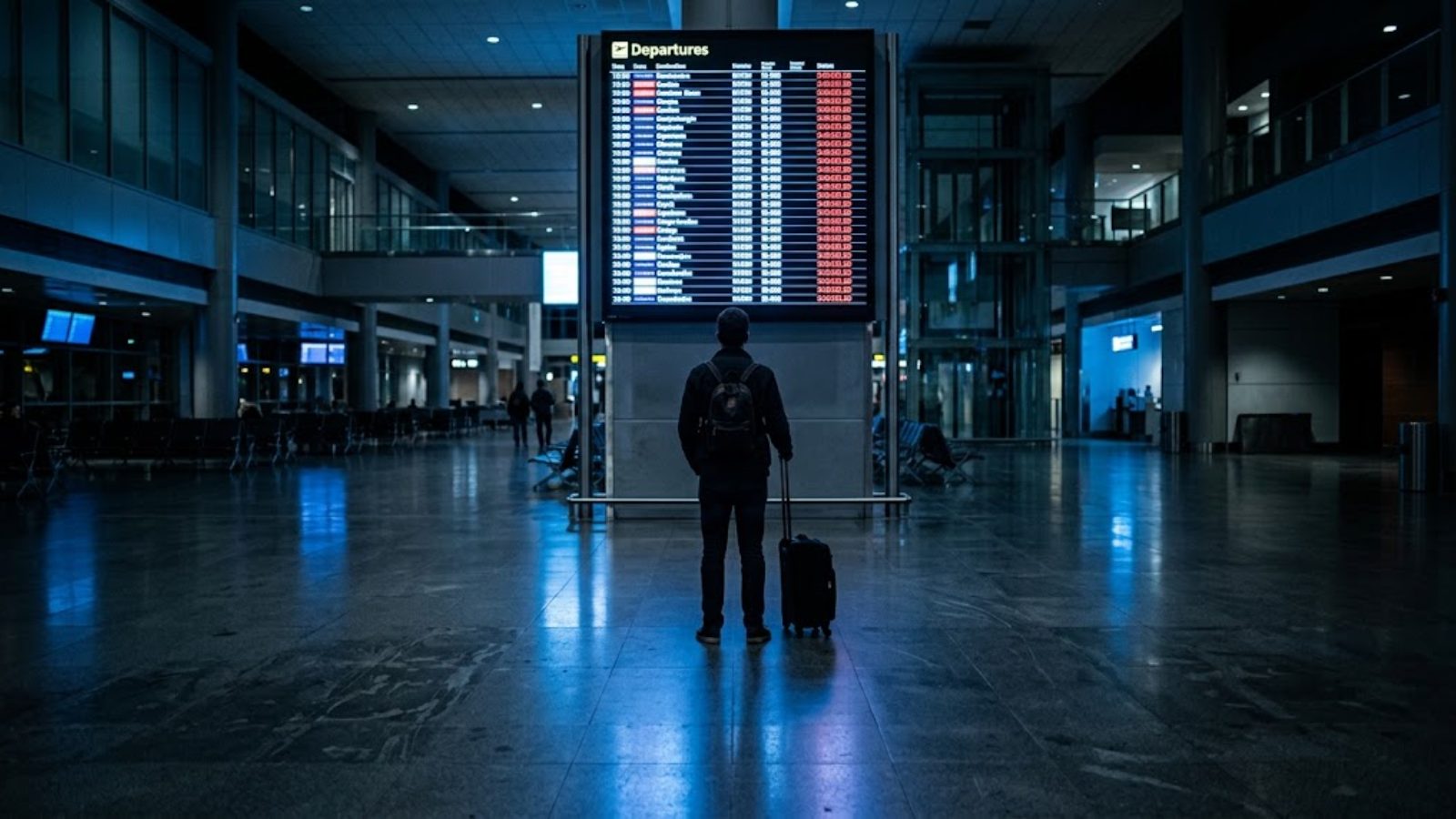
The departures board at a Moscow airport has become a weapon, and the Ukrainians are saying so out loud. President Volodymyr Zelensky warned airlines and their insurers Tuesday that Russian airspace “is becoming completely unsafe.” Behind the sentence is a plan: put so many drones near Russian airports that the temporary closures, already routine, become a shutdown. “This is no longer simply a repetition of isolated, sporadic emergency alerts,” said Serhiy Bratchuk, spokesman for the Ukrainian Armed Forces’ Southern Command; “it is a transition to constant pressure aimed at paralyzing civilian air traffic in the European part of the Russian Federation.”
The scale is already there. In August a record of about 16,000 Ukrainian drones entered airspace Russia has kept open to civilian aircraft, per aviation-security specialist Osprey Flight Solutions, and their proximity forced the temporary closure of 32 Russian airports a day on average. Domestic and international carriers have canceled an average of 86 flights a day since Sept. 1, per tracking specialist Flightradar24. Ukraine calls the tactic Operation Carpet: drones circulate near an airport and air-traffic control pauses takeoffs and landings until they leave. Russia has refused to close its airspace to civil aviation; Ukraine has kept its own closed since the February 2022 invasion. President Vladimir Putin called the warning a “declaration of terrorism” and added: “If they follow through, we’ll see how best to answer.”
The risk isn’t the drone; it’s the defense
Here’s the part aviation-safety experts underline, and it’s the underrated one. The sheer number of drones and the frantic work of Russian air defenses trying to shoot them down raise the risk to civilian aircraft on their own. Worse, those defenses lean on large-scale spoofing — transmitting fake GPS signals to send drones off course — and a spoofed sky doesn’t check whether the receiver is a drone or an airliner. Zelensky insists “Ukraine does not threaten civilian aviation as such”; there would simply be drones in Russia’s skies, he said, “on a scale that has to be taken into account,” and Ukrainian officials say they have vowed to avoid targeting airliners and civilians. The physics of a jammed navigation signal don’t take vows.
Airlines are voting with their schedules. In June, El Al (ELAL) halted Tel Aviv-Moscow, citing the drone attacks. In April, Air India shifted its last U.S. route crossing Russia, adding a refueling stop in Seoul on San Francisco-Delhi. After Zelensky’s comments, Turkish low-cost carrier Pegasus Airlines (PGSUS) scrapped several Russia flights for “technical and operational reasons,” and the next day Emirati carrier Flydubai followed, citing the “evolving situation in the region.” Carriers from the Middle East and Asia had kept flying to Russia — the absence of U.S. and European competitors has been a boon — and many now rely on private security firms to map which flight paths, altitudes and times of day to use.
The same day, Foreign Minister Sergei Lavrov said Russia is closing German cultural centers on its territory, after Berlin blamed Moscow for an attempted drone attack at a German airport on Aug. 4: an explosives-laden drone, found and defused near a Ukrainian plane at an international freight hub supporting Kyiv. Germany said Wednesday it’s closing the Russian consulate in Bonn and the Russian House cultural center in Berlin. The war’s airports now run from the Black Sea to the Rhine.
What your travel policy actually says
Now the consumer-protection part, because most travelers assume “travel insurance” covers a war-adjacent cancellation, and it usually doesn’t. Speaking generally and about no particular product: standard trip-cancellation policies carry war and act-of-terrorism exclusions. A government travel advisory, by itself, is often not a covered reason. “Cancel for any reason” is a separate, more expensive rider that typically has to be bought within a short window of the first deposit and typically reimburses only a portion of the trip cost. And when an airline re-times or reroutes a flight — a refueling stop in Seoul, say — that’s usually handled as a schedule change, not a cancellation, which is a different remedy with different money attached.
So for any itinerary that crosses a contested region this autumn, read the exclusions before the deposit, not after the headline. Check the credit card you booked on; its built-in trip protection may be broader than the policy you were sold at checkout, and it’s already paid for. Get the airline’s own schedule-change terms in writing. And then the house rule, because it applies to a departure gate exactly as it applies to a portfolio: you don’t go looking for the umbrella once the sky opens. You find it on the clear morning, in about fifteen minutes, with the paperwork in front of you.