There is a number in Jason Zweig’s column this weekend that ought to be printed on the inside cover of every brokerage app. A fund that seeks to triple the daily return of the tech-heavy Nasdaq-100 has returned nearly 35,000% since it launched in 2010. The index itself returned north of 1,800% over the same stretch. So the leveraged version won by a factor that does not fit on a chart. Zweig’s question is the good one: who actually earned that? His best guess is absolutely nobody.
Here is why. In the worst five weeks of the pandemic crash in 2020, the Nasdaq-100 fell 27.8%. The triple fund fell 69.8%. In 2022 the index dropped 32.4%; the fund lost 79%. From mid-February to early April of 2025 the index gave up 22.8% and the fund gave up 56.9%. Those are not typos and they are not bad luck. That is the product working exactly as designed. A fund built to double or triple a daily move does not amplify only the good days. It enlarges the bad ones by identical arithmetic.
The part the research skipped
New academic work argues that better-diversified leveraged funds could be ‘potentially useful as a permanent component’ of a portfolio, and would be ‘a natural holding’ for younger investors whose savings are small next to their future earnings. Zweig has three objections and they are all worth borrowing. The first is that the paper describes a market that no longer exists: as of late August, 612 of the 772 leveraged funds trading in the United States tracked a single stock, commodity or cryptocurrency instead of an index. Undiversified, by construction. Traders and speculators love them. That is a different sentence from investors should own them.
The second is that markets do not only go up, and the third is the one that actually decides outcomes: investors are not superhuman. We like pleasure and we hate pain. The human mind is not built to sit through a 79% drawdown on the theory that the long-run number will be worth it. This is not a character flaw to be lectured out of people. It is the operating condition.
South Korea ran the experiment this summer
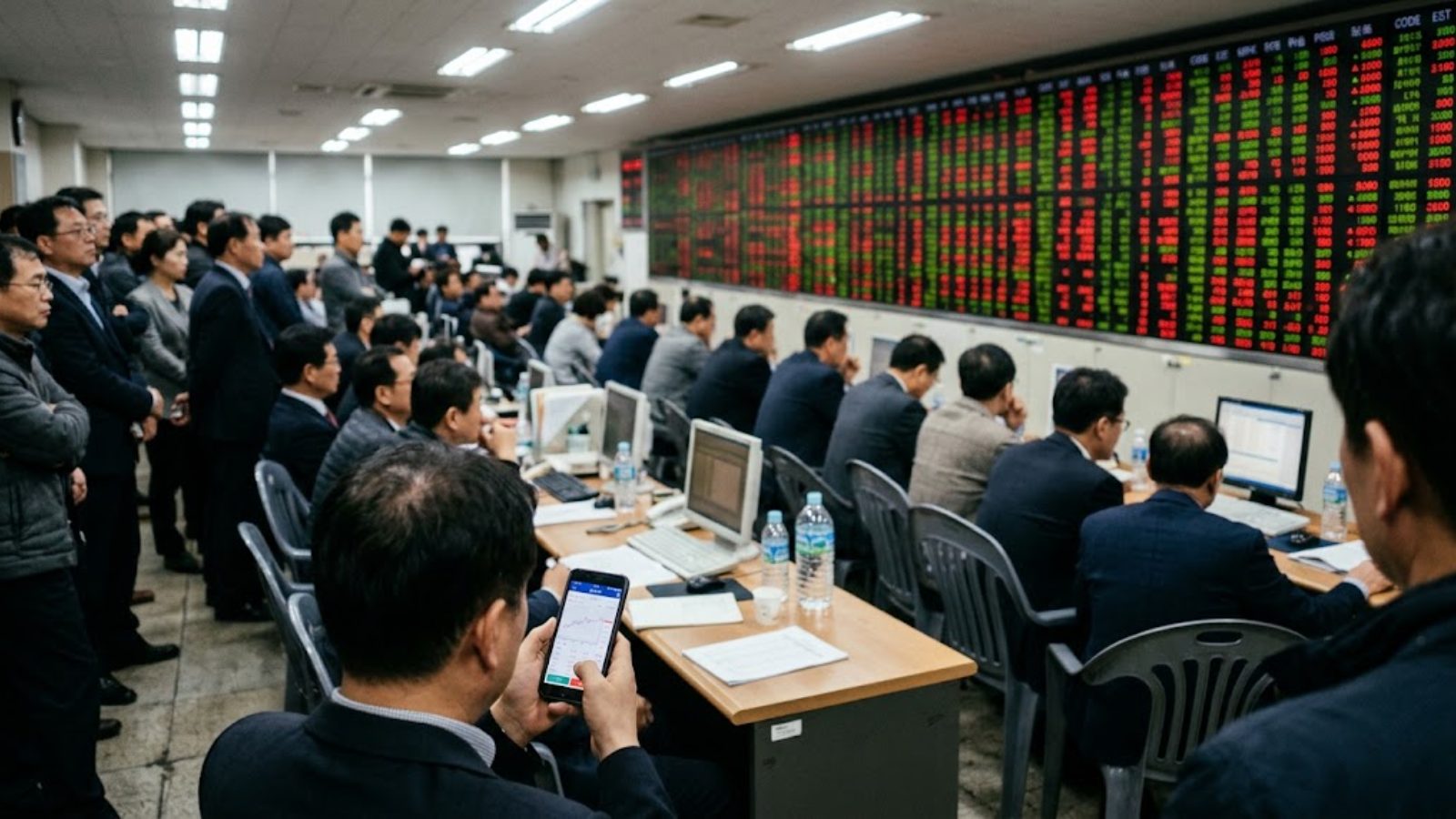
If you want the compressed version, it happened this year. South Korean stocks more than doubled in the first five months of 2026. At the end of May, fund managers launched the country’s first leveraged funds tied to single stocks, and individuals poured in the equivalent of billions of dollars. Then, over six brutal weeks in June and July, South Korean stocks fell roughly 40%. Every down day, the leveraged funds multiplied the loss. Hundreds of thousands of Koreans sold in a frenzy. Researchers at Harvard Business School who study these funds estimate the investors in ten of the largest ones gave up a great deal of money doing so — not because the market never recovered, but because they were not there when it did.
And this is not an exotic problem happening to other people. On one unremarkable Thursday this week, the S&P 500 rose a little over 1% and more than two dozen leveraged funds gained at least 20% — while at least seven lost more than a fifth of their value in that same session. Both things, same day, same market.
The planning translation is not ‘avoid leverage,’ though for most retirement money that is the right answer anyway. It is this: the return you will actually receive is the return you can sit through, and the two numbers are frequently not close. That is the real argument for owning things whose worst quarter you can describe out loud without flinching. Before the market gives you a chance to find out the hard way, it is worth knowing what your own portfolio’s bad year looks like — and whether you would still be holding it in month four. Fifteen minutes with a statement answers that better than any backtest.