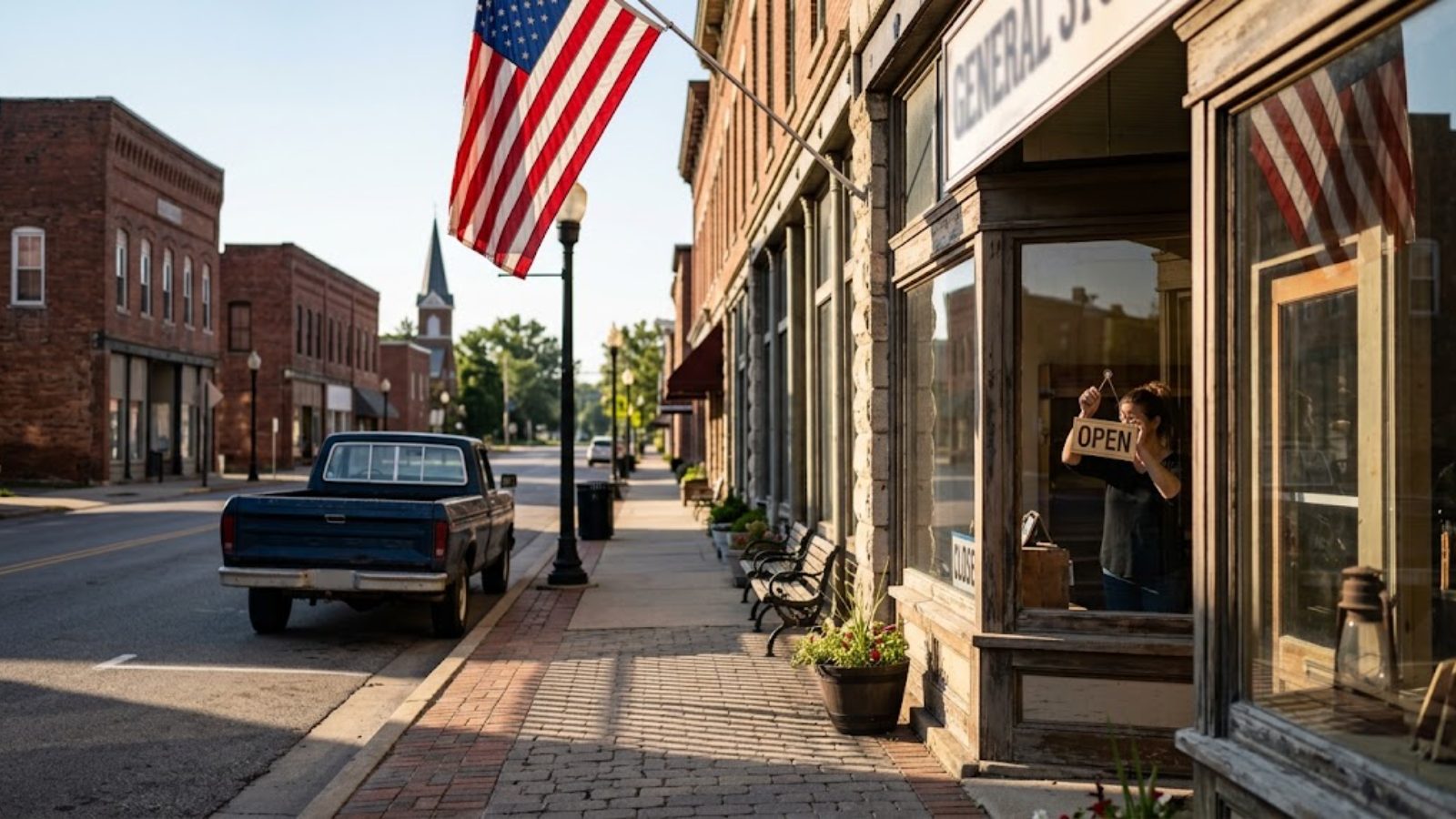
To understand how a Chinese ice-cream shop passed McDonald’s in store count, Stu Woo and Raffaele Huang suggest you skip Beijing and Shanghai and look instead at a Dollar General in Dayton, Ohio.
The same play, run twice, independently
Dollar General’s formula over seven decades: go where Walmart will not, keep stores bare-bones, sell cheap staples to people stretching a paycheck. Then-chief executive David Perdue put it as “We went where they ain’t” — rural areas forty miles from the nearest Walmart, and cities where a driver passes three Dollar Generals before reaching a superstore. Today about 75% of Americans live within five miles of one.
The economics are deliberately plain. The company mostly leases rather than buys. A store costs about $500,000 to open, a fraction of a big-box price tag. Inside: concrete floors, exposed LEDs, almost no backroom. Deliveries go from truck to shelf, often still in the shipping box.
In 1997 Zhang Hongchao opened a shaved-ice stall in Henan, a province the reporters compare to Ohio. His younger brother Zhang Hongfu joined a decade later and eventually ran it. They ignored the middle-class customers that Starbucks and the fashionable Chinese brands were chasing in Shanghai, and opened in workers’ dormitories, village markets and universities — cheap rent, heavy foot traffic. Three-quarters of Mixue’s Chinese shops are in second- and third-tier cities.
They squeezed the blueprint into franchised stalls as small as 45 square feet — a walk-in closet. An early store cost $950 to open: $740 for a secondhand ice-cream machine, $120 for rent, $90 for electrical work.
The sentence to take away
Buried in the middle of the piece: both companies learned that chasing upper-crust customers was “a dangerous and often doomed temptation.”
That is the interesting part, because it is not a strategy. It is a refusal. Both businesses had every opportunity to trade up — better locations, nicer fit-out, a more flattering customer — and the discipline that made them enormous was declining to.
The household version
The same temptation operates on a personal balance sheet, and it has the same shape: the plan is working, the plan feels unglamorous, and the urge is to upgrade it.
A savings rate that is working does not need a more sophisticated vehicle. A diversified low-cost fund does not become better by being replaced with something that has a story attached. The upgrade is rarely presented as an upgrade in risk; it is presented as an upgrade in seriousness.
The pressure is strongest exactly when the plain approach is doing well, which is the same moment these two companies felt it.
One more line from the piece, for the file. When Zhang Hongfu told his managers in Singapore the company was going global, he said it in Chinese and then, for emphasis, switched to English: “The world is big, so we have to give a f—.” Not every lesson from a 45-square-foot ice-cream stall is about restraint.