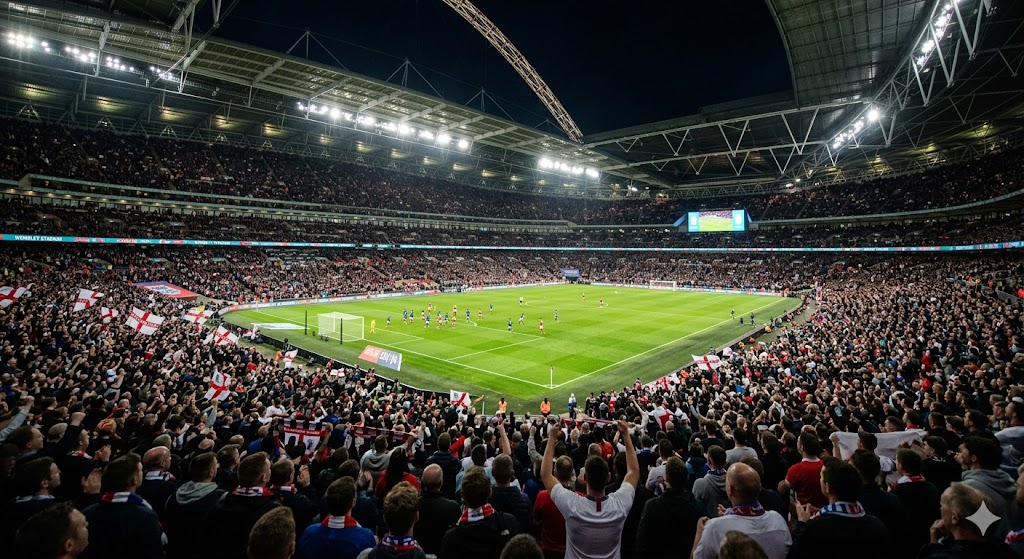
Football is the most expensive laboratory ever built for studying risk. Six weeks of it, and the same three mistakes kept walking onto the pitch in different shirts. None of them are football mistakes. You have made all three with money.
Three Matches, Translated Into Money
The favorite problem
You have seen this game. Enormous talent on both sides, and ninety minutes of sideways passing because nobody wanted to be the one who made the mistake. The team that finally won did not out-play anybody. It out-waited them.
The most crowded, most obvious, most expensive trade in the market is not wrong — it is priced for perfection and paralyzed by its own expectations. When everyone owns the same seven stocks, nobody is playing to win; they are all playing not to be the one holding it when the market turns. That is what a 30x multiple sounds like translated into football.
The small-position lesson
Ten islands in the Atlantic, a population smaller than Fresno, and a squad assembled largely from the diaspora — and they were here, on the same grass as France. They did not win it. They were never going to win it. That was never the point.
This is the entire argument for owning a small, deliberate slice of things that cannot hurt you if they fail and change the shape of your decade if they work. International, emerging markets, sized so that being wrong is survivable and being right is meaningful. The mistake is not owning Cape Verde. The mistake is betting the retirement on it — or refusing to hold any of it because it has never won anything.
The one-star problem
Every Egypt match ran through one man. When it worked it was glorious. When he was marked out of the game — doubled, crowded, one bad afternoon — there was no second idea, because the whole structure was designed to deliver the ball to him.
Concentrated stock. Company shares from your employer, the position that grew into 40% of the account because it was right for a decade, the pension that assumes one income stream forever. It is the most common single risk we find in a review, and it never feels like risk on the way up. Diversification is not a lack of conviction. It is a second idea.
That is the whole tournament, and it is most of financial planning.
Eight Nations Have Ever Lifted It
Ninety-six years, twenty-three tournaments, eight winners. No nation won the World Cup in a single summer — Brazil’s five stars and Germany’s four were built over decades. The record, briefly.
Brazil
The only nation to appear at every World Cup, and the standard the rest of the world measures itself against. The 1970 side is still called the greatest team ever assembled.
Germany
Relentless across seven decades, from the “Miracle of Bern” to the 7–1 dismantling of Brazil on home soil in 2014. Eight finals reached — more than anyone.
Italy
Masters of the defensive arts. The Azzurri turned organization into a trophy cabinet, winning back-to-back in the 1930s and again in Berlin in 2006.
Argentina
Maradona carried them in 1986; Messi finally completed his story in Qatar in 2022, in one of the greatest finals ever played.
Uruguay
The first-ever champions, and the authors of the Maracanazo — silencing 200,000 Brazilians in 1950. No nation has done more with so little.
Spain
The tiki-taka generation perfected possession football and won it all in 2010. Sixteen years later they came back to MetLife and took the second star.
France
Champions at home in 1998 and again in Russia in 2018, and a whisker from a third in 2022. The modern game’s deepest talent pipeline.
England
The game’s birthplace, champions once — at home, with Geoff Hurst’s hat-trick in the final. A nation still chasing a second.
Still Chasing The First Star
Not every football giant has lifted the trophy. These are the proud histories — and the best finishes — of nations that shaped the game without yet winning it.
The Three Hosts
The first World Cup shared by three countries, and the biggest in history. The United States carried eleven cities and the final at MetLife, having hosted in 1994 and reached the semifinal at the very first tournament in 1930. Mexico became the first nation to host three World Cups, opening the tournament at the Estadio Azteca — the only stadium to stage three. Canada hosted for the first time, in Toronto and Vancouver.
No nation won this in a single summer. Brazil’s five stars and Germany’s four were built over decades — patient development, a clear philosophy, and the discipline to stick with it through the lean years. That is the only part of a tournament that transfers cleanly to money.
The three mistakes do too, and they are worth checking for by name. Are you crowded into the obvious — is the same handful of names most of your equity? Do you own a small, survivable slice of the unlikely, or none at all? And is there one position, one employer’s stock, one income stream that the whole plan quietly depends on? That last one is the most common single risk we find, and it never feels like risk on the way up. Bring a statement to a review and we will look at all three.