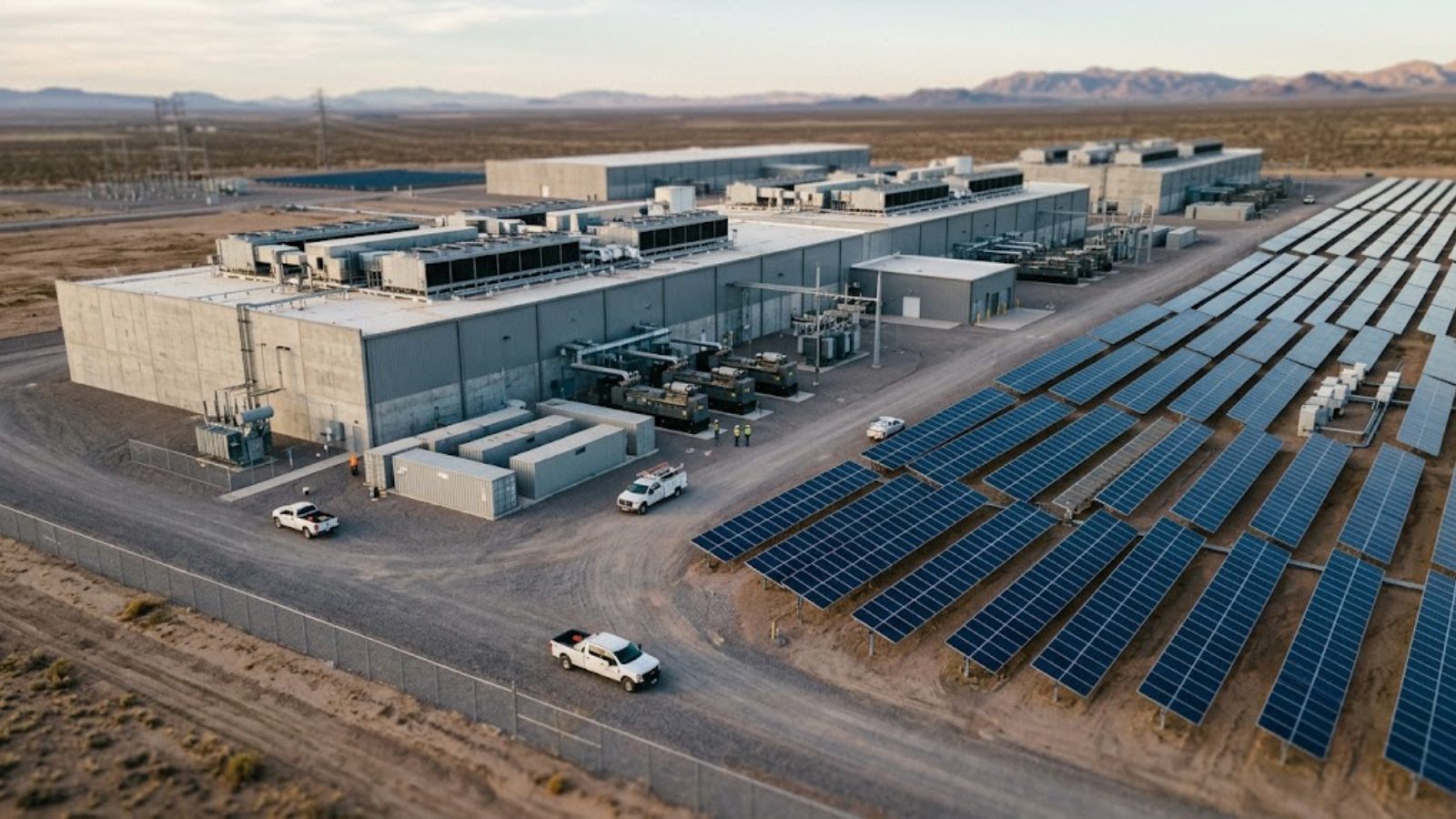
Here is the number that reorganizes everything else. A one-gigawatt artificial-intelligence data center uses about as much electricity as a thousand Walmart stores. Or, put another way, as much as the entire city of San Francisco.
Not a neighborhood. The city.
Now the complication. In many parts of the country, the utility cannot hook a new data center up to the power grid until sometime in the 2030s. The transmission lines do not exist, the waiting list is years deep, and nobody is building fast enough.
So the technology companies did what people do when the restaurant says the wait is six years. They brought their own food. The industry calls it BYOP — Bring Your Own Power — and it is the reason a natural-gas pipeline company is now an artificial-intelligence story.
The Scale
| Item | Number | Context |
|---|---|---|
| 1-GW AI data center | ~1,000 Walmarts | Or the entire city of San Francisco |
| Colossus, Memphis | ~300 MW | Delivered as ~200 semi-trucks of turbines |
| xAI turbines in Memphis | 69 | Temporary units, as of July 30 |
| Off-grid data centers tracked | 59 | ~90 GW combined (Cleanview) |
| Power executives planning on-site generation | 65% | McKinsey survey |
| Of those, using natural gas | 64% | Not solar, not nuclear. Gas. |
Two hundred semi-trucks of gas turbines is not a metaphor. That is how the Colossus site in Memphis got its roughly 300 megawatts — on the highway, one flatbed at a time.
Speed Wins
Michael Thomas of Cleanview, which tracks this build-out, offers the comparison that explains the hurry. xAI, now part of SpaceX, built its first data center in four months. A comparable project in Virginia took more than five years.
Four months against five years is not an efficiency gain. It is a different business. When being late means losing the AI race entirely, a company will happily pay more per kilowatt-hour to start next quarter instead of next decade.
SpaceX is spending accordingly. It disclosed a $16.8 billion, 100-million-square-foot chip facility called Terafab, plus a new solar factory in Bastrop, Texas, for data centers in orbit. Colossus 2 is going up in Mississippi. And the company has committed to pay Anthropic $1.25 billion a month and Google $920 million a month.
Those are monthly numbers. Read them again if you like. That is the size of a computing bill that makes a fleet of trucked-in turbines look like a rounding error.
Who Gets Paid
This is where a technology story becomes an income story.
Chevron (CVX) signed a twenty-year deal to sell electricity to Microsoft (MSFT) in West Texas, generated from Chevron’s own natural gas. Twenty years. A contract that long is not a trade. It is an annuity with a pipeline attached — a stream of payments that just keeps arriving.
Williams (WMB) is building off-grid natural-gas generation for Meta (META) in Ohio. Same structure, different customer.
A McKinsey survey says this is now the norm. Sixty-five percent of power-industry executives plan on-site generation, and 64% of those will use natural gas. Cleanview already counts 59 off-grid data centers representing roughly 90 gigawatts.
Ninety gigawatts is ninety San Franciscos.
Nobody in this office can tell you which AI model will be winning in 2031. That is a genuinely hard question, and the honest answer is a shrug. But every one of those models has to plug into something. The company selling the gas and the company moving it get paid whether the customer’s chatbot is brilliant or embarrassing.
That is the shape of investment we like: demand locked into contracts, long time horizons, and a dividend that arrives while the argument about AI continues without us. We built our energy holdings on the theory that the electricity bill is the most predictable part of the boom. This week, the theory got its receipts.