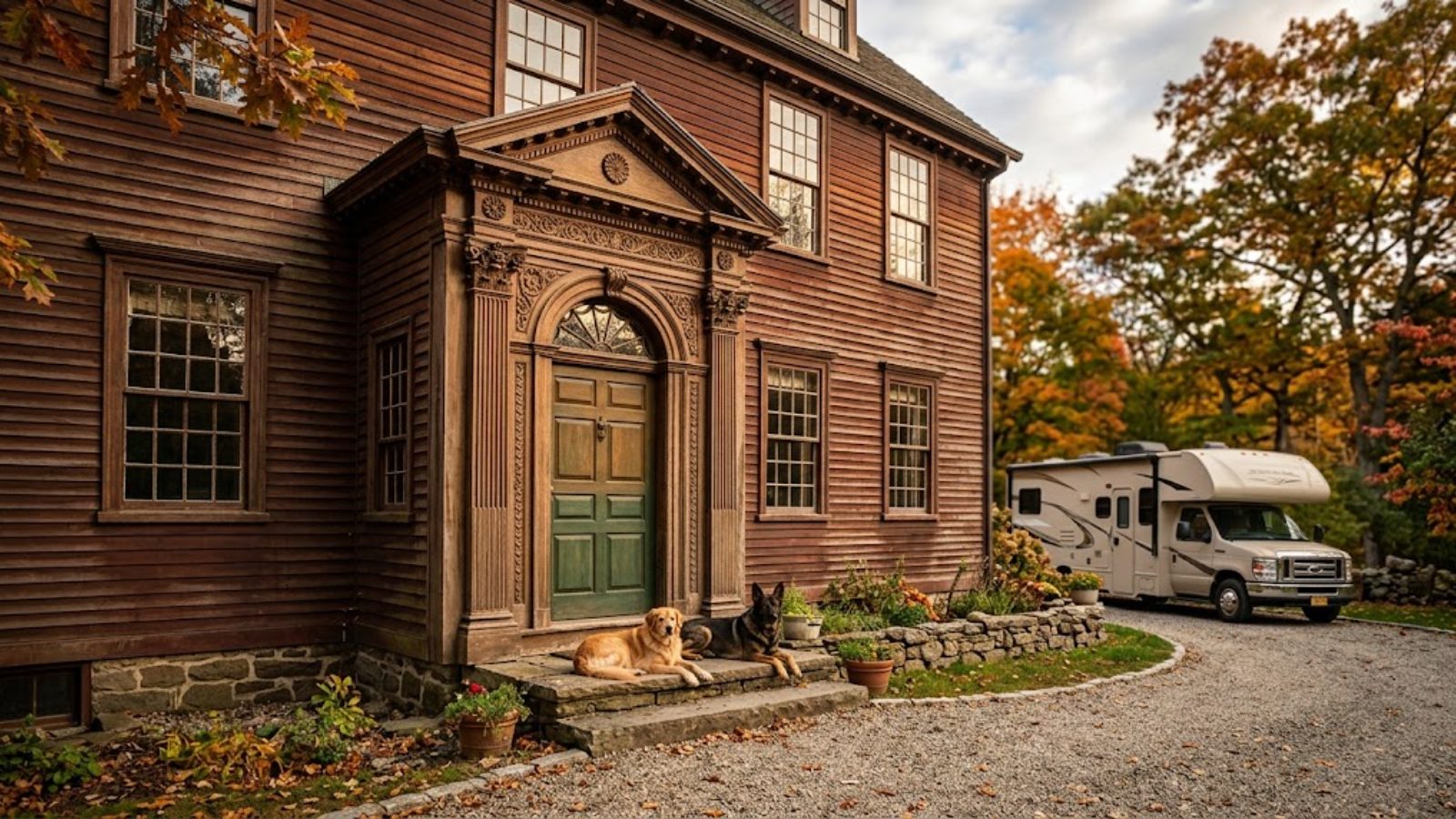
When James and Kelsey Shutts moved to Connecticut from Georgia, they had a single goal: to buy a really old house. “Where else are you going to be able to own a home that was built prior to the 1770s?” Kelsey asks. In 2024 they bought one in South Windsor for $399,000. Sections date to 1695, and according to the National Register of Historic Places it was once used to confine William Franklin, Benjamin’s son, the Loyalist royal governor of New Jersey.
The Journal’s Sarah Paynter has the history: a carpenter built the original small house in 1695, his son wrapped a large Georgian home around it in about 1757, and during the Revolution the Patriots moved Franklin there when his health failed in a Connecticut jail, before trading him for another prisoner in October 1778. A psychiatrist and history buff bought it in 1972 for about $70,000, having fallen in love with the front door.
What the romance cost
Most of the plumbing did not work. Unstable support beams put a second-floor bathroom at risk of collapsing into the dining room. The Shuttses shored up the structure and replaced the mechanicals — air conditioning, plumbing, electricity, heating — which meant cutting hundreds of holes in walls and ceilings that James, 41, the chief executive of a granola company, then repaired by hand.
They spent $1 million and two years. For much of the first year they lived with two large dogs in an RV in the driveway, showering at the gym and using a portable toilet. The hardest part of owning a historic home, Kelsey, 32, says without hesitation: living through the renovation.
The best part: the doorway. It is an elaborate Connecticut River Valley Doorway, a style elite New England homeowners invented to display their wealth — “a wham-bang statement of power and wealth,” the deputy director of Preservation Connecticut told the Journal. Tourists photograph it.
The math
They finished in June and are now selling, moving to Florida to be closer to James’s three children. Asking price: $1.45 million, in a town where the median sale was $477,000 in July. The listing agent is marketing it not as a historic house but as a turnkey home with high-end finishes, betting the historic designation will earn a premium over new construction of the same size.
| Line | Amount |
|---|---|
| Purchase, 2024 | $399,000 |
| Renovation, two years | ~$1,000,000 |
| All-in, before carrying costs and commissions | ~$1,400,000 |
| Asking price | $1,450,000 |
| Paper margin before costs | ~$50,000 |
If they get the ask, they roughly return their money before commissions, taxes, interest and two years of gym showers. That is not a criticism. It is the honest shape of the old-house dream: a hobby that, done well, you might break even on, plus a doorway strangers photograph, plus the sentence “Ben Franklin’s son was held in our dining room.” Kelsey’s own summary of the best part is “improving it and passing it on to the next steward,” which is the language of a custodian, not an investor.
For anyone with this dream
Three rules from the Shuttses’ file. Budget the renovation at the purchase price times two and a half, because that is what this one cost. Decide in advance what you will do if life moves you before the house pays you back, because life moved them. And separate the two ledgers — the financial one, which is about even, and the other one, which has an RV and a dog and a wham-bang doorway in it and is plainly, by their account, the richer of the two. Just do not let anyone tell you the first ledger is the second.