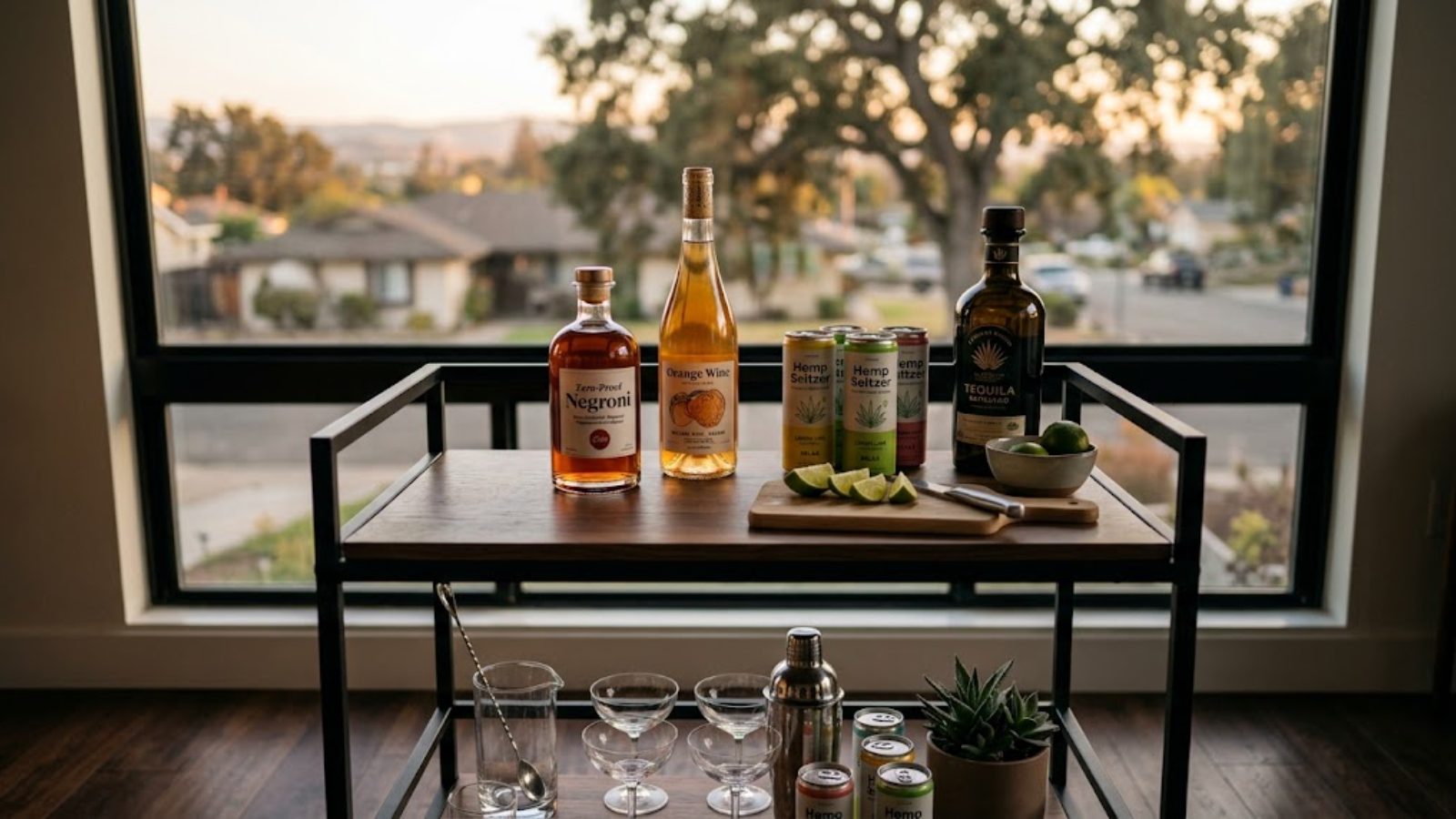
These days, the Journal’s Adam Chandler writes, it is as common to see people swigging hard seltzers and zero-proof cocktails at happy hour as sipping cosmos and espresso martinis. Bars from gritty dives to high-end taverns are leaning into bubblier drinks, canned cocktails and Dry Tais instead of Mai Tais. As a self-described stubborn barfly and former bartender, he resisted the shift away from boilermakers and Irish whiskey shots for as long as he could. Then he tried the new stuff, and liked some of it.
His guide to stocking a modern home bar is a fun read. It is also, line by line, a price list for the wellness economy.
The six categories
Cannabis drinks. A bill in 2018 passed with a loophole that allowed hemp-derived THC beverages onto grocery shelves and into lowboy fridges; the category now includes wine, sparkling water, seltzer and coffee. Chandler likes the slickly packaged cans from Nowadays ($32 for six), which deliver a slow-and-steady buzz at 5 and 10 milligrams per can — the low end of the spectrum. Look for the dosing on the package. Always start small.
Zero-proof cocktails. The most noticeable edit to bar menus in a decade, inviting to the growing number of people cutting back, and a good break between stiffer rounds for those who are not. The standout: St. Agrestis Phony Negroni, $40 for six, with a calibrated bitter finish that will ring familiar.
New Age bubbles. Functional additives — plant-derived adaptogens and nootropics promising clarity and calm. Aplós nonalcoholic spritzes ($16 for four) include a zero-proof Negroni containing lion’s mane, a mushroom said to promote brain and nerve health. Tepache, a fermented Mexican pineapple drink now gone mass-market, is pitched for gut health; De La Calle ($37 for twelve) comes in chamoy, hibiscus and prickly pear.
Hard seltzers. Around 5% alcohol, a middle ground. High Noon ($17 for eight) uses real vodka or tequila and real fruit juice; grapefruit is the author’s pick.
Orange wine. A very old drink with new fans, ascending as the rosé alternative. Gulp Hablo, $15, eminently drinkable, nice salty finish.
One celebrity spirit. Chandler generally avoids the crowded field. The exception is Pantalones, the $40 tequila co-founded by Matthew McConaughey, which surprised him with lime and light spice and mixes well into a Paloma.
The arithmetic nobody says out loud
Read the prices again. The zero-proof Negroni costs $6.67 a bottle. The mushroom spritz is $4 a can. The cannabis seltzer is over $5. The hard seltzer with actual vodka in it is about $2.12. Taking the alcohol out has, in several of these categories, made the drink more expensive, not less, because what you are paying for is the wellness framing and the small-batch branding, not the ethanol.
None of that is a criticism; Chandler likes the drinks and so might you. It is simply a reminder that the wellness wallet is one of the quietest growth lines in a household budget — premium water, functional drinks, supplements, the $16 four-pack — and it tends to arrive in amounts too small to notice and too frequent to ignore. If you are tracking where the money goes and a category called “groceries” keeps growing while the cart does not, this is often why.
And start at 5 milligrams. That one applies to everything on the list.