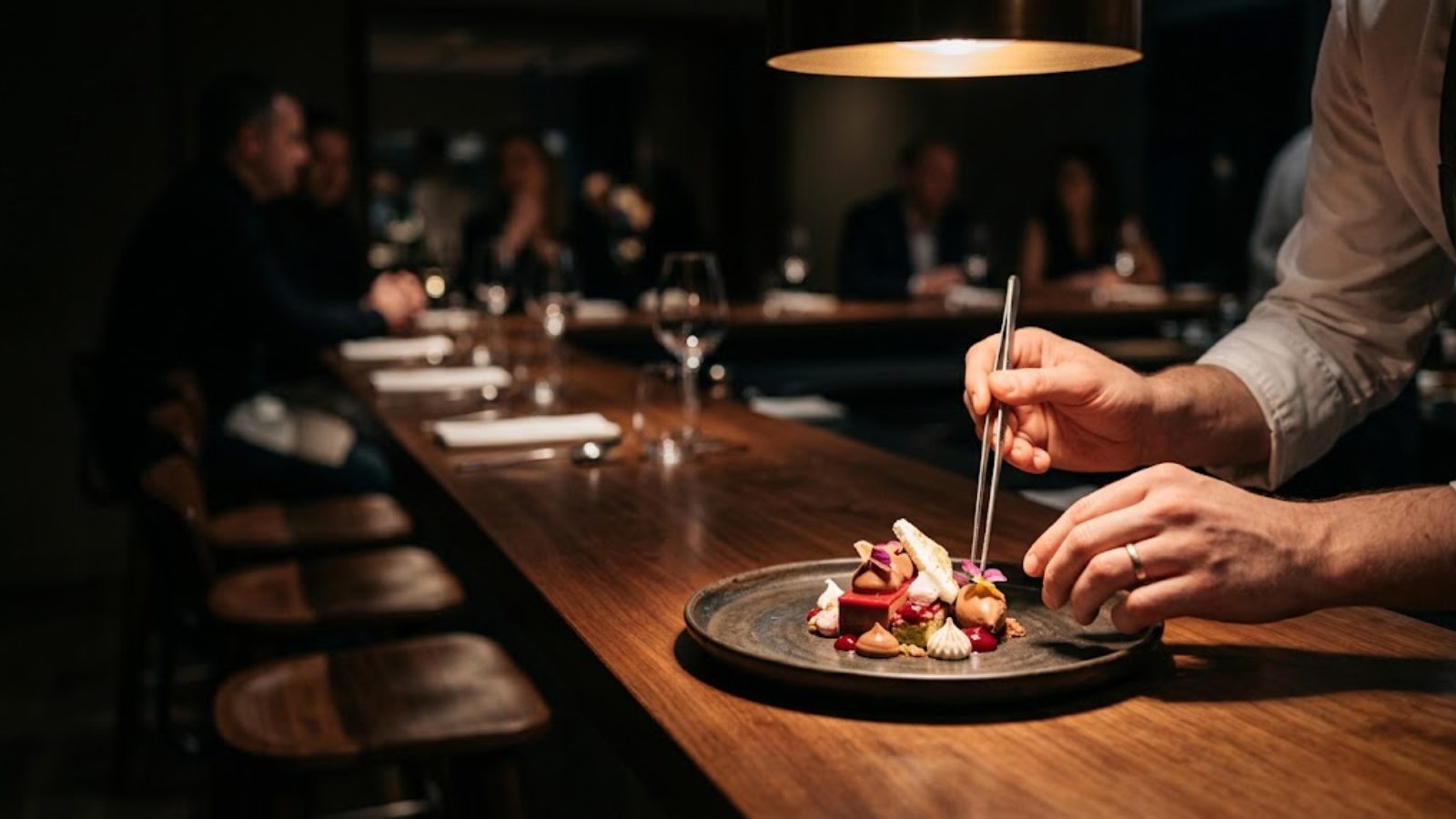
Most diners come to Nisei in San Francisco for the $274-a-person omakase. Arrive late, though, and you will see a different crowd — drawn not by the Japanese-Californian seafood but by a craving for something sweet. For about a third of the main menu’s price, they get five courses of nothing but dessert. It starts with a Japanese milk-bread sandwich layered with duck liver, raspberry, blackberry and whipped cream, which straddles sweet and savory, and goes from there.
The Journal’s Amber Gibson reports that a new generation of pastry chefs is stepping into the spotlight with stand-alone dessert restaurants and multicourse sweet tasting menus in New York, Chicago, San Francisco and beyond. It is the rare food trend with a clean economic story underneath it.
The scoreboard
When Nicosi in San Antonio got its Michelin star in October 2025, it became the first and only restaurant in the country to earn one serving desserts exclusively. Twenty seats around an open kitchen, eight courses for $120 with four drink pairings, a reimagined s’more built from an aerated dark-chocolate rock and burnt meringue, and a ban on photography so the surprise survives. “In most restaurants, dessert is an afterthought,” the chef said. “But I’ve always believed it deserves to be the reason you come in the first place.”
In New York, after five years as executive pastry chef at a Tribeca Korean restaurant, Eunji Lee opened Lysée in 2022, where pastries sit gallery-style on individual plates with placards. In March she introduced a $140, ten-course tasting on Thursday nights, for no more than sixteen guests. Three savory bites, then the desserts, including a deconstructed version of her signature mousse cake in brown rice and pecan praline.
And in Chicago, a fourteen-seat counter called Valhalla gained notoriety for a $198 dinner with “unlimited” desserts — up to 25 on the menu, sample as many as you like. “It went viral on TikTok,” pastry chef Tatum Lynéa Sinclair said, “and it started to get out of hand.” Her forthcoming twelve-seat restaurant, Haven, will cap its $98 dessert tasting at eight courses. “We are in the Midwest, and people love butter, sugar and dessert.”
The economics, which are the interesting part
The line that explains all of it came from Nisei’s pastry chef: “A lot of fine-dining restaurants are not investing in pastry programs right now, and for those that do, it’s a unique selling point.”
Read that as a business strategist would. Restaurants, under cost pressure, cut the pastry kitchen because it is the course with the worst margin and the easiest one to outsource. Supply fell. Demand did not. A few chefs noticed the gap and built a premium product in the vacuum — small rooms, capped seatings, one night a week, no photos. Scarcity did the marketing. A $140 dessert menu for sixteen people is not a restaurant; it is a waiting list with a kitchen.
The household version
Two notes for a plan. First, the experience line in retirement budgets keeps growing and this is what it is buying: a Thursday night at a counter, not a thing that sits in a closet. That is a good use of money and it should be in the plan on purpose, with a number, rather than arriving as a surprise on the card statement.
Second, the Valhalla lesson: “unlimited” is a marketing word, not a menu, and the chef who offered it had to walk it back. Any product — dessert, yield, return — sold as unlimited eventually has to be capped by somebody, and it is better if that somebody is you, before it gets out of hand.