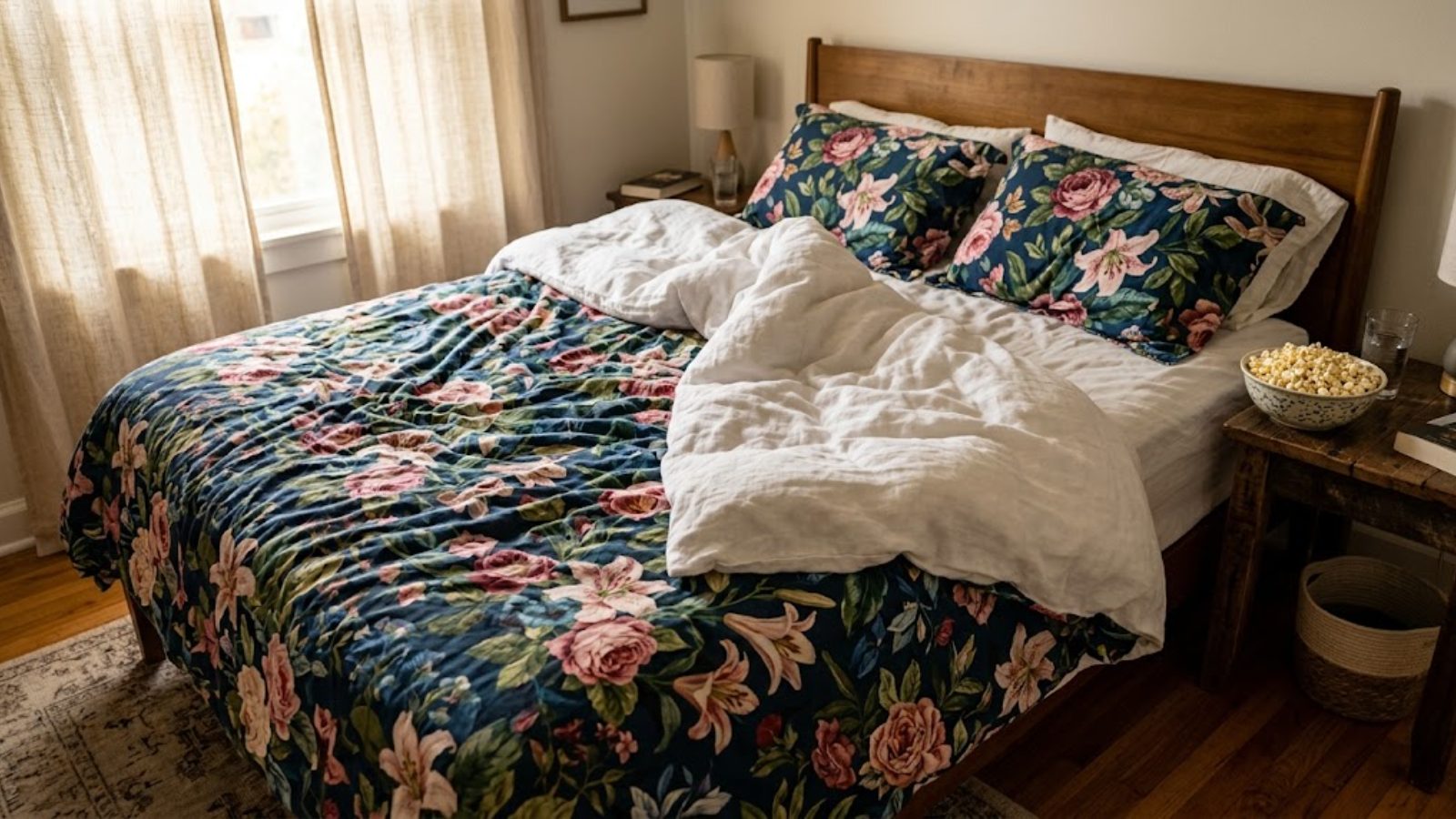
People are looking to spice things up in the bedroom, the Journal’s Misty White Sidell writes — with their sheets. For decades Americans overwhelmingly bought plain white ones that resembled a hotel’s. Now flowers, stripes and paisleys are becoming fashionable, and bedding companies report a groundswell. “The pared-back, hotel aesthetic is going away,” said the founder of one Los Angeles textile company.
A Manhattan shop sells painterly floral sheets at $3,100 for a queen, and says printed-sheet sales have nearly doubled in a year and a half. The fine-linens line Matouk has seen printed sales (about $1,000 for a queen) climb nearly 100% in three years, while whites grew at about half that rate. Brooklinen’s striped sateen set is $195; a forthcoming Studio Ford line with earth-tone chrysanthemums or deep-brown polka dots is $400.
The taste argument
White sheets long spelled cleanliness and order, a crisp banality that matched the beige-white-gray American home. That is receding as maximalism — a rich layering of texture, color and pattern — takes hold. A New York interior designer known for unexpected pairings said he rarely uses white sheets anymore: “I’m not going to have a dramatic room draped in a pattern or moody, seductive color and then you open up the coverlet and have a glaring white sheet. It’s like wearing a fabulous outfit with white Nike socks.”
Printed sheets used to read as lowbrow — chintz, Disney characters, the back of the linen closet for sleepovers. Today’s prints are designed with a sense of history and chosen to harmonize with the room. In an algorithm-driven world, the shop owners say, it is this kind of intrigue people seek to set their taste apart from the monotony of a digital feed.
The arithmetic argument, which is the one we care about
Buried in the middle of the story is the real engine. Many shoppers, Sidell writes, see the busier styles as an easy way to spruce up a room at a time when the cost of renovations is skyrocketing. They are also easier to take care of. As a San Francisco designer put it: “You’re a little less on edge when you bring popcorn in bed to watch a movie.”
That is the whole thing. A kitchen is six figures and eight months. A set of sheets is a Saturday. When the big upgrade becomes unaffordable, demand does not disappear; it migrates to the largest upgrade that is still affordable, and the price of that upgrade drifts up to meet it. Hence $3,100 sheets.
The household rule
This is a genuinely good move and worth stating as a principle: when you cannot afford to change the house, change the thing in the house you touch every day. Sheets, a lamp, the chair you actually sit in. The return per dollar is higher than the renovation, and it does not require a loan at a 4.7% ten-year.
The caution is the flip side. The same logic that makes a $195 set of stripes a smart substitute makes a $3,100 set an expensive way to avoid a decision. If the sheets are being bought instead of fixing something that actually needs fixing — the roof, the boiler, the plan — that is a different purchase wearing the same floral print. Buy the stripes. Eat the popcorn. Check the roof anyway.