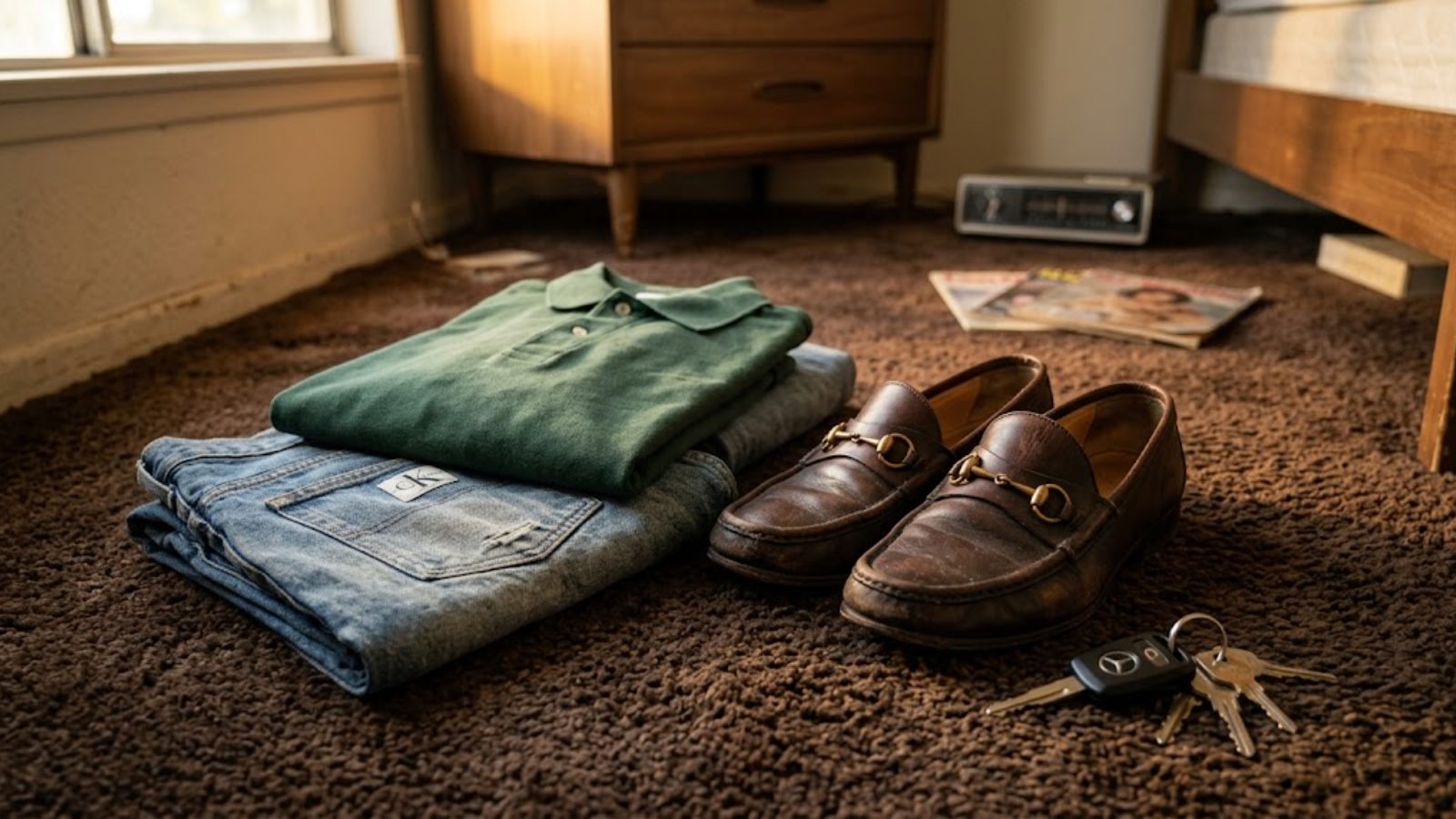
FX’s new murder mystery “The Shards” opens with its narrator, a teenage Bret Easton Ellis, describing the outfit he wore to the movies: a brown Ralph Lauren shirt with white accents, Calvin Klein jeans, Gucci loafers. The year is 1980. This guy is rich. “These kids were trying to keep up with the Joneses,” a costume designer told the Journal’s Esther Zuckerman, “because they were the Joneses.”
The Journal then did the thing we would have done, which is price the outfit three ways: then, then-adjusted-for-inflation, and now. The result is a small table that teaches more about the cost of living than most economics columns.
| Status symbol | 1980 price | In today’s dollars | Actual price today | Verdict |
|---|---|---|---|---|
| Calvin Klein jeans | $42 | ~$164 | ~$100 | Lost value |
| Ralph Lauren polo | $29.50 | ~$115 | ~$115–150 | Kept pace |
| Gucci loafers | $160 | ~$625 | $1,090 | Outran inflation |
| DVF wrap dress (1975) | $84 | ~$502 | up to $948 | Outran inflation |
| Giorgio Beverly Hills, 1 oz (1981) | $135 | ~$500 | ~$23 for 3 oz | Collapsed |
| Mercedes 450 SL (1979) | ~$28,000 | ~$124,000 | six figures | Roughly kept pace |
Three things happened to three things
Calvin Klein jeans were the status symbol of the 1980s. Adjusted for inflation they should cost $164; they cost about $100, because the brand’s crown slipped. (It got a recent bump from another Ryan Murphy series, about John F. Kennedy Jr. and Carolyn Bessette.)
The Ralph Lauren polo is almost eerily flat: $29.50 then is $115 now, and a classic polo sells for $115 to $120. A product that has simply tracked the cost of living for forty-six years.
Gucci loafers — the ultimate luxury footwear for prep style of the era, per the Vintage Fashion Guild — were $160, which translates to $625. They are $1,090. Luxury did not track inflation. It ran away from it, because the product stopped being a shoe and became a membership.
And the signature Giorgio Beverly Hills fragrance, a plot point in the show, was $135 an ounce in 1981 — nearly $500 today. You can buy three ounces on Amazon for about $23. Status is a perishable good.
Why this is your retirement, in miniature
When a planner says “we assume 3% inflation,” that is the Ralph Lauren line — a reasonable average. But nobody lives on the average. A retiree’s actual basket is heavy on the Gucci-loafer categories: healthcare, elite education for the grandkids (Buckley, the school in the book, is $58,788 a year for grades six through twelve), insurance, the good seats at things. Those have a long history of outrunning the index. The Calvin Klein categories — electronics, clothing, the fragrance — get cheaper and matter less.
A plan that uses one inflation number for everything will look fine on paper and feel wrong in year twelve, when the polo is still $115 and the things you actually buy are $1,090. The fix is not complicated: inflate the categories that historically outrun, and stop pretending the average is your life. Bret’s father paid $28,000 for a two-door tank. You could tell his son it was a bargain.