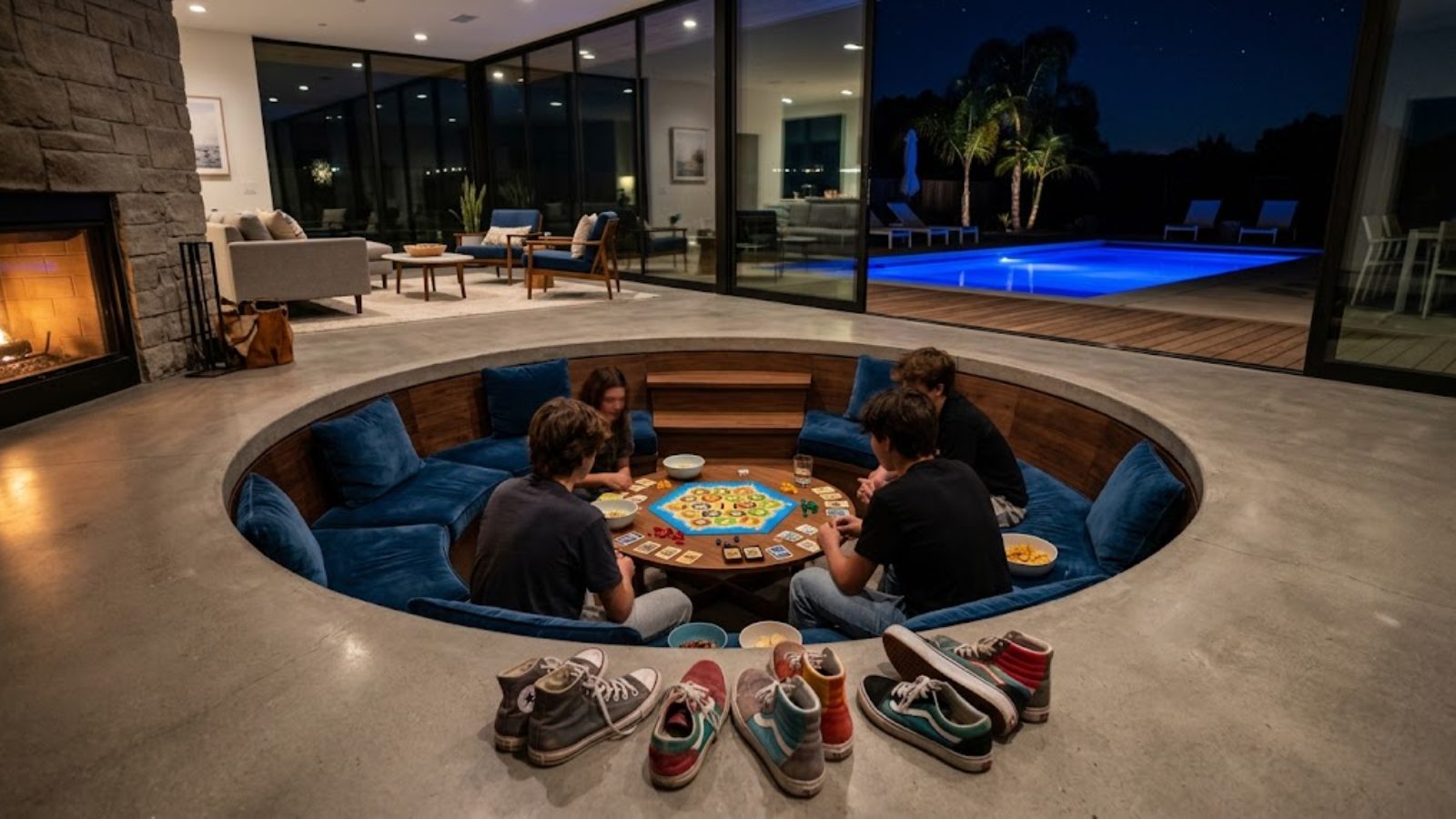
Yuri and Michelle Sagatov wanted their home to be the go-to spot for their teenagers before and after football and soccer games, and for prom parties — while still getting quality time with them and giving everyone privacy. Their solution, the Journal’s Nancy Keates reports, was to build a $2.8 million contemporary house in Arlington, Virginia, with four interconnected pavilions, each with its own bedroom and bath, angled away from one another and joined by a central staircase.
The 7,000-square-foot house has a large open kitchen and a living room taken up entirely by a circular sunken conversation pit. Because it sits near the kids’ high school, the Sagatovs added a swimming pool with a heated outdoor lounge and a basement sports room with twelve-foot ceilings for soccer, basketball and tennis. “We didn’t want our kids just disappearing into their rooms,” said Yuri, 50, who runs a design-build firm. “We wanted places where they would want to hang out with us and their friends.”
Did it work
Ask the kids. Alina, 19, a rising sophomore at the University of Virginia: “My friends in high school loved coming over. Now, all my college friends have been here.” James, 17, a rising senior, has friends at the house at least weekly during the school year — board games in the pit, soccer in the basement, the pool all summer. He is leaning toward a college nearby so he can come home often.
The family bought the lot in 2019 for $870,000 — unusually large for a neighborhood where developers scoop up oversize parcels — tore down the small ranch house and finished the build in 2021. Yuri grew up on construction sites with his contractor father; Michelle, a real-estate agent and former Arlington police officer, calls building and renovating their own homes the couple’s side hustle. This is their fifth. In the earlier ones they always thought about resale and avoided choices that might divide buyers. “In this house, we wanted to do what we really wanted.”
Alina’s one note is the honest one. It is her favorite house, which makes her worry about losing it, because she has moved so many times as her parents built the next one. “They say this is their forever home, but I think they could move again.”
The estate-planning version
We spend a great deal of time on the mechanics of passing money to the next generation — trusts, beneficiary forms, step-ups in basis. All of it matters. None of it is the thing families actually lose, which is the place everybody comes back to.
The Sagatovs bought that on purpose, for $2.8 million, and by the kids’ own testimony it is working: the son is choosing a college by its distance from the basement. That is the rarest outcome in the wealth-transfer business, and it did not come from a document. It came from a pit in the living room and a decision to build for the family instead of the next buyer.
Two practical notes. First, the Sagatovs could afford to ignore resale on their fifth house because the first four were built with it in mind; the indulgence was earned, not borrowed. Second, Alina’s worry is worth hearing: a forever home is only forever if the people who built it decide to stop. If the point of the house is that the kids come back, the plan has to include actually staying. That is a conversation, not a floor plan — and it is the one worth having before the next lot comes up.