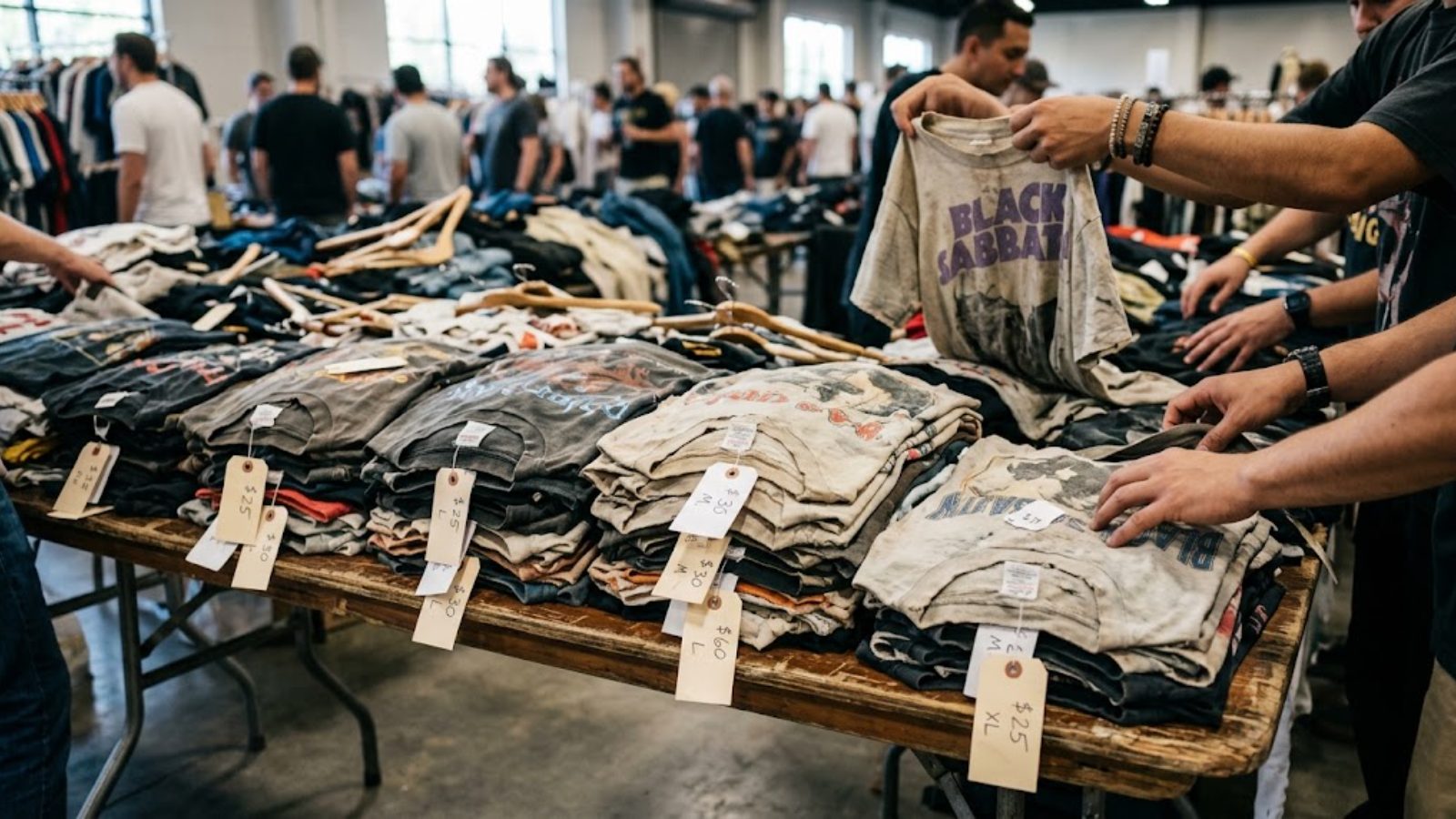
At ThriftCon, a vintage-clothing convention in New York earlier this month, a self-described elder millennial came looking for a shirt from A Tribe Called Quest and left with an old tee for MTV’s “Celebrity Deathmatch.” Someone else was replacing a lost Smashing Pumpkins shirt. Some styles on the tables cost more than $800. “You’ve heard of comfort food?” one attendee joked to the Journal’s Marcus Holmlund. “These are comfort tees.”
“Nostalgia is big business,” said a Houston dealer selling graphic tees from $30 to upward of $1,000. In 2021 a Grateful Dead shirt from 1967 sold at Sotheby’s for more than $17,640, a record. Art, music and pop culture are always the most sought after.
The price list
The COO of a luxury-resale business noted that band and rap tees are conversation starters and the rarer the better: “If it’s a one-off or something not licensed, there’s a market.” His company recently sold a bootleg Lauryn Hill shirt — unofficial merchandise — for $4,500.
Patrick Matamoros, 51, grew up in East Los Angeles and started picking threadbare T-shirts out of flea markets more than thirty years ago. “Early on, people and stores wouldn’t buy anything distressed or with holes,” he said. “Now, people can’t get enough, because they have history to them; they took years to get like that.” His biggest sale: a long-sleeve Nirvana tee from the British leg of the band’s final U.K. tour, one of only nine said to exist, sold to a vintage dealer in Japan for $55,000. He remembers being asked what he would do when vintage was not cool anymore. “I’d always laugh.”
Celebrities have noticed. Janet Jackson ditched a runway look for the BET Awards in June and wore a Tupac tee instead, a nod to their 1993 film. Miley Cyrus marked twenty years of “Hannah Montana” in an old show shirt under a Rabanne gown. Zendaya wore an oversize Spider-Man tee as a dress. A vintage tee, one showroom owner said, gives a character a backstory without having to say a word.
The collectibles rule, again
Every few months a story like this lands and a client asks whether the box in the garage is an asset. The honest answer has three parts, and the T-shirt market illustrates each one unusually well.
The winners are real and the base rate is tiny. Nine Nirvana long-sleeves exist. One sold for $55,000. Tens of millions of band shirts were printed in the 1990s and nearly all of them are worth the cotton. The $17,640 Grateful Dead is the headline precisely because it is the exception.
Condition is inverted, which means the market is taste, not math. In most collectibles, mint commands the premium. Here, holes and fade are the point because they are proof of years. When a market’s pricing rule can flip like that, the value is whatever the current buyer feels, and feelings rotate.
The person who made money did not “invest.” He worked. Matamoros spent thirty years at flea markets developing an eye, a network and a client in Japan. That is a business, and a good one. It is not a thing a retirement account can replicate by buying a shirt and waiting.
So: keep the tee. Wear it. If it turns out to be one of nine, sell it to a dealer who knows what it is. But the plan does not get to count it, because the whole reason it is valuable is that nobody could have planned on it.