The fastest way to lose a fortune is to borrow money and bet it on one story. Korea just ran that experiment with about 14 million people, live, inside a single stock market.
The Kospi — Korea’s main stock index — was the best market on Earth in 2025. It gained 76%. That run lifted Korea to the world’s fifth-largest stock market, up from 13th.
Then came June and July. The Kospi dropped about 40% in six weeks. Roughly $2.5 trillion in value disappeared. It has since clawed back about 20% from the low, and it was still up 60% for 2026 through August 25. That is a full round trip most savers never signed up for.
Meet the ants
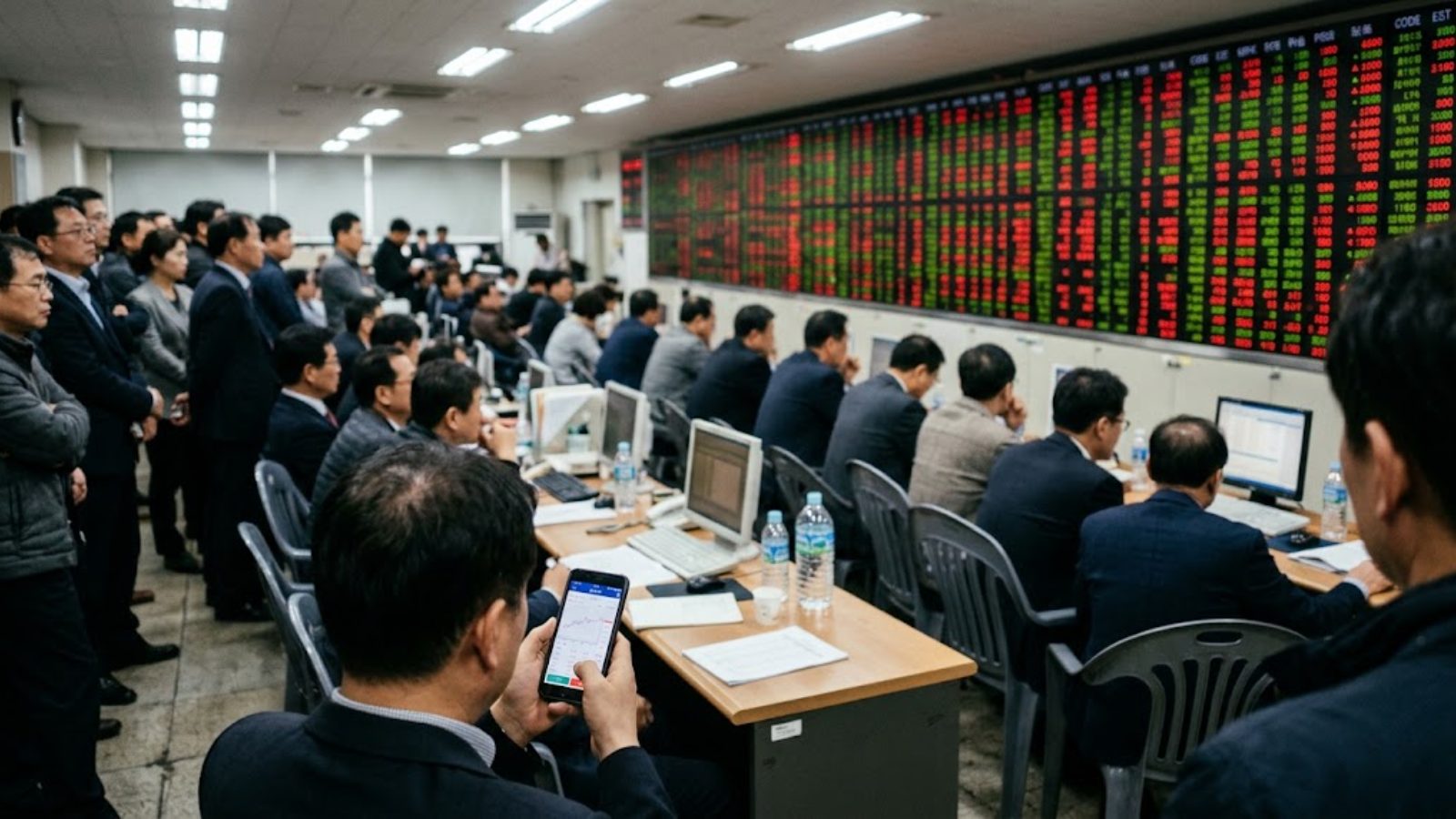
Korean individual investors call themselves “ants.” There are about 14 million of them, and they account for 60% to 70% of daily trading volume. In America, big institutions dominate the trading day. In Korea, the crowd is the market.
The crowd also borrowed. Margin loans — money borrowed from a broker to buy stocks — grew by $7.9 billion in six months, reaching $27.1 billion. Leverage works like a megaphone. It makes gains louder on the way up and losses louder on the way down.
New megaphones arrived just in time. Single-stock leveraged ETFs — funds that multiply the daily move of one company — launched in Korea on May 27. One investor’s leveraged position, described in the Journal, was down 69%. Other losses in the story ran $19,000 and $7,200. Some retirees cashed in pensions to keep trading.
The fever chart
There is a number for panic. The Kospi 200 volatility index — a gauge of how wild traders expect prices to be — hit 86.18 on July 30. By August 24 it had cooled to 56.76. For comparison, America’s VIX spent the month in the mid-teens.
| The ride, by the numbers | Figure |
|---|---|
| 2025 full-year gain (world’s best) | +76% |
| Six-week slide, June into July | about −40% |
| Value erased at the low | ~$2.5 trillion |
| Rebound off the low | about +20% |
| 2026 gain through Aug. 25 | +60% |
| Margin loans (grew $7.9B in six months) | $27.1 billion |
| Kospi 200 volatility index, Jul. 30 → Aug. 24 | 86.18 → 56.76 |
None of this makes Korea a bad market. Samsung and SK Hynix are world-class companies riding a real memory-chip boom. The lesson is not the country. The lesson is the borrowing, the leverage, and the pension checks placed on the table.
What the ride teaches
Every mania hands out the same three receipts. Borrowed money turns a correction into a wipeout. Concentration turns one bad summer into a lost decade. And the people least able to afford the loss — retirees — are usually the last ones aboard.
If this feels far away, it should not. The same instincts live in every 401(k): chasing the hot fund, doubling down after a run, borrowing confidence from a crowd. Korea just showed the ending at full speed. The dollar figures change by country. The receipts never do.
The people in the Journal’s story were not fools. They watched their neighbors get rich for a year and drew the obvious conclusion. The market then charged them tuition for it — $19,000 here, $7,200 there, a pension cashed in somewhere else.