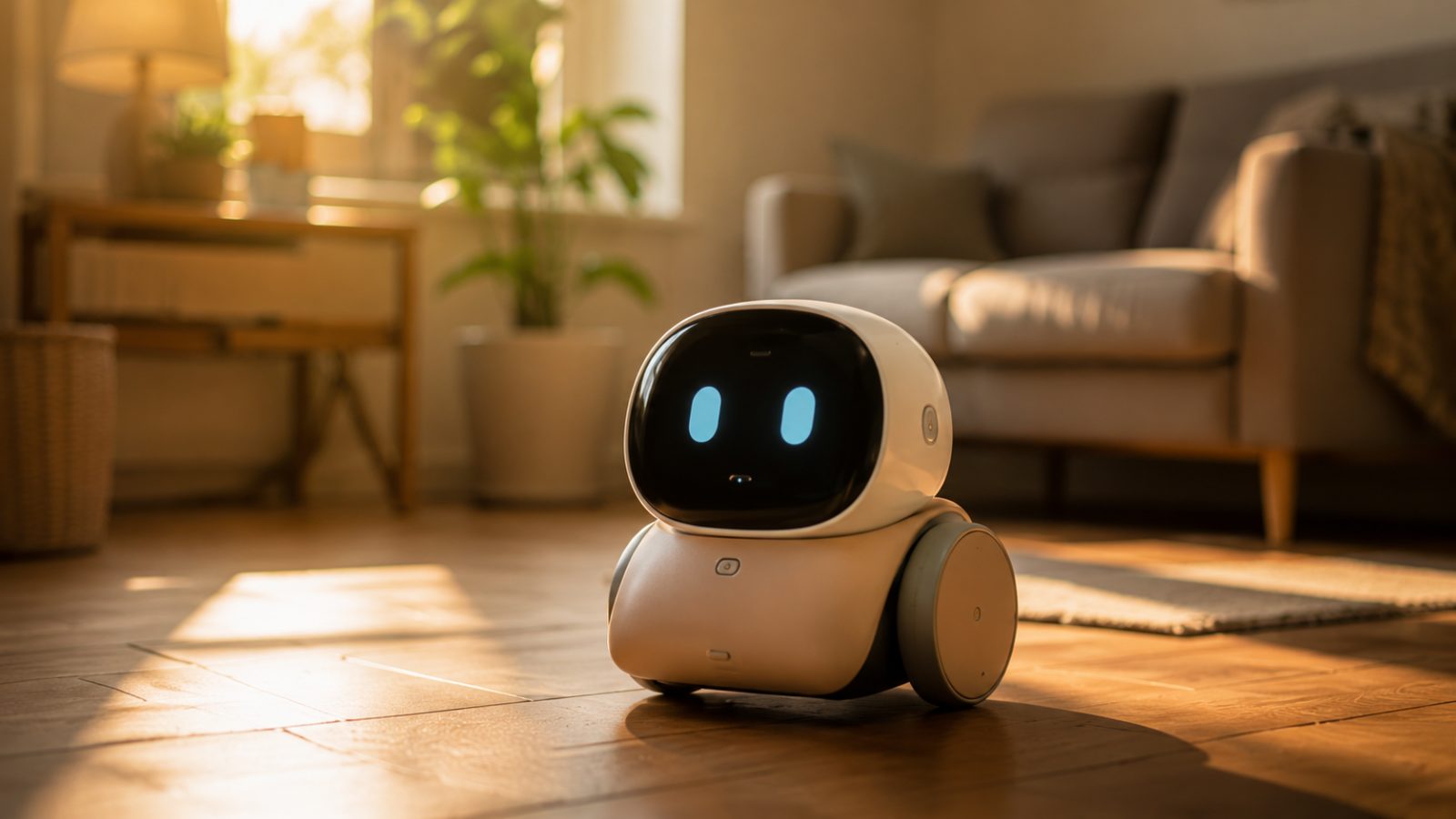
In a factory in Cheraw, South Carolina, a robot named Digit lifts a 25-pound basket of bearing components off a stamping press and sets it on a conveyor. About one basket a minute, eight hours a day. A person did that job a year before the Journal visited in March.
Digit's legs angle backward like an ostrich's, which helps with balance and lifting. Its eyes are LEDs that show you where it is looking.
It also works inside a Plexiglas cage. It cannot detect people nearby, and federal safety rules require the separation. Four hours of work, a recharge over lunch, four more hours.
Fewer than 200 of them exist
That is the honest picture of the humanoid robot as it stands. Ani Kelkar, who leads the robotics practice at McKinsey, counts fewer than 200 of them working in the world's factories.
He also thinks up to five million could be in place by 2040. Both numbers are true, and the distance between them is the entire investment argument.
The margin is the pitch
XPeng, the Chinese electric-car maker, shows most clearly how this gets sold.
Its robotics unit is valued at more than $6.3 billion and is moving a humanoid called Iron toward mass production. Iron has electronic skin and a bionic spine, which is impressive or unsettling depending on your evening.
But the pitch is not the robot. The pitch is the margin.
| The margin case | Reading |
|---|---|
| XPeng robotics unit valuation | more than $6.3 billion |
| Potential hardware gross margin, per co-president Brian Gu | more than 50% |
| XPeng vehicle gross margin, second quarter | 12.1% |
| Unitree Robotics gross margin, 2025 | more than 60% |
| Private round raised by the robotics unit | more than $900 million |
Brian Gu, XPeng's co-president, thinks hardware gross margin can clear 50%. The car business earned 12.1% last quarter. That contrast is the whole argument, in two numbers.
Now the part the announcement skips. The robotics unit has yet to generate meaningful revenue. There is no public date for when it breaks even.
Gu is candid about the cost. A robot that can staff an information desk and also make coffee needs training and computing power that will probably cost more than developing a car.
The money showed up anyway. The unit raised more than $900 million in a round led by IDG Capital, with Alibaba and Tencent joining as strategic investors. Gu says the goal is “a general-purpose robot,” starting with small businesses and storefronts.
Where the jobs go
This is the part that reaches a household.
The white-collar version is already visible in the data. About 16.5 million Americans work in office and administrative support, down from roughly 18 million at the end of 2019. The Labor Department expects a further 4% decline over eight years, the steepest of any major category.
In metro Phoenix, the count of customer-service representatives fell 26% over the most recent four-year stretch the department measured.
The ladder is what worries Mark Muro of Brookings Metro. Between 2000 and 2019, manufacturing employment fell 26% while full-time customer-service jobs grew 32%. The office job caught the factory worker. Nothing obvious is waiting to catch the office worker.
Not everyone is cutting. Some employers say AI increases their need for juniors, and IBM is expanding entry-level hiring on the argument that it needs the talent in three to five years.
Some jobs are being created in enormous numbers, in unlikely places. Louisiana Governor Jeff Landry said SpaceX is committing $100 billion of capital investment near Pecan Island, and the company expects at least 3,000 permanent jobs.
Treat that carefully. It is a commitment announced by a governor, not money spent, and SpaceX hopes to fly from the site for the first time in 2029.
The locals are split, which is fair. A bait-shop owner ran an informal sticker poll and got more than 100 votes for and 72 against. A retired shrimper on seven stilted acres asked where his family is supposed to go.
Doug Thompson, 74, spent 14 years at the Schaeffler plant. Efficiency, he said, is the name of the game, and it is relentless.
He is right, and he is also describing every decade since the 1950s. The Schaeffler worker Digit replaced was moved to a higher-skilled inspection job, and the plant manager says there has never been a layoff there tied to automation.
That is the useful posture. Not panic and not denial. Just the working assumption that the job you hold today will be a somewhat different job in ten years.