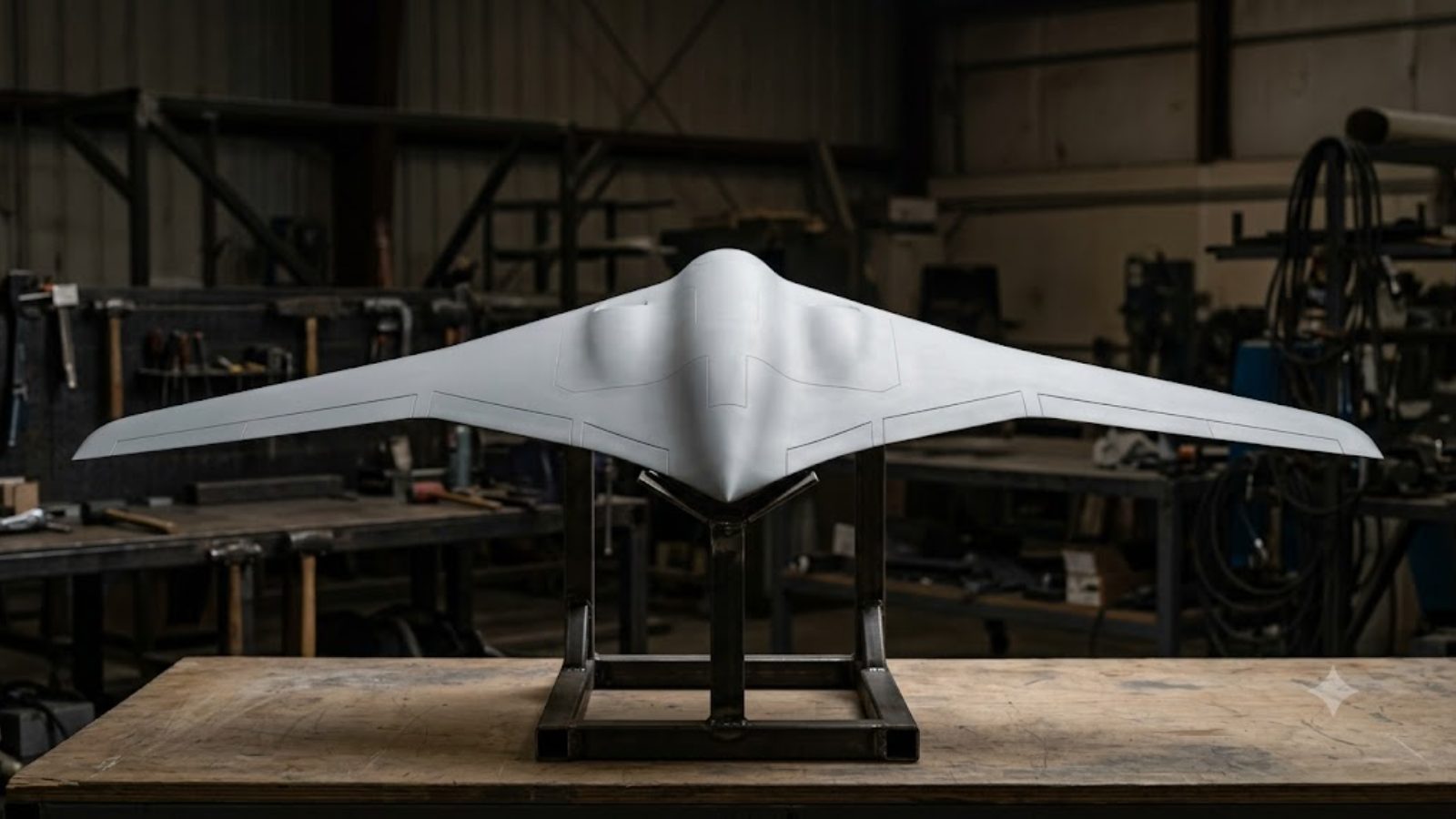
The default shape of a passenger airplane — a tube with wings bolted on — has gone unchallenged for over seventy years. That is roughly seventy years longer than most industrial designs survive. This week, the United States government decided to pay someone to challenge it.
The airplane
JetZero’s proposed aircraft looks more like a manta ray than an airliner. If it flies commercially, the blended-wing design would be the biggest shift in passenger-jet design since the supersonic Concorde.
The details sound like science fiction. Four aisles, not one or two. No physical windows — a skylight instead. Every seat gets its own overhead bin, and every toilet gets a waiting space. It would cruise about 10,000 feet higher than current jets, seat about 250 passengers and fly about 5,000 nautical miles. That lands right in the gap Boeing left when it shelved plans to replace the 757 and 767.
Here is the trick: the radical plane is not actually that new. Almost all of the Z4’s parts — controls, previous-generation engines on the demonstrator — come from existing planes that already have FAA signoff. The new thing, chief executive Tom O’Leary says, is the shape. NASA spent more than $1 billion over about 30 years studying the concept. The payoff, according to JetZero: about 30% better fuel efficiency than later-generation jets like the 787.
Where the money comes from
Last week JetZero reached an early deal with the U.S. Export-Import Bank, under its Make More in America initiative, for as much as $3 billion in loans and guarantees to build its first factory. The bank’s chairman wants it fast-tracked.
“How real it is is effectively, ‘Where’s all the money coming from?’” O’Leary said. The answer keeps growing. There is $235 million from the Air Force for a prototype, plus backing from Northrop Grumman and RTX — whose Pratt & Whitney unit supplies the demonstrator’s engines — and support from about 20 airlines. United holds a conditional order for 200 planes.
The company broke ground on a Greensboro, N.C. factory in June, slated to produce the first Z4s by 2030 for testing and certification. The full-scale prototype is set to fly toward the end of 2027. Passenger service? Possibly the early 2030s — and deliberately vague, because the FAA decides.
One titan left
The ambition lands on a bruised industry. America once had three titans making about 90% of the world’s airliners. Boeing now fights alone, while Airbus controls more than half the market. Airbus just posted second-quarter adjusted operating earnings up 54% to €2.43 billion, with revenue up 28%. Boeing’s quarterly net loss of $428 million narrowed from $612 million a year earlier. China’s Comac is coming too, with its own blended-wing ambitions.
The skeptics have real points. Passengers seated out in the wings could feel stronger forces in turns. No windows might mean more motion sickness. Four aisles change how an evacuation works, and jetways were not built for this shape. Airbus studied a similar concept and shelved it.
“I think everybody’s ready for something new,” said Aleksey Matyushev, chief executive of fellow startup Natilus. That is the sentiment the money is buying. Whether it is also the engineering takes a decade to answer.