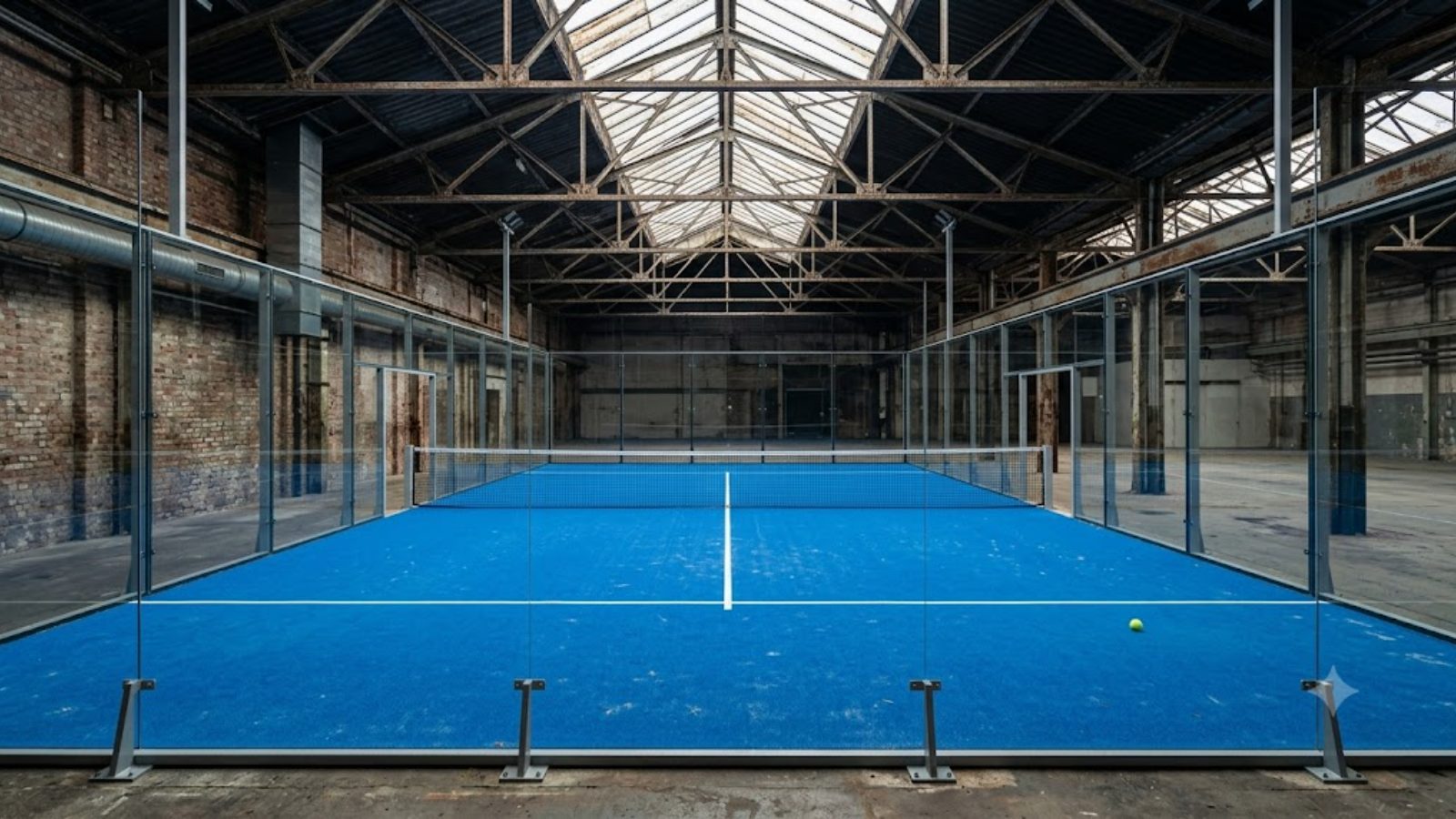
For most of the 20th century, the Delaware Power Station supplied electricity to Philadelphia. It was finished in 1923 and closed in 2008. Last year its abandoned turbine hall became a place to play padel.
The Build-Out
The 55,000-square-foot hall reopened in November as Ballers. Skylights sit in 75-foot ceilings above three glass-and-mesh padel courts, golf simulators, and courts for squash and pickleball.
“The real anchors are the pickle and the padel,” said founder David Gutstadt, 50, a former Equinox executive.
The club has some 700 members paying between $110 and $457 a month. Gutstadt has opened another Ballers in Boston and is developing a Los Angeles location.
The participation numbers are early but real. Padel drew one million American players last year, according to the U.S. Tennis Association, which only began tracking the sport in 2025.
USA Padel, the sport’s governing body here, says club and individual memberships grew about 50% year over year in 2025.
Why a Racket Sport Is in a Markets Letter
Because the last one was a building cycle wearing shorts.
Pickleball built courts, clubs, apparel lines and $250 paddles. It moved real money through real companies before anyone agreed it was a sport.
Padel is making a different bet. Not mass participation, but scarcity.
A padel court needs glass walls, an enclosure and serious height. You cannot paint one onto a tennis court on a Saturday morning.
That constraint is the business model. It keeps supply low and lets a club charge like a gym rather than a park.
It is also the trade-off. Scarcity supports the price and caps the volume, which is a better margin story and a worse growth story.
What We Actually Do With This
Nothing, for now, and we are not going to pretend otherwise.
The useful reminder is that consumer building cycles start in converted power plants long before they show up on anybody’s revenue line.
By the time a trend is investable, the interesting part of the return is usually gone. By the time it is in a converted turbine hall, nobody can size it yet.
So we file it, and we keep the receipts. It is also an excellent hedge at a cocktail party where somebody has just discovered the sport and wants to explain it to you.
There is one more thing worth noticing in the story. The club is not really selling padel. It is selling a converted turbine hall with 75-foot ceilings and skylights.
Golf simulators, squash and pickleball share the floor. If padel fades, the building still works, and the membership fee still clears.
That is a more durable business than a single trend, and it is roughly how we think about owning anything cyclical. Buy the operator who survives the fad, not the fad.
Pickleball taught that lesson expensively. Plenty of paddle brands and pop-up court companies did not make it to the second act.
The clubs that owned real estate mostly did. One million players is a real number, and it is also a number that says almost nothing about who eventually gets paid.