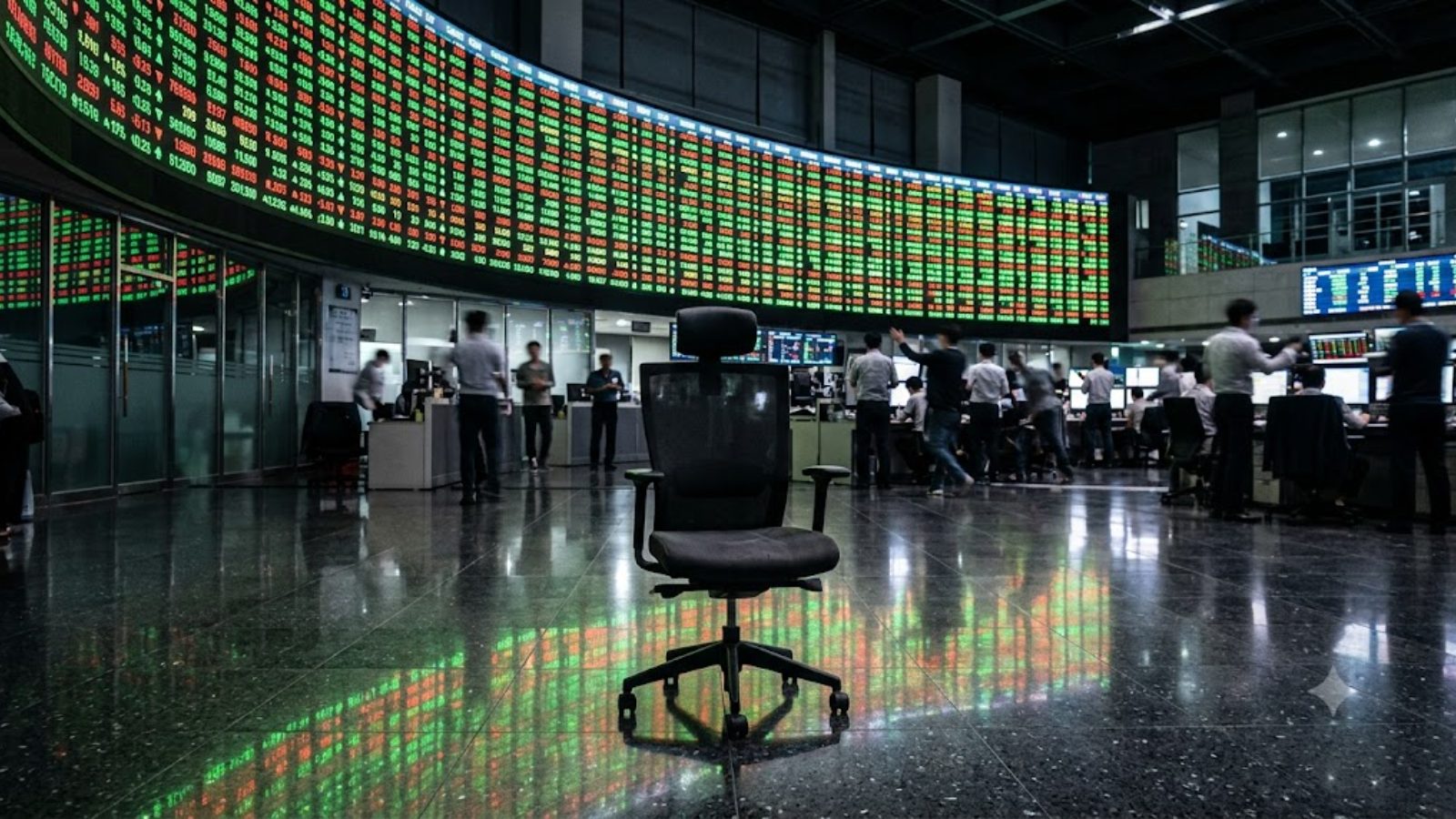
SK Hynix is pricing its $28 billion U.S. listing this week at roughly six times forward earnings — six times next year’s expected profit. Samsung just guided to a 19-fold profit jump and fell 6.9% anyway. Micron (MU) trades at the same suspicious discount. If that combination looks like a screaming bargain, congratulations: it is supposed to.
Forward earnings — the profit analysts expect next year — are the denominator in that famous multiple. A low multiple usually means a stock is cheap. In memory chips, it often means something else entirely: the market does not believe next year’s number.
The movie everyone has seen
Memory investors have watched this exact film before. It has four acts: boom, glut, apology, repeat. Demand surges, so every maker builds capacity at once. The new capacity arrives together, supply swamps demand, and prices collapse. Executives apologize on the earnings call. Then the cycle starts over.
That history is why the trap is built into the valuation itself. Valuations run lowest exactly when profits run hottest, because the market is already pricing the glut that has always followed the boom. A six-times multiple on a peak-cycle profit is not cheap. It is the market pricing the apology in advance.
Samsung’s week is the trap in one sentence. A company forecast profits nineteen times higher — and its stock went down. Investors were not grading the forecast. They were grading how long it can last.
This is worth sitting with, because it is the opposite of how bargains work in most of the market. Usually, cheap plus booming equals opportunity. In memory, cheap plus booming is the pattern that shows up right before the glut. The screen that finds the bargain cannot see the cycle.
What would change our mind
So Micron stays on the watch bench, and we watch the SK Hynix debut from the stands. Cheering is free.
The trigger to upgrade is not a cheaper multiple. Cheaper multiples are how this cycle lures people in. The trigger is an underwritable contract — a signed, multi-year buyer, U.S.-plan money, something you could take to a committee and defend line by line. A contract converts a cyclical guess into a countable revenue stream. Until one shows up, the bargain is only a story about a bargain.
In the meantime, we are not missing the boom. Our memory exposure rides inside the sleeve we already own: Broadcom (AVGO), Taiwan Semiconductor (TSM) and Nvidia (NVDA). Those three get paid whichever memory maker wins the food fight — the designer, the foundry and the AI platform collect their tolls no matter whose chips end up in the box.
That is the quiet advantage of owning the toll collectors instead of the combatants. You do not have to predict the winner of a knife fight. You just have to own the arena.
Patience here is not timidity. It is the recognition that this cycle has punished early confidence every single time it has run. When the contract arrives, we will still be early enough. Until then, the stands are comfortable, the view is excellent, and nobody in them loses money.