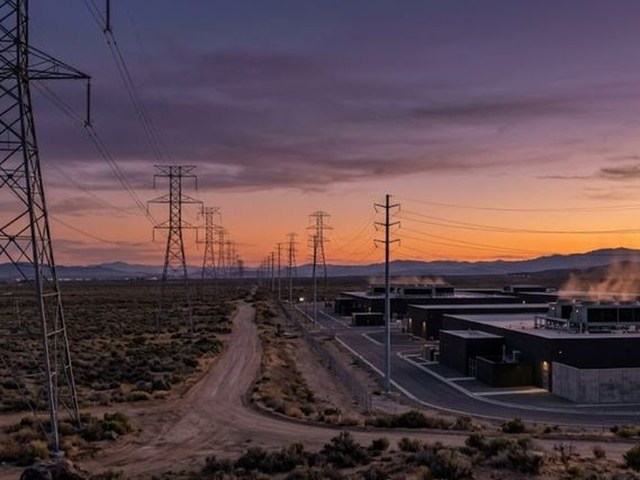
Wall Street had a theory about Texas. Gov. Greg Abbott's pause on new data centers was for show, a pre-election move that would be undone after the vote. Then the vote came. Gov.-elect Gina Hinojosa, a Democrat, said new approvals should stay paused until the Legislature meets next year to pass “real protections.” Texas has more planned data-center projects than any other state. The theory broke on Thursday, Nov. 5. So did Texas power stocks.
Matt Rowe of Man Group put the math plainly to the Journal. If you thought a project was six to 12 months from earning revenue, and it's really two to three years away, “you've got a number of problems.” Few expect projects to stop. Delay is the issue. Vistra (VST), the Texas power producer, fell $7.40 to $112.89, a new 52-week low. GE Vernova (GEV), which builds the turbines, fell $62.32 to $770.51. NextEra (NEE), whose rates are mostly set by regulators, slipped 20 cents to $88.25. The Dow utility average, mostly regulated names, fell less than 1%. The companies that sell power into Texas's open market took the hit. Mark Melchiorre of Forza Investment Group told the paper nobody in July or August expected it to get this dicey.
The giants may come out ahead
Heard on the Street's Telis Demos sees a twist. The market's real worry lately has been cost, not growth. Building capacity got so expensive that even AI's winners might end up less profitable. A forced slowdown takes some heat off the price of supplies, workers and borrowing. And anyone who already runs a data center with power in place owns something scarce. Since the election, Amazon (AMZN) is up 3.8% and Microsoft (MSFT) 2.9%. Over the same stretch, since Tuesday, a fund of bitcoin miners that pivoted to AI is down more than 20%, and the chip index is off about 15%. Bonds tell the same story. Debt on data centers for Microsoft, Amazon and even CoreWeave as tenant rallied since Tuesday. The exception was bonds funding Texas projects, whatever the tenant.
CoreWeave (CRWV) itself is a different case. Its own 2032 bonds traded as low as 74.75 cents on the dollar Thursday, the lowest since they were sold in June. The extra yield over Treasurys touched 12 percentage points. It was 10.7 late Wednesday and about 5 in June. The company rents out high-end chips, and analysts told the Journal that new rules could delay revenue from projects already under way. The project bonds where CoreWeave is only the tenant rallied. CoreWeave's own debt didn't. Keep the two apart.
Our read
Investments/Risk · IN04, and Time Value of Money · M3. A delay doesn't have to kill a project to cut its value. Money that arrives in three years is worth less today than money that arrives in one, and Thursday's prices said so. For our model books, the North Star's dated second third was bought Friday, Nov. 6, after the open. It included small slices of Vistra, GE Vernova and NextEra, the morning after Texas power sold off. That was our decision for our model books, not advice. Vistra stays held in 17 books, GE Vernova in 30, NextEra in 21. CoreWeave is in one book, at 10% of its chips sleeve. The policy risk is real.
For your own money, the check is your utility or infrastructure fund. A utility fund can feel safe and still hold Texas power producers that sell into an open market. An infrastructure fund may hold the turbine makers too. Open the fund's top holdings this week and count the names tied to Texas data centers. A fund that leans on a legislative calendar is different from one that leans on regulated rates. Know which one you own before the Legislature meets. If the list is hard to read, that's a fair question to bring to a review. You read the lease before the rent changes.